%20%20--%3E%0A%3Csvg%20version%3D%221.1%22%20id%3D%22Layer_1%22%20xmlns%3D%22http%3A%2F%2Fwww.w3.org%2F2000%2Fsvg%22%20xmlns%3Axlink%3D%22http%3A%2F%2Fwww.w3.org%2F1999%2Fxlink%22%20x%3D%220px%22%20y%3D%220px%22%0A%09%20viewBox%3D%220%200%20684.6%2068.1%22%20style%3D%22enable-background%3Anew%200%200%20684.6%2068.1%3B%22%20xml%3Aspace%3D%22preserve%22%3E%0A%3Cg%3E%0A%09%3Cpath%20d%3D%22M444.1%2C29.3h-17.4v14.5h17.4V29.3z%20M36.4%2C68.1l29.3-50.8V0H50.4L32.9%2C36.8L15.5%2C0H0v68.1h16.7V45.8l12.4%2C22.3H36.4z%0A%09%09%20M49.1%2C68.1h16.6V23.4L49.1%2C52.1V68.1z%20M76.6%2C68.1h45V53.8H93.3V41.6h21V27.1h-21V14.8h28.3V0.1h-45V68.1z%20M175.6%2C68.1h17.3v-68%0A%09%09h-16.5v40.3L150%2C0.1h-17.6v68h16.7V27.7L175.6%2C68.1z%20M235.8%2C14.8h15.4V0.1h-47.4v14.7H219v53.2h16.8V14.8z%20M290.3%2C45.9h-17.1%0A%09%09l7.5-15.6h2L290.3%2C45.9z%20M298.7%2C68.1h18l-32.2-68h-5.7l-32%2C68h18l3.3-7.1h27.1L298.7%2C68.1z%20M325.2%2C68.1h46.2V53.8h-29.6V0.1h-16.7%0A%09%09V68.1z%20M423.7%2C14.8h27.2V0.1H407v68h16.7V14.8z%20M462%2C68.1h46.2V53.8h-29.6V0.1H462V68.1z%20M564.8%2C34.1c0%2C10.7-7.2%2C19.2-18.5%2C19.2%0A%09%09c-11.4%2C0-18.5-8.5-18.5-19.2s7.1-19.2%2C18.5-19.2C557.6%2C14.9%2C564.8%2C23.4%2C564.8%2C34.1%20M580.6%2C34.1c0-19-14.2-34-34.3-34%0A%09%09c-20.2%2C0-34.3%2C15-34.3%2C34c0%2C19%2C14.1%2C34%2C34.3%2C34C566.4%2C68.1%2C580.6%2C53.1%2C580.6%2C34.1%20M604.8%2C20.5c0-4.1%2C3.3-6.2%2C6.7-6.2%0A%09%09c4.4%2C0%2C6.6%2C3%2C6.6%2C6.6h14.7C631.8%2C9.1%2C625.1%2C0.1%2C611%2C0.1c-12%2C0-21.7%2C9.3-21.7%2C20.6c0%2C10.9%2C5.9%2C15.9%2C16.7%2C19.8%0A%09%09c5.2%2C1.8%2C11.5%2C3.2%2C11.5%2C8c0%2C3.3-2.4%2C5.5-6.4%2C5.5c-3.6%2C0-6.6-3-6.6-6.7h-15.2c0%2C11.5%2C7.9%2C20.8%2C21.8%2C20.8c12%2C0%2C21.6-9.3%2C21.6-20.6%0A%09%09c0-10-5.3-16.4-16.7-19.8C610.6%2C26.1%2C604.8%2C25.3%2C604.8%2C20.5%20M670%2C20.9h14.7C683.8%2C9.1%2C677.1%2C0.1%2C663%2C0.1c-12%2C0-21.7%2C9.3-21.7%2C20.6%0A%09%09c0%2C10.9%2C5.9%2C15.9%2C16.7%2C19.8c5.2%2C1.8%2C11.5%2C3.2%2C11.5%2C8c0%2C3.3-2.4%2C5.5-6.4%2C5.5c-3.6%2C0-6.6-3-6.6-6.7h-15.2c0%2C11.5%2C7.9%2C20.8%2C21.8%2C20.8%0A%09%09c12%2C0%2C21.6-9.3%2C21.6-20.6c0-10-5.3-16.4-16.7-19.8c-5.4-1.6-11.3-2.4-11.3-7.2c0-4.1%2C3.3-6.2%2C6.7-6.2C667.7%2C14.4%2C670%2C17.3%2C670%2C20.9%0A%09%09%22%2F%3E%0A%3C%2Fg%3E%0A%3C%2Fsvg%3E%0A)

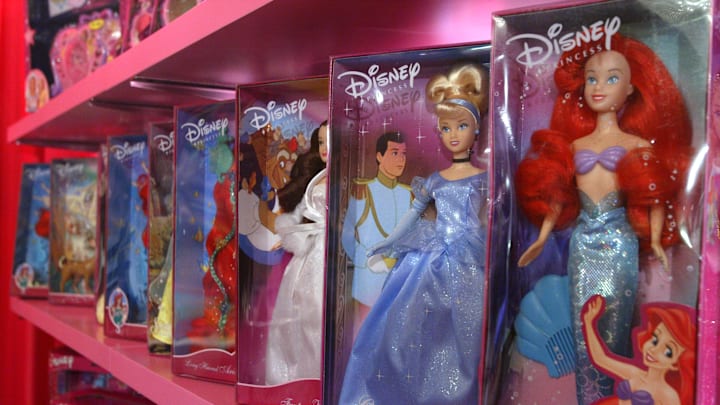
While Disney is known for its fairytale retellings, the idea of the iconic Disney Princesses is actually fairly recent. The Disney Princess line was introduced in the 1990s as a way to sell merchandise to young girls. Until that point, the movies had been fairly distinct, but the Disney Princesses line grouped eleven of the most popular heroines into their own universe.
While the lineup of which characters are considered Princesses has changed over the decades, the franchise continues to be one of the most financially successful subdivisions of Disney's marketing sphere. Thanks to the current media landscape's insistence on multiverses, we have even seen the Princesses unite in films like Ralph Breaks the Internet.
But who exactly counts as a Princess? At the moment, 13 Disney princesses are in the official brand. The broad criteria require each Disney princess to be primarily human and either born royal, married into royalty, or have completed an act of heroism. In addition to those rules, characters from successful films like Frozen and Encanto are not included because they make more money on their own, while less popular characters simply don't have enough market appeal.
Read on to learn more about the 13 heroines who made the cut, how their stories play out, and how they fit within the brand.
- Snow White (Snow White and the Seven Dwarfs)
- Cinderella (Cinderella)
- Aurora (Sleeping Beauty)
- Ariel (The Little Mermaid)
- Belle (Beauty and the Beast)
- Jasmine (Aladdin)
- Pocahontas (Pocahontas)
- Mulan (Mulan)
- Tiana (The Princess and the Frog)
Rapunzel (Tangled)- Merida (Brave)
- Moana (Moana)
- Raya (Raya and the Last Dragon)
Snow White (Snow White and the Seven Dwarfs)
As the lead from Disney's first feature-length film, there was never any doubt that Snow White would be a part of the Disney Princesses line. Snow White was born royalty, but was forced to flee her home when her stepmother (The Evil Queen) decided to have her killed. Although the Evil Queen eventually succeeded in 'killing' Snow White with a poisoned apple, a prince was able to bring her back to life with true love's kiss.
Snow White is the prototype for all the princesses that came after her, which means that she is both beloved as the embodiment of those tropes while also being scorned for the ones that have not aged well. She sings, communicates with animals, and is known above all for her kindness and generosity. However, her love story is probably the weakest of any Disney princess, and she can be overshadowed by the more unique characters in her film.
Cinderella (Cinderella)
While Snow White got the studio started, Cinderella is known as the character (and film) that saved Disney during one of its darkest moments. Debuting 13 years after Snow White and the Seven Dwarfs, Cinderella depicted a young noblewoman who was tormented by her stepmother and step-sisters and made to be a servant in her own home. Through a combination of her own determination, her animal companions, and her fairy godmother, she was able to meet Prince Charming and escape her life of servitude.
While Cinderella embraced many of the same tropes as Snow White, she was a more active protagonist, taking her fate into her own hands. She was not looking for love when she snuck out to the ball, and the fact that her dance partner was the prince was more by chance than anything else. There have now been many different Cinderella stories following this basic structure, but Disney's version remains one of the most iconic and enjoyable to rewatch.
Aurora (Sleeping Beauty)
Aurora is the first Disney Princess whose name was not in the title of her film, causing many people to call her by her title: Sleeping Beauty. After being cursed by an evil fairy named Maleficent, Aurora was hidden away in the forest and raised by three fairies. Despite her chaotic beginning, she had a happy childhood and eventually fell in love with a man she met in the woods (who conveniently happened to be her betrothed). After falling prey to Maleficent's sleeping curse, Aurora and the rest of her kingdom fell into a deep slumber until Prince Phillip arrived to rescue her with true love's kiss.
Aurora is the last of the "classic" Disney princesses, as it would be another 30 years before The Little Mermaid was released. She was also the last princess to be created by Walt Disney, who died in 1966. While much of her story mirrors facets of her predecessors, Aurora actually has one of the most developed romances in Disney's classic age, having fallen for her prince without either of them knowing each other's true identities.
Ariel (The Little Mermaid)
Ariel is the first of the Disney Renaissance-era princesses, and as such, she embodies many of the traits that were prominent in this time period. Fascinated by humanity, Ariel made a deal with the sea witch Ursula to acquire legs and breathe on land. However, she only had three days to make Prince Eric fall in love with her and grant her true love's kiss, or she would lose everything. While she and Eric did fall in love, Ursula was able to manipulate circumstances so that she would win—until Eric and Ariel worked together to kill Ursula and break all of her spells.
Despite having an animal companion and musical ability, Ariel broke a lot of the 'rules' that bound the classic-era princesses. She was far more active in pursuing her goals than most of those who came before her, and she was allowed to have personality traits beyond being kind and beautiful. Furthermore, Ariel rescued Eric first, and the love between them wasn't a magical cure to all of their problems. These modernizations made Ariel a popular character when her movie came out, and she remains one of the most popular Disney princesses today.
Belle (Beauty and the Beast)
If Ariel was the ideal princess for the rebels, Belle was the bookworm's favorite. She lived in a small village in France with her father, where she was often mocked for her love of reading. However, her beauty caught the eye of hometown hero Gaston, who decided he would marry her. When Belle's father was captured by a cruel beast, Belle offered herself in his place, escaping Gaston and finding a chance at true love. Although she initially left him to protect her father, Belle's love ultimately transformed the Beast back into his human form.
Belle's story and personality resonated with a lot of children who felt like outsiders in their own lives. Despite the townsfolk's scorn, she stayed true to herself and was rewarded with love and a library most booklovers would kill for. While the film is often mocked for glamorizing Stockholm Syndrome, it was actually revolutionary for showing how cruelty could thrive with a handsome villain who embodied many of the characteristics of the previous films' heroes.
Jasmine (Aladdin)
Jasmine was the first non-white princess in Disney's roster, but she was also the first not to be the title character of her own film. At the start of Aladdin, Jasmine seemed to be little more than a naive princess trying to avoid an arranged marriage. As the movie went on, however, her determination and yearning for freedom were crucial to saving the day. She played a key role in defeating Jafar and proved herself to be a strong character in a movie that was not intended to be about her.
Despite playing the secondary role in Aladdin, Jasmine is one of the most-adapted Disney princesses thanks to her prominent fan base. She appeared in four Disney movies and four television series, including both the Aladdin series and Hercules: The Animated Series. Although there was no direct literary parallel for Jasmine in One Thousand and One Nights, the Disney character is so iconic that it now feels wrong to adapt Aladdin's story without her.
Pocahontas (Pocahontas)
Pocahontas was the first Disney princess to be based on a historical figure, although her story ends far happier than her real-world counterpart. Pocahontas was the only child of the Powhatan Chief when the English came to colonize the Americas. Despite being betrothed to one of her father's best warriors, Pocahontas fell in love with John Smith, one of the settlers. As the conflict between Native Americans and colonists increased, Pocahontas and John fought to minimize the bloodshed.
The Disney film is a very loose adaptation of a famous story about a Powhatan girl named either Amonute or Matoaka. According to the legend, she threw herself atop John Smith to stop him from being killed by her father. However, there was no romance involved, and her relationship with the English was far more complicated than the Disney tale suggests. Perhaps because the company is wary of acknowledging that history, Pocahontas often gets less attention and merchandise than the other official Princesses.
Mulan (Mulan)
Mulan is the final member of the original Disney Princess line-up and is the only one with no connection to royalty. After the Huns attacked China, every family was commanded to send a man to fight. Mulan disguised herself as a man to save her father from that fate. While she had no innate skills suitable for war, she refused to quit and eventually earned the respect of her commanding officer, Li Shang, and her peers. Although she was rejected when her gender was revealed, Mulan continued to fight for her country and eventually took down the leader of the Huns.
While Mulan was neither born royal nor married into royalty, Disney honors her as a Princess out of respect for her heroism. Though every future Princess had some royal connection, Mulan's heroic nature became an increasingly important part of the Disney Princess legacy. The rebellious spirit that was revolutionary with Ariel was replaced by martial prowess in Mulan, who exemplifies both the strength of character of earlier Princesses and a bodily strength that was not shown in her predecessors.
Tiana (The Princess and the Frog)
Tiana was the first Disney Princess to be created after the franchise was born, which also makes her the first to receive an official coronation into the brand. Tiana was a young woman living in New Orleans who wanted to own her own restaurant. When a frog prince offered her the money to make her dream come true if she kissed him, she was instead turned into a frog as well. While trying to become human again, she and Prince Naveen fell in love, eventually defying the evil Dr. Facilier and making their dreams a reality.
Tiana was incredibly culturally significant, as she was both the first Black Disney Princess and the first Princess from the United States. Though her story is officially based on The Frog Prince fairytale, it is more directly inspired by the culture of New Orleans, which is prominently shown throughout the film. Like Ariel, Tiana spends part of her film in a non-human form, but her official merchandise is generally inspired by her human form and her ballgown costume design.
Rapunzel (Tangled)
Rapunzel's story began before she was even born, when a flower her mother consumed during pregnancy gave her child magical powers—and prompted the witch Mother Gothel to kidnap her and raise her in isolation. When notorious thief Flynn Ryder stumbled into her tower, Rapunzel negotiated with him to help her experience the world and see the lantern release that took place every year on her birthday.
Rapunzel marked another development in the Disney Princess lineup, as she was the first princess to possess magic. While magic was traditionally used by villains and side characters, Rapunzel's powers added a new energy to the franchise that fit well in a superhero-dominated period. While her abilities were limited in the original film, they were greatly expanded upon in Rapunzel's spin-off series, which was arguably the most successful of Disney's film-universe shows.
Merida (Brave)
Merida is the first (and only) official Disney Princess to come from Pixar, which made her stand out in a variety of ways from the others in the franchise. As the only daughter of a Scottish king, Merida was expected to be a proper young lady, but she refused to conform to her mother's expectations. The conflict between mother and daughter turned dangerous when Merida accidentally transformed the queen into a bear, and they both had to learn from one another to set things right.
Many Disney fans were surprised when Merida became an official Disney Princess because she seemed to break all the rules. In addition to being created by Pixar, Merida doesn't sing, has no love interest, and is not based on any established story, historical or fictional. However, her addition made it possible for future princesses to likewise break away from the traditional mold, with many of her traits being mirrored in future characters.
Moana (Moana)
Moana was the culmination of many previous Princesses, able to mock the classical tropes while also expanding the idea of who could be a princess and what kind of stories they could experience. She was the daughter of a Polynesian chief who left her home and learned to wayfind to save her people from ecological devastation. Teaming up with shapeshifting demigod Maui, Moana was able to restore the mythical heart of Te Fiti and help her people reclaim their roots.
Moana was able to blend a lot of the development that previous films had fought for into a princess story that couldn't have been imagined during the classical era. Despite singing and having animal companions, Moana's narrative wasn't nearly as straightforward as most of her predecessors. She had to grapple with what it meant to be part of her community, what a leader's role was, and the very nature of good and evil, allowing for enough moral ambiguity for her to be the first Princess to redeem her villain, instead of defeating them.
Raya (Raya and the Last Dragon)
Raya's story began with betrayal, when fellow princess Namaari befriended her only to steal the Dragon Gem that Raya had been tasked with protecting. When the gem shattered and devastated the kingdoms, Raya sought out the last living dragon to save her father and her people. However, she was only capable of bringing peace back to the land when she learned how to trust again.
Like Moana, Raya's film merged many of the themes and ideals from previous Disney movies with original storylines and expanded representation. Following in Mulan's footsteps as a warrior princess, Raya's fighting style was based on the real-world martial art, Kali. Her story blends an epic hero tale with a deeply personal character journey that demonstrates just how complex a Disney Princess movie can be.