%20%20--%3E%0A%3Csvg%20version%3D%221.1%22%20id%3D%22Layer_1%22%20xmlns%3D%22http%3A%2F%2Fwww.w3.org%2F2000%2Fsvg%22%20xmlns%3Axlink%3D%22http%3A%2F%2Fwww.w3.org%2F1999%2Fxlink%22%20x%3D%220px%22%20y%3D%220px%22%0A%09%20viewBox%3D%220%200%20684.6%2068.1%22%20style%3D%22enable-background%3Anew%200%200%20684.6%2068.1%3B%22%20xml%3Aspace%3D%22preserve%22%3E%0A%3Cg%3E%0A%09%3Cpath%20d%3D%22M444.1%2C29.3h-17.4v14.5h17.4V29.3z%20M36.4%2C68.1l29.3-50.8V0H50.4L32.9%2C36.8L15.5%2C0H0v68.1h16.7V45.8l12.4%2C22.3H36.4z%0A%09%09%20M49.1%2C68.1h16.6V23.4L49.1%2C52.1V68.1z%20M76.6%2C68.1h45V53.8H93.3V41.6h21V27.1h-21V14.8h28.3V0.1h-45V68.1z%20M175.6%2C68.1h17.3v-68%0A%09%09h-16.5v40.3L150%2C0.1h-17.6v68h16.7V27.7L175.6%2C68.1z%20M235.8%2C14.8h15.4V0.1h-47.4v14.7H219v53.2h16.8V14.8z%20M290.3%2C45.9h-17.1%0A%09%09l7.5-15.6h2L290.3%2C45.9z%20M298.7%2C68.1h18l-32.2-68h-5.7l-32%2C68h18l3.3-7.1h27.1L298.7%2C68.1z%20M325.2%2C68.1h46.2V53.8h-29.6V0.1h-16.7%0A%09%09V68.1z%20M423.7%2C14.8h27.2V0.1H407v68h16.7V14.8z%20M462%2C68.1h46.2V53.8h-29.6V0.1H462V68.1z%20M564.8%2C34.1c0%2C10.7-7.2%2C19.2-18.5%2C19.2%0A%09%09c-11.4%2C0-18.5-8.5-18.5-19.2s7.1-19.2%2C18.5-19.2C557.6%2C14.9%2C564.8%2C23.4%2C564.8%2C34.1%20M580.6%2C34.1c0-19-14.2-34-34.3-34%0A%09%09c-20.2%2C0-34.3%2C15-34.3%2C34c0%2C19%2C14.1%2C34%2C34.3%2C34C566.4%2C68.1%2C580.6%2C53.1%2C580.6%2C34.1%20M604.8%2C20.5c0-4.1%2C3.3-6.2%2C6.7-6.2%0A%09%09c4.4%2C0%2C6.6%2C3%2C6.6%2C6.6h14.7C631.8%2C9.1%2C625.1%2C0.1%2C611%2C0.1c-12%2C0-21.7%2C9.3-21.7%2C20.6c0%2C10.9%2C5.9%2C15.9%2C16.7%2C19.8%0A%09%09c5.2%2C1.8%2C11.5%2C3.2%2C11.5%2C8c0%2C3.3-2.4%2C5.5-6.4%2C5.5c-3.6%2C0-6.6-3-6.6-6.7h-15.2c0%2C11.5%2C7.9%2C20.8%2C21.8%2C20.8c12%2C0%2C21.6-9.3%2C21.6-20.6%0A%09%09c0-10-5.3-16.4-16.7-19.8C610.6%2C26.1%2C604.8%2C25.3%2C604.8%2C20.5%20M670%2C20.9h14.7C683.8%2C9.1%2C677.1%2C0.1%2C663%2C0.1c-12%2C0-21.7%2C9.3-21.7%2C20.6%0A%09%09c0%2C10.9%2C5.9%2C15.9%2C16.7%2C19.8c5.2%2C1.8%2C11.5%2C3.2%2C11.5%2C8c0%2C3.3-2.4%2C5.5-6.4%2C5.5c-3.6%2C0-6.6-3-6.6-6.7h-15.2c0%2C11.5%2C7.9%2C20.8%2C21.8%2C20.8%0A%09%09c12%2C0%2C21.6-9.3%2C21.6-20.6c0-10-5.3-16.4-16.7-19.8c-5.4-1.6-11.3-2.4-11.3-7.2c0-4.1%2C3.3-6.2%2C6.7-6.2C667.7%2C14.4%2C670%2C17.3%2C670%2C20.9%0A%09%09%22%2F%3E%0A%3C%2Fg%3E%0A%3C%2Fsvg%3E%0A)

Back in August 1958, Billboard published its first Hot 100, with Ricky Nelson’s “Poor Little Fool” at No. 1. In the decades since, that top spot has gone to the likes of the Archies and Henry Mancini’s orchestra—but never to any of the iconic acts on this list. Here, we’re talking about songs they performed rather than songs they wrote for other people, which don’t count, nor does a charity single like “We Are the World.” Mental Floss has already quizzed readers on the No. 1s that classic rock bands did produce; this list is about the acts that never got there, in order of how close they came.
- Bob Dylan
- Creedence Clearwater Revival
- Johnny Cash
- The Allman Brothers Band
- Journey
- Bruce Springsteen
- James Brown
- Tom Petty
- Led Zeppelin
- R.E.M.
- The Kinks
- Nirvana
- Joni Mitchell
- Lynyrd Skynyrd
- The Who
- Van Morrison
- Grateful Dead
- Jimi Hendrix
- AC/DC
- Bob Marley
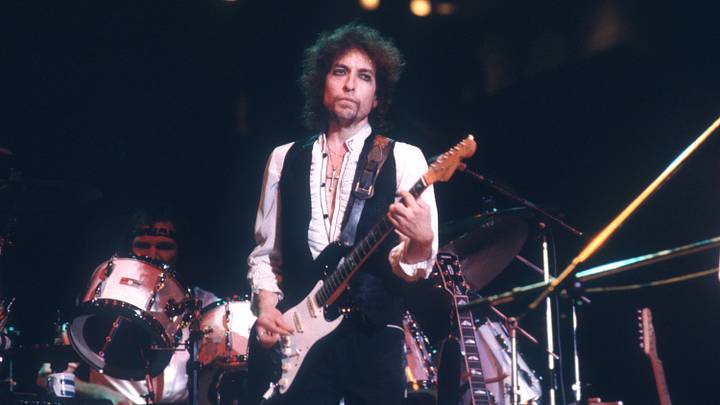
Bob Dylan
“Like a Rolling Stone” reached No. 2 on the chart dated Sept. 4, 1965, and spent two weeks there behind the Beatles’ “Help!” The next spring, “Rainy Day Women #12 & 35” stalled at No. 2 behind the Mamas & the Papas’ “Monday, Monday.” Dylan’s name did reach the top once, as a writer: the Byrds took his “Mr. Tambourine Man” to No. 1 on June 26, 1965, four weeks before “Like a Rolling Stone” entered the chart.
Creedence Clearwater Revival
“Proud Mary,” “Bad Moon Rising,” “Green River,” “Travelin’ Band,” and “Lookin’ Out My Back Door” all peaked at No. 2 in 1969 and 1970, the most runner-up hits for any act that never reached No. 1. It took six different songs to keep them there, from Tommy Roe’s “Dizzy” and the Archies’ “Sugar, Sugar” to “Bridge Over Troubled Water.” The band did land two No. 1 albums, Green River and Cosmo’s Factory, which had to help a little.
Johnny Cash
Most people probably don’t know it, but Shel Silverstein—yes, the one who wrote The Giving Tree—wrote “A Boy Named Sue,” the tale of a man hunting down the father who gave him a girl’s name. Johnny Cash recorded a version live at San Quentin, and it became his biggest pop hit, sitting at No. 2 for three weeks in August and September 1969 and spending all of them behind the Rolling Stones’ “Honky Tonk Women.” Silverstein’s songbook also included “The Cover of ‘Rolling Stone,’” a Top 10 hit for Dr. Hook and the Medicine Show.
The Allman Brothers Band
Dickey Betts wrote “Ramblin’ Man” at 3 a.m. at the kitchen table in bassist Berry Oakley’s house, and it was the last song Oakley ever recorded. It became the band’s biggest hit, reaching No. 2 on the chart dated Oct. 13, 1973, with Cher’s “Half-Breed” in the way. A week later, the Rolling Stones’ “Angie” took over No. 1, and “Ramblin’ Man” slid to No. 3.
Journey
“Open Arms” reached No. 2 on the chart dated Feb. 27, 1982, and stayed there for six weeks. For the first three, it sat behind the J. Geils Band’s “Centerfold,” and when that finally slipped, Joan Jett & the Blackhearts’ “I Love Rock ’n’ Roll” jumped right over it and held No. 1 for the next three. “Don’t Stop Believin’” had already peaked, at No. 9, in December 1981.
Bruce Springsteen
“Dancing in the Dark” spent four weeks at No. 2 in the summer of 1984, the highest the Boss has ever reached as an artist. Duran Duran’s “The Reflex” held No. 1 the first week, and Prince’s “When Doves Cry” held it for the other three. However, Springsteen did write a No. 1: Manfred Mann’s Earth Band took his “Blinded by the Light” to the top in February 1977, and the Pointer Sisters got his “Fire” to No. 2.
James Brown
The Godfather of Soul put 91 songs on the Hot 100, starting with “Try Me” in the late 1950s, and none of them made it to No. 1. He came closest with “I Got You (I Feel Good),” which peaked at No. 3 on the chart dated Dec. 18, 1965, and “Living in America,” which reached No. 4 in 1986. The R&B chart treated him better: he topped it 17 times.
Tom Petty
Petty’s highest-charting single isn’t entirely his: “Stop Draggin’ My Heart Around,” credited to Stevie Nicks with Tom Petty and the Heartbreakers, reached No. 3 in September 1981. Under his own name, he never did better than “Free Fallin’,” which hit No. 7 in January 1990, and that was a solo single, not a Heartbreakers one. The band’s own high-water mark was “Don’t Do Me Like That,” No. 10 in 1980.
Led Zeppelin
The band refused to release “Whole Lotta Love” as a single in the U.K. In the U.S., Atlantic Records talked them into a three-minute edit, and it reached No. 4 on the chart dated Jan. 31, 1970, still their highest Hot 100 peak. “Stairway to Heaven” only ever went out as a promotional single, and Robert Plant explained in 2005 that “there’s no point putting out a single when the album is the statement of the band.”
R.E.M.
“Losing My Religion” was built around acoustic guitar and mandolin, not exactly the sound of pop radio in 1991, and Michael Stipe called it a “freak hit.” It reached No. 4 on the chart dated June 22, 1991, the band’s highest Hot 100 peak, and it isn’t really about religion: Stipe said he “wanted to write a classic obsession song.” “Shiny Happy People,” from the same album, stopped at No. 10.
The Kinks
The Kinks peaked at No. 6 twice, 18 years apart: “Tired of Waiting for You” in April 1965 and “Come Dancing” in July 1983. Their best-known songs fell short of even that, with “You Really Got Me” and “All Day and All of the Night” both stopping at No. 7 and “Lola” reaching No. 9 in 1970.
Nirvana
“Smells Like Teen Spirit” peaked at No. 6 on the Hot 100 dated Jan. 11, 1992, the same week Nevermind knocked Michael Jackson’s Dangerous out of No. 1 on the Billboard 200. A week later, Garth Brooks’ Ropin’ the Wind topped the album chart. Nirvana never got that close on the singles chart again: “Come As You Are” stopped at No. 32.
Joni Mitchell
“Help Me” reached No. 7 in June 1974, Mitchell’s only Top 10 single, and the next best, “Free Man in Paris,” stopped at No. 22 later that year. Both came from Court and Spark, which had a near miss of its own: the album spent four weeks at No. 2 on the Billboard 200 in March 1974, and for the first two of them, the record in front of it was Bob Dylan’s Planet Waves.
Lynyrd Skynyrd
“Sweet Home Alabama” calls out Neil Young by name, answering his songs “Southern Man” and “Alabama,” and it peaked at No. 8 in October 1974. Their target had already been to No. 1 with “Heart of Gold” in 1972. “We wrote ‘Sweet Home Alabama’ as a joke,” Ronnie Van Zant said later, and Young played it himself at a show in Miami weeks after the 1977 plane crash that killed Van Zant.
The Who
“I Can See for Miles” reached No. 9 in November 1967, and it’s still the Who’s only Top 10 hit in the U.S. The songs people know best did worse: “Won’t Get Fooled Again” stopped at No. 15, “Pinball Wizard” at No. 19, and “My Generation” peaked at No. 74 in 1966.
Van Morrison
“Brown Eyed Girl,” originally titled “Brown Skinned Girl,” peaked at No. 10 in September 1967, and Morrison has never been fond of it: he once said he doesn’t consider it one of his 300 best songs. His actual highest-charting single is “Domino,” which beat it by one spot, reaching No. 9 on the chart dated Jan. 2, 1971.
Grateful Dead
By 1987, the Dead were more than 20 years into a career built on live shows, and their best Hot 100 showing was still “Truckin’,” which hit No. 64 in 1971. Then “Touch of Grey” reached No. 9 on the chart dated Sept. 26, 1987, and pushed In the Dark to No. 6 on the Billboard 200. It remains their only Top 10 single.
Jimi Hendrix
Hendrix’s only Top 40 hit was a Bob Dylan song. Dylan released “All Along the Watchtower” on John Wesley Harding in 1967, Hendrix recorded his version at Olympic Studios in London in January 1968, and it peaked at No. 20 that October. “Purple Haze” had stopped at No. 65 the year before, and “Crosstown Traffic” got to No. 52.
AC/DC
The band behind Back in Black never had a Top 20 hit in the U.S. The album’s title track peaked at No. 37 in early 1981 and “You Shook Me All Night Long” at No. 35, and the band’s best showing came a decade later, when “Moneytalks” reached No. 23 on the chart dated Feb. 9, 1991. The album itself never made it to No. 1 on the Billboard 200, either.
Bob Marley
Marley put exactly one song on the Hot 100: “Roots, Rock, Reggae,” with the Wailers, which peaked at No. 51 in 1976. He does have a No. 1 to his name, as a writer: Eric Clapton’s cover of his “I Shot the Sheriff” topped the chart in September 1974, two years before Marley’s own single charted. He died in 1981, at 36.