%20%20--%3E%0A%3Csvg%20version%3D%221.1%22%20id%3D%22Layer_1%22%20xmlns%3D%22http%3A%2F%2Fwww.w3.org%2F2000%2Fsvg%22%20xmlns%3Axlink%3D%22http%3A%2F%2Fwww.w3.org%2F1999%2Fxlink%22%20x%3D%220px%22%20y%3D%220px%22%0A%09%20viewBox%3D%220%200%20684.6%2068.1%22%20style%3D%22enable-background%3Anew%200%200%20684.6%2068.1%3B%22%20xml%3Aspace%3D%22preserve%22%3E%0A%3Cg%3E%0A%09%3Cpath%20d%3D%22M444.1%2C29.3h-17.4v14.5h17.4V29.3z%20M36.4%2C68.1l29.3-50.8V0H50.4L32.9%2C36.8L15.5%2C0H0v68.1h16.7V45.8l12.4%2C22.3H36.4z%0A%09%09%20M49.1%2C68.1h16.6V23.4L49.1%2C52.1V68.1z%20M76.6%2C68.1h45V53.8H93.3V41.6h21V27.1h-21V14.8h28.3V0.1h-45V68.1z%20M175.6%2C68.1h17.3v-68%0A%09%09h-16.5v40.3L150%2C0.1h-17.6v68h16.7V27.7L175.6%2C68.1z%20M235.8%2C14.8h15.4V0.1h-47.4v14.7H219v53.2h16.8V14.8z%20M290.3%2C45.9h-17.1%0A%09%09l7.5-15.6h2L290.3%2C45.9z%20M298.7%2C68.1h18l-32.2-68h-5.7l-32%2C68h18l3.3-7.1h27.1L298.7%2C68.1z%20M325.2%2C68.1h46.2V53.8h-29.6V0.1h-16.7%0A%09%09V68.1z%20M423.7%2C14.8h27.2V0.1H407v68h16.7V14.8z%20M462%2C68.1h46.2V53.8h-29.6V0.1H462V68.1z%20M564.8%2C34.1c0%2C10.7-7.2%2C19.2-18.5%2C19.2%0A%09%09c-11.4%2C0-18.5-8.5-18.5-19.2s7.1-19.2%2C18.5-19.2C557.6%2C14.9%2C564.8%2C23.4%2C564.8%2C34.1%20M580.6%2C34.1c0-19-14.2-34-34.3-34%0A%09%09c-20.2%2C0-34.3%2C15-34.3%2C34c0%2C19%2C14.1%2C34%2C34.3%2C34C566.4%2C68.1%2C580.6%2C53.1%2C580.6%2C34.1%20M604.8%2C20.5c0-4.1%2C3.3-6.2%2C6.7-6.2%0A%09%09c4.4%2C0%2C6.6%2C3%2C6.6%2C6.6h14.7C631.8%2C9.1%2C625.1%2C0.1%2C611%2C0.1c-12%2C0-21.7%2C9.3-21.7%2C20.6c0%2C10.9%2C5.9%2C15.9%2C16.7%2C19.8%0A%09%09c5.2%2C1.8%2C11.5%2C3.2%2C11.5%2C8c0%2C3.3-2.4%2C5.5-6.4%2C5.5c-3.6%2C0-6.6-3-6.6-6.7h-15.2c0%2C11.5%2C7.9%2C20.8%2C21.8%2C20.8c12%2C0%2C21.6-9.3%2C21.6-20.6%0A%09%09c0-10-5.3-16.4-16.7-19.8C610.6%2C26.1%2C604.8%2C25.3%2C604.8%2C20.5%20M670%2C20.9h14.7C683.8%2C9.1%2C677.1%2C0.1%2C663%2C0.1c-12%2C0-21.7%2C9.3-21.7%2C20.6%0A%09%09c0%2C10.9%2C5.9%2C15.9%2C16.7%2C19.8c5.2%2C1.8%2C11.5%2C3.2%2C11.5%2C8c0%2C3.3-2.4%2C5.5-6.4%2C5.5c-3.6%2C0-6.6-3-6.6-6.7h-15.2c0%2C11.5%2C7.9%2C20.8%2C21.8%2C20.8%0A%09%09c12%2C0%2C21.6-9.3%2C21.6-20.6c0-10-5.3-16.4-16.7-19.8c-5.4-1.6-11.3-2.4-11.3-7.2c0-4.1%2C3.3-6.2%2C6.7-6.2C667.7%2C14.4%2C670%2C17.3%2C670%2C20.9%0A%09%09%22%2F%3E%0A%3C%2Fg%3E%0A%3C%2Fsvg%3E%0A)

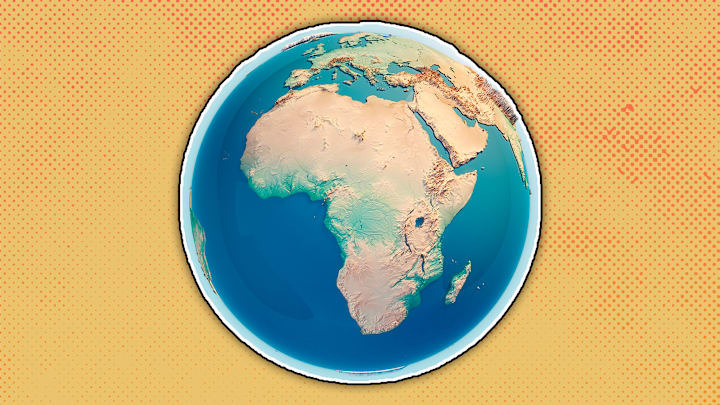
Have you ever been to Africa? If your answer was “could you be more specific?” good for you.
What comes to mind for many people upon picturing Africa is a vast land where safari animals roam freely and in tandem with the village people. Where food and water are perpetually sparse, winding dirt paths are your only method of travel, and technology doesn’t exist. But, of course, none of that is accurate.
As Dipo Faloyin, author of Africa is Not a Country: Breaking Stereotypes of Modern Africa, writes, “Few entities have been forced through [a] field of distorted reality as many times as Africa … A region that is treated and spoken of as if it were a single country, devoid of nuance and cursed to be forever plagued by deprivation.”
Why is the continent that scientific evidence supports we all came from so stereotyped and misunderstood? A lot of those misconceptions can be boiled down to the fact that Africa is too big, both geographically and culturally, for certain things to apply to the whole continent. Let’s break down some of the biggest misconceptions about Africa, as adapted from the above episode of Misconceptions on YouTube.
- Misconception: Africa is a country.
- Misconception: Africans speak African.
- Misconception: Africa is always hot.
- Misconception: Wild animals roam among the African people.
- Misconception: All native Africans have dark skin.
- Misconception: African food is simple and sparse.
- Misconception: Africa doesn’t have technology.
- Misconception: There is no major African folklore or fantasy.
Misconception: Africa is a country.

Without looking it up, how many countries do you think there are in Africa? It’s probably more than you think, because Africa has a whopping 54 countries. In fact, Africa accounts for over a quarter of the 193 member states in the United Nations.
Africa isn’t just large in the number of countries it has, but also in its land mass, which totals 11.7 million square miles, or about 30.4 million square kilometers. Not only is it 14 times bigger than Greenland, but it could (theoretically) fit the entirety of the contiguous U.S., India, China, Japan, and a whole bunch of Europe within its area.
So if Africa is such a force to be reckoned with, why is there so much general ignorance about its continental status?
Along with the lack of Afro-centric curricula in non-African countries (and particularly in the United States), a lot of world maps show Africa to be much smaller than it really is. The Mercator projection model causes land masses to appear more stretched out the closer to the north and south poles they are. As a result, Greenland looks stretched out to 14 times its size, while Africa stays relatively close to scale because it lies on the equator.
Misconception: Africans speak African.

In the same vein as the previous misconception, a lot of people think that 1) “African” is a language, and 2) every African person speaks it. Needless to say, neither is the case.
There were over 2000 languages spoken across Africa’s 54 countries as of 2022, with over 8000 dialects. The most commonly spoken language in Africa is often listed as Swahili, with estimates of over 16 million native speakers and over 200 million speakers worldwide. Though Arabic is right there, as are European languages like English or French. One African language, Afrikaans, is the closest thing you can get to a language that’s literally called “African.” It’s spoken in South Africa, and has around 7 million native speakers.
African languages are divided into several major families. There’s the Niger-Congo family, with approximately 1350-1650 languages on the continent; the Afroasiatic, with 200-300; the Nilo-Saharan, with around 80 languages; the Khoisan languages—which are actually several different language families that get lumped together under one umbrella; and the Austronesian family, which is limited to the languages spoken in and around Madagascar. According to Harvard’s African Language Program, the continent hosts around a third of all the languages in the world.
You May Also Like ...
- 5 Unique Currencies From Precolonial Africa
- 8 Facts about Olduvai Gorge, the “Cradle of Mankind”
- The Agojie Amazons of West Africa: The Real Female Warriors Behind 'The Woman King'
Add Mental Floss as a preferred news source!
Misconception: Africa is always hot.

Knowing that Africa is an equatorial continent, one might assume it would always be hot. Pair that with the deserts the continent is known for, like the Sahara and the Kalahari, and Africa seems like a universally hot region.
However, Africa’s deserts have drastic variations in temperature. The Kalahari, for example, may boast high temperatures of 110–115° F (43–46° C) during the day, but come nightfall, temperatures drop to around 70-80° F (21–27° C) in the summer, and as low as 10° F (-12° C) in the winter.
Additionally, Africa has a lot of varied climates over its previously mentioned gigantic landmass, including rainforests, grasslands, and semi-arid areas as well as deserts. Notably, Morocco has snowy areas with popular ski resorts.
Misconception: Wild animals roam among the African people.

After the U.S. won against Ghana in a 2014 World Cup match, Delta Airlines notoriously tweeted out a seemingly innocent picture celebrating the win, with a silhouette of the Statue of Liberty underlaid behind the U.S. team’s final score of two goals, and a silhouette of a giraffe behind Ghana’s final score of 1.
The problem? There are about as many wild giraffes in Ghana as there are in North America and Europe. That is to say, none.
While many people think giraffes, lions, elephants, and tigers casually roam among African people going about their daily affairs, they don’t. Lions are mostly found in wild areas south of the Sahara; elephants are pretty widespread but predominately in the more central part of the continent; and wild tigers aren’t even native to Africa at all—they’re native to Asia.
All of these animals that are so synonymous with a Western view of Africa actually tend to avoid people altogether. However, they do occasionally interact with humans, and not always with great results as people and wildlife try to live in the same space
Misconception: All native Africans have dark skin.

A 2021 study that details the history of variations in skin pigmentation found that skin pigmentation correlates with UV radiation. The more UV rays a person is exposed to, the more likely they are to have more melanin, resulting in a darker complexion. On the other hand, the less UV radiation someone regularly comes into contact with, the less melanin they are likely to have. Which may lead people to believe that people living in Africa—which straddles the equator—universally have dark skin.
But as the scientists who conducted the study noted, African populations are “vastly underrepresented” when it comes to the study of skin pigmentation, and a closer examination reveals that skin pigmentation of modern Africans varies greatly. “For example,” the study says, “the KhoeSan hunter-gatherers in Botswana have relatively light skin, while Nilo-Saharan-speaking populations from East Africa have some of the darkest pigmented skin on Earth.”
The authors conclude that further study of the diversity of African populations "will be essential for a full understanding of the evolutionary genetics of human skin pigmentation." And that’s just people of African descent in Sub-Saharan Africa. There are millions of people with ancestry from across the world living on the continent, and North Africa has its own fascinating history.
Misconception: African food is simple and sparse.

One reason you may not have heard of African foods is that the cousine isn’t as widely popularized in Western countries as South American or Asian food. But that isn’t to say that African cuisine doesn’t exist.
Northern African staples like za’atar, an herb and spice mix that can be used on everything from veggies to chicken, has been rising in popularity among non-African and Middle Eastern palates. So have West African foods like jollof, a rice dish made from a base of tomatoes, onions, and spices. There’s even an annual Jollof Festival in Washington, D.C. that brings together chefs, restaurant owners, and food enthusiasts from different African nationalities to represent their country with their best jollof recipe. The winner receives a trophy, and of course, bragging rights.
Other African cuisine includes meat dishes like suya, a kind of spiced meat skewer, and nyama choma, a barbecued meat dish that’s typically made with beef or goat.
Piri piri (or peri peri) chicken originated from Southern Africa, and has been brought to Western foodies through restaurants like Nando’s.
The native crops in each African region also inform what that area’s cuisine may be. For example, northern African countries cultivate couscous, mint, and citrus fruits, and it shows up in their cooking. Elsewhere on the continent, people harvest rice, okra, plantains, sugarcane, watermelon, mangoes … the list goes on. These foods are staples to African cuisine.
Misconception: Africa doesn’t have technology.

A lot of modern technological innovations were invented by African scientists.
People from the continent have been instrumental in modern medicine advancements. The first successful heart transplant was done in Cape Town in South Africa. The Cardiopad, which helps with heart readings, was invented by Arthur Zang, a Cameroonian scientist a decade ago. And that’s not to mention the ongoing research in medicine and technology that occurs daily.
Africans make cars, use laptops, and have an entertainment industry. Nollywood, the Nigerian film industry, is a force to be reckoned with. The Democratic Republic of Congo has traffic robots.
But if Africa is so technologically advanced, why aren’t a lot of African people on the internet?
Think about how much you see African content online. Not a lot, right? This is one of the factors in the usage gap. While there is, unfortunately, a high illiteracy rate in many African countries, the lack of content in accessible native languages is also a problem. As of April 2024, only around two dozen African languages are supported by Google Translate.
Additionally, the digital divide isn’t just a problem in African countries. The Federal Communications Commission estimates that over 14 million people in the United States also don’t have broadband internet access. Cost is a major factor. According to the Pew Research Center, in 2019, approximately 44 percent of American adults with annual household incomes of less than $30,000 don’t have broadband internet.
Misconception: There is no major African folklore or fantasy.

European folklore, like Greek and Roman myths, are pretty well-known to most Westerners Many people are also familiar with Egyptian mythology, but that’s a tiny fraction of what African folklore has to offer.
Many people aren’t nearly as well-versed in African folklore, and that could be due to its lack of written tradition. While Greek myths were often written down, a lot of African folklore was mostly passed down through oral stories. So while these tales do exist and have for centuries, they’re a bit harder to keep track of.
Here are just a handful of deities from African folklore:
- Oshun, a Nigerian Yoruba goddess of sex and fertility, was brought to light to Westerners when Beyoncé took inspiration from her in her 2017 Grammy’s performance.
- Ananse the spider is an Ghanaian Ashanti trickster entity who is also revered as a god of storytelling.
- Nyame, the Sky God of the Ghanaian Akan people, has his name show up in the popular Gye Nyame symbol, which means “except for God.”
- According to the Encyclopedia of African Religion, Mawu-Lisa are sort of twin deities of the Fon people of Benin and Togo that can either be separate, in which case only the male deity—Lisa—is worshipped or the two can be merged into the Supreme God.