%20%20--%3E%0A%3Csvg%20version%3D%221.1%22%20id%3D%22Layer_1%22%20xmlns%3D%22http%3A%2F%2Fwww.w3.org%2F2000%2Fsvg%22%20xmlns%3Axlink%3D%22http%3A%2F%2Fwww.w3.org%2F1999%2Fxlink%22%20x%3D%220px%22%20y%3D%220px%22%0A%09%20viewBox%3D%220%200%20684.6%2068.1%22%20style%3D%22enable-background%3Anew%200%200%20684.6%2068.1%3B%22%20xml%3Aspace%3D%22preserve%22%3E%0A%3Cg%3E%0A%09%3Cpath%20d%3D%22M444.1%2C29.3h-17.4v14.5h17.4V29.3z%20M36.4%2C68.1l29.3-50.8V0H50.4L32.9%2C36.8L15.5%2C0H0v68.1h16.7V45.8l12.4%2C22.3H36.4z%0A%09%09%20M49.1%2C68.1h16.6V23.4L49.1%2C52.1V68.1z%20M76.6%2C68.1h45V53.8H93.3V41.6h21V27.1h-21V14.8h28.3V0.1h-45V68.1z%20M175.6%2C68.1h17.3v-68%0A%09%09h-16.5v40.3L150%2C0.1h-17.6v68h16.7V27.7L175.6%2C68.1z%20M235.8%2C14.8h15.4V0.1h-47.4v14.7H219v53.2h16.8V14.8z%20M290.3%2C45.9h-17.1%0A%09%09l7.5-15.6h2L290.3%2C45.9z%20M298.7%2C68.1h18l-32.2-68h-5.7l-32%2C68h18l3.3-7.1h27.1L298.7%2C68.1z%20M325.2%2C68.1h46.2V53.8h-29.6V0.1h-16.7%0A%09%09V68.1z%20M423.7%2C14.8h27.2V0.1H407v68h16.7V14.8z%20M462%2C68.1h46.2V53.8h-29.6V0.1H462V68.1z%20M564.8%2C34.1c0%2C10.7-7.2%2C19.2-18.5%2C19.2%0A%09%09c-11.4%2C0-18.5-8.5-18.5-19.2s7.1-19.2%2C18.5-19.2C557.6%2C14.9%2C564.8%2C23.4%2C564.8%2C34.1%20M580.6%2C34.1c0-19-14.2-34-34.3-34%0A%09%09c-20.2%2C0-34.3%2C15-34.3%2C34c0%2C19%2C14.1%2C34%2C34.3%2C34C566.4%2C68.1%2C580.6%2C53.1%2C580.6%2C34.1%20M604.8%2C20.5c0-4.1%2C3.3-6.2%2C6.7-6.2%0A%09%09c4.4%2C0%2C6.6%2C3%2C6.6%2C6.6h14.7C631.8%2C9.1%2C625.1%2C0.1%2C611%2C0.1c-12%2C0-21.7%2C9.3-21.7%2C20.6c0%2C10.9%2C5.9%2C15.9%2C16.7%2C19.8%0A%09%09c5.2%2C1.8%2C11.5%2C3.2%2C11.5%2C8c0%2C3.3-2.4%2C5.5-6.4%2C5.5c-3.6%2C0-6.6-3-6.6-6.7h-15.2c0%2C11.5%2C7.9%2C20.8%2C21.8%2C20.8c12%2C0%2C21.6-9.3%2C21.6-20.6%0A%09%09c0-10-5.3-16.4-16.7-19.8C610.6%2C26.1%2C604.8%2C25.3%2C604.8%2C20.5%20M670%2C20.9h14.7C683.8%2C9.1%2C677.1%2C0.1%2C663%2C0.1c-12%2C0-21.7%2C9.3-21.7%2C20.6%0A%09%09c0%2C10.9%2C5.9%2C15.9%2C16.7%2C19.8c5.2%2C1.8%2C11.5%2C3.2%2C11.5%2C8c0%2C3.3-2.4%2C5.5-6.4%2C5.5c-3.6%2C0-6.6-3-6.6-6.7h-15.2c0%2C11.5%2C7.9%2C20.8%2C21.8%2C20.8%0A%09%09c12%2C0%2C21.6-9.3%2C21.6-20.6c0-10-5.3-16.4-16.7-19.8c-5.4-1.6-11.3-2.4-11.3-7.2c0-4.1%2C3.3-6.2%2C6.7-6.2C667.7%2C14.4%2C670%2C17.3%2C670%2C20.9%0A%09%09%22%2F%3E%0A%3C%2Fg%3E%0A%3C%2Fsvg%3E%0A)

The most famous photos from the history of journalism cover tragic events like wars and natural disasters. The big awards go to photos that show people at their lowest. The goal is to inform about groups who died horribly, and the specific person the photographer managed to record surely suffered some terrible epilogue soon after the photo was taken.
Surprisingly, however, some of the subjects in these photos managed to escape those situations and turn their lives around.
The Napalm Girl
The 1973 Pulitzer for Breaking News Photography went to The Terror of War, better known as Napalm Girl. The South Vietnamese Air Force wrongly hit a village with napalm, mistaking the residents for enemy soldiers, and the photo shows children fleeing the strike. The 9-year-old girl in the center is nude (the above video preview shows a cropped version of the photo), having pulled off all her burning clothes. Removing those clothes did not save her from severe burns.
That girl is Phan Thị Kim Phúc, and she was not among the two million civilians who died during the Vietnam War. The strike killed two of her cousins, as well as other people in the village, but she is here fleeing the village with Associated Press photographer Nick Ut. Ut got her and the other fleeing children to a hospital. Kim Phúc did suffer third-degree burns, but the hospital was able to treat them.
When she grew up, the Vietnamese government used her as a propaganda tool. But when she was 30, she flew to Moscow, and during a stopover in Canada, she applied for asylum. Kim Phúc has lived in Canada ever since and is still around to comment on war issues and advocate for refugees.
The Starving Vulture Child
Tens of thousands of people starved in Sudan during a 1993 famine. The most famous image from the famine was this photo, which is titled The Vulture and the Little Girl, though the child pictured there is actually a boy.
Judging by the vulture patiently waiting for a corpse to scavenge, that child is surely just minutes away from dying. When the photo appeared in the New York Times, people felt horrified, not just by this insight into the famine but by the implication that this specific child had starved to death, and photographer Kevin Carter just stood there and snapped photos instead of doing anything to help.
But take a closer look at the boy. That white strip around his arm is a wristband. It was placed on him by Operation Lifeline Sudan, a United Nations aid initiative. The very reason Carter was around to witness this scene was that he’d flown here on a UN plane carrying aid. Also, Carter chased the vulture away after taking the photo. The vulture probably didn’t pose any real threat to the boy, but it seemed like the right thing to do.
The boy was named Kong Nyong, and the UN food station distributing aid took care of him. He survived the famine and actually outlived Carter by 13 years.
Unfortunately, though, given that Nyong died in 2007, his outliving Carter points to another tragedy. Carter took his own life in 1994, shortly after receiving the Pulitzer for his photo.
The Little Rock Nine Enemies
The above photo shows Elizabeth Eckford, one of nine Black students who in 1957 enrolled in the previously all-white Little Rock Central High School. The nine had planned to march into school together on their first day, but due to a mix-up, Eckford came alone. On her left, we see Hazel Massery, a white girl protesting against integration. Both girls are 15.
This photo has resurfaced online in recent years during debates about how much schools need to teach about America’s racial past. Massery’s opposition to integration went even further than the photo suggests. Despite not attending Little Rock Central High herself, she continued to work with the protestors and even joined a group that later attacked the Nine physically.
But then a few more years went by. Once both had left high school, but with integration still far from a settled matter nationally, Massery tracked Eckford down and phoned her to apologize.
On the photo’s 40th anniversary, photographer Will Counts staged a reunion, and Massery apologized to Eckford again. And for the next few years after that, the two became friends.
When the media checked in with them after another decade, it seemed the friendship hadn’t lasted. Eckford actually hadn’t previously known the full extent of Massery’s involvement with the more physical attacks, and when she did learn about them, their relationship ended. But it’s still quite inspirational that those could ever reconcile at all.
The Afghan Girl
When the above photo appeared on a National Geographic cover in 1984, no one knew the unnamed girl’s identity. She represented refugees of the Soviet–Afghan War, and all people knew was that her prospects did not look good. Multiple generations have passed since the photo was first published, which is a long enough time for multiple epilogues.
The first was when, in 2002, National Geographic managed to finally identify the photo’s subject. They traveled to Afghanistan and followed the trail from the refugee camp photographer Steve McCurry originally visited. They found that the 12-year-old girl was Sharbat Gula, who now had three children and had no idea her face was world-famous.
She had been living in Pakistan almost continuously since the time of the photo. Then, in 2016, Pakistan deported her back to Afghanistan. While this was, perhaps, not the worst time to be living in Afghanistan, the deportation did upend her life.
Then, a few years later, the Taliban retook control of the country, and now, it really may have been the worst time to be living in Afghanistan. But in 2021, she was one of the fortunate ones to get out of the country during the evacuation. She now lives in Italy.
Migrant Mother
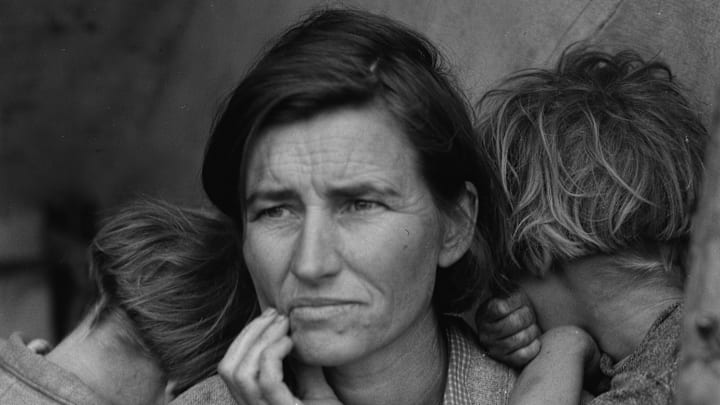
You’ve seen this photo many times, representing the Great Depression. The mother and her children look hopeless, and that’s before you even notice that the bundle in her arms is a baby. The caption reads, “Destitute pea pickers in California. Mother of seven children. Age thirty-two. Nipomo, California.”
Photographer Dorothea Lange took this photo in 1936, and while this really was a family of poor pea pickers, it took a bit of staging to get them looking quite like this. It’s possible that the mother’s pained expression says less about the family’s long-term economic prospects and more about simply how exhausting breastfeeding is.
The mother, whose name Lange didn’t record at the time, was a Cherokee woman named Florence Owens Thompson, and she did survive the Depression. So did that baby, her six other children, and three additional children she had in the years that followed.
We look at the photo and see that she’s living in a uniquely terrible time, but every kid surviving into adulthood makes the family more fortunate than most similarly sized families at any previous time in history. Her children also went on to buy her her own house—which she eventually rejected in favor of a mobile home, saying, “I need to have wheels under me.”