%20%20--%3E%0A%3Csvg%20version%3D%221.1%22%20id%3D%22Layer_1%22%20xmlns%3D%22http%3A%2F%2Fwww.w3.org%2F2000%2Fsvg%22%20xmlns%3Axlink%3D%22http%3A%2F%2Fwww.w3.org%2F1999%2Fxlink%22%20x%3D%220px%22%20y%3D%220px%22%0A%09%20viewBox%3D%220%200%20684.6%2068.1%22%20style%3D%22enable-background%3Anew%200%200%20684.6%2068.1%3B%22%20xml%3Aspace%3D%22preserve%22%3E%0A%3Cg%3E%0A%09%3Cpath%20d%3D%22M444.1%2C29.3h-17.4v14.5h17.4V29.3z%20M36.4%2C68.1l29.3-50.8V0H50.4L32.9%2C36.8L15.5%2C0H0v68.1h16.7V45.8l12.4%2C22.3H36.4z%0A%09%09%20M49.1%2C68.1h16.6V23.4L49.1%2C52.1V68.1z%20M76.6%2C68.1h45V53.8H93.3V41.6h21V27.1h-21V14.8h28.3V0.1h-45V68.1z%20M175.6%2C68.1h17.3v-68%0A%09%09h-16.5v40.3L150%2C0.1h-17.6v68h16.7V27.7L175.6%2C68.1z%20M235.8%2C14.8h15.4V0.1h-47.4v14.7H219v53.2h16.8V14.8z%20M290.3%2C45.9h-17.1%0A%09%09l7.5-15.6h2L290.3%2C45.9z%20M298.7%2C68.1h18l-32.2-68h-5.7l-32%2C68h18l3.3-7.1h27.1L298.7%2C68.1z%20M325.2%2C68.1h46.2V53.8h-29.6V0.1h-16.7%0A%09%09V68.1z%20M423.7%2C14.8h27.2V0.1H407v68h16.7V14.8z%20M462%2C68.1h46.2V53.8h-29.6V0.1H462V68.1z%20M564.8%2C34.1c0%2C10.7-7.2%2C19.2-18.5%2C19.2%0A%09%09c-11.4%2C0-18.5-8.5-18.5-19.2s7.1-19.2%2C18.5-19.2C557.6%2C14.9%2C564.8%2C23.4%2C564.8%2C34.1%20M580.6%2C34.1c0-19-14.2-34-34.3-34%0A%09%09c-20.2%2C0-34.3%2C15-34.3%2C34c0%2C19%2C14.1%2C34%2C34.3%2C34C566.4%2C68.1%2C580.6%2C53.1%2C580.6%2C34.1%20M604.8%2C20.5c0-4.1%2C3.3-6.2%2C6.7-6.2%0A%09%09c4.4%2C0%2C6.6%2C3%2C6.6%2C6.6h14.7C631.8%2C9.1%2C625.1%2C0.1%2C611%2C0.1c-12%2C0-21.7%2C9.3-21.7%2C20.6c0%2C10.9%2C5.9%2C15.9%2C16.7%2C19.8%0A%09%09c5.2%2C1.8%2C11.5%2C3.2%2C11.5%2C8c0%2C3.3-2.4%2C5.5-6.4%2C5.5c-3.6%2C0-6.6-3-6.6-6.7h-15.2c0%2C11.5%2C7.9%2C20.8%2C21.8%2C20.8c12%2C0%2C21.6-9.3%2C21.6-20.6%0A%09%09c0-10-5.3-16.4-16.7-19.8C610.6%2C26.1%2C604.8%2C25.3%2C604.8%2C20.5%20M670%2C20.9h14.7C683.8%2C9.1%2C677.1%2C0.1%2C663%2C0.1c-12%2C0-21.7%2C9.3-21.7%2C20.6%0A%09%09c0%2C10.9%2C5.9%2C15.9%2C16.7%2C19.8c5.2%2C1.8%2C11.5%2C3.2%2C11.5%2C8c0%2C3.3-2.4%2C5.5-6.4%2C5.5c-3.6%2C0-6.6-3-6.6-6.7h-15.2c0%2C11.5%2C7.9%2C20.8%2C21.8%2C20.8%0A%09%09c12%2C0%2C21.6-9.3%2C21.6-20.6c0-10-5.3-16.4-16.7-19.8c-5.4-1.6-11.3-2.4-11.3-7.2c0-4.1%2C3.3-6.2%2C6.7-6.2C667.7%2C14.4%2C670%2C17.3%2C670%2C20.9%0A%09%09%22%2F%3E%0A%3C%2Fg%3E%0A%3C%2Fsvg%3E%0A)

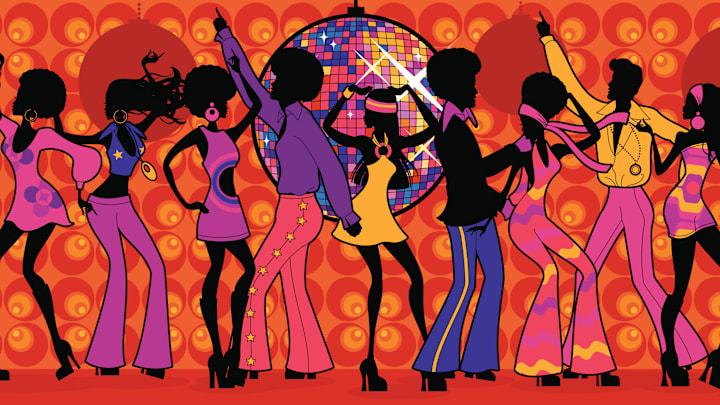
Disco, punk, and the sexual revolution. Let’s break down some common myths about the 1970s, as adapted from an episode of Misconceptions on YouTube.
- Punk rock originated in the ‘70s—and in the UK.
- Everybody was on board with the sexual revolution.
- It was a low-tech era.
- Everybody thought disco sucked.
Punk rock originated in the ‘70s—and in the UK.

It’s 1973 and you’ve never seen anything like this before. You’re packed into the sweaty upstairs space at Max’s Kansas City and the roar of the crowd is thunderous. From the floor, you’re witnessing something that makes The Rolling Stones feel like child’s play:
They’re the New York Dolls and they’re the talk of the town. With their teased, bouffant-style hair, satin and spandex get-ups, and giant platform heels, these already larger-than-life figures seem to tower over everyone else in the room. And it’s fitting, considering these guys have been towering over the scene for months now—and will be for years to come.
But 40, 50 years from now, a lot of people are going to say this wasn’t punk. They’re going to point across the pond, to the UK, and say that a sound this dirty and this raucous doesn’t get invented until 1977, with the release of Never Mind the Bollocks, Here’s The Sex Pistols.
Generally speaking, most would say that punk rock as a music genre fully emerged in the 1970s. By the latter part of the decade, bands like The Ramones and The Clash began to typify it, thanks to seminal albums like 1976’s Ramones—which kicks off with “Blitzkrieg Bop”—and the 1979 London Calling double LP. But if you dig a bit deeper into it, the root system for that kind of sound is actually much wider, and stems from much earlier.
While still pretty hotly contested among music lovers and historians alike, most agree that the first-ever punk band wasn’t The Sex Pistols, who released their first—and only—studio album, Never Mind the Bollocks, in 1977. Many contend that the genre actually grew from a number of different American-based influences, namely ‘60s-era girl groups like The Ronettes and The Shangri-Las, as well as the nascent garage rock scene, fueled by songs like “Louie, Louie” by The Kingsmen and The Seeds’ 1965 classic, “Pushin’ Too Hard.”
With the 1967 release of The Velvet Underground & Nico, the modern-day punk genre got one of its truest progenitors. Fronted by Lou Reed and managed by none other than Andy Warhol, it’s been claimed that the Velvet Underground only sold about 30,000 copies of their debut album within the first five years of its release (according to the Library of Congress it was actually nearly 60,000 in the first two years) but as Brian Eno would later put it: “I think everyone who bought one of those 30,000 copies started a band.”
The thruline to ‘70s-era punk becomes even clearer once you toss Detroit-area bands like Death and MC5 into the mix, the latter of whom created a legendary banger with 1969’s “Kick Out the Jams.” And no conversation about the origins of punk would be complete without mentioning Iggy Pop and The Stooges. While their 1969, self-titled debut LP features some proto-punk tracks like “I Wanna Be Your Dog,” it’s the grittier, furious sound of the 1973 Raw Power LP, with standouts like “Search and Destroy” and “Gimme Danger,” that has led modern-day critics to dub it the “punk rock Bible.”
You May Also Like ...
- Fuzzy Memory: Why Shag Carpeting Fell Out of Fashion
- 15 Funky 1970s Slang Terms
- The 21 Best Movies of the 1970s
Add Mental Floss as a preferred news source!
By 1973, The New York Dolls had also leapt into the limelight and developed a cult-like following. Often regarded as a direct catalyst to not only New York City’s emerging punk scene but also ‘80s hair metal, the pioneering glam band gained attention not only for their whip-sharp sound, but also for their androgynous style, as frontman David Johansen and other members of the band often wore Spandex, fishnets, dresses, high-heeled shoes, and heavy makeup on stage.
The New York Dolls also indirectly helped bring UK-based punk to greater notoriety. For a brief period of time in 1975 they were managed by Malcolm McLaren who would soon go on to help assemble and then manage what became The Sex Pistols, in hopes of achieving the international mega-stardom with them that had eluded the Dolls.
For McLaren—who had seen the stir the Dolls had caused in the U.S. with their irreverent look—punk and fashion became interwoven. Collaborating with his partner Vivienne Westwood out of their London-based boutique SEX, the pair helped create the distressed, DIY-inspired aesthetic that The Sex Pistols became known for, and that would later become the standard punk uniform. But all things considered, McLaren’s heavy influence has also led some critics to regard The Sex Pistols as a manufactured boy band of sorts, not unlike The Monkees—and as such, definitely not the originators of all things punk. Though others argue McLaren has overstated how much control he really had over the band and they were no more manufactured than any other big group—it’s a debate in the punk world.
Everybody was on board with the sexual revolution.

Speaking of sex, people were having a lot of it in the 1970s. It was all part of the sexual revolution, which was a period throughout the 1960s and into the 1970s where traditional societal norms surrounding sexuality were challenged, and which led to the widespread normalization of things like birth control and premarital sex.
While the first oral contraceptive was approved for sale by the FDA in the U.S. in 1960 and the Supreme Court’s 1965 ruling in Griswold v. Connecticut made it unconstitutional for states to prohibit married couples from using birth control [PDF], the sexual revolution really kicked into high gear by the 1970s. The Supreme Court’s landmark 1973 ruling on Roe v. Wade was a big contributor, as it struck down some state-mandated laws around abortion and offered federal protection for a woman’s right to choose [PDF].
The sexual revolution trickled into pop culture. Founded by Larry Flynt in 1974, Hustler magazine offered a more graphic—and some argued demeaning— alternative to the relatively tame pornography on display in Hugh Hefner’s Playboy. By the late 1970s, public sex clubs like Plato’s Retreat were being frequented by average Americans and weren’t exactly kept a secret. Cities like New York and San Francisco were also home to a vibrant LGBTQ+ community.
But just because sex sells doesn’t mean everyone was buying into it back in the 1970s—there was actually considerable backlash. Judith Rossner’s best-selling 1975 novel, Looking for Mr. Goodbar, was based on the real-life murder in 1973 of a New York-based schoolteacher who reportedly lived a “double life,” as she frequented the local singles bars, picking up strange men.
The book—and its subsequent 1977 film adaptation starring Diane Keaton—was seen as a cautionary tale for women about the dangers of casual sex. And it wasn’t the only cautionary tale from the era: The 1970 novel Cruising, by New York Times magazine editor Gerald Walker, follows an undercover cop on the hunt for a serial killer who prowls New York’s queer bars for victims. Published before the American Psychiatric Association declassified homosexuality as a mental disorder in 1973, Cruising generated major controversy within the LGBTQ+ community, and members actively staged protests while director William Friedkin shot the 1980 adaptation on location in New York.
Conservative activists like Phyllis Schlafly were also very outspoken during the 1970s. A lawyer and mother of six, Schlafly launched a grassroots campaign to thwart the Equal Rights Amendment, which had passed through Congress in March 1972, but still needed to be ratified by state legislatures by 1979. Arguing that the ERA undermined traditional gender roles, promoted abortion, subverted the rights of housewives, as well as claiming women would lose rights to things like alimony or not having to register for the draft, she largely succeeded and is credited with playing a crucial role in halting the ERA right in its tracks.
In 1978, Hustler founder Larry Flynt was shot and left partially paralyzed with permanent spinal cord damage by Joseph Paul Franklin, a white supremacist serial killer who had targeted him because of depictions of interracial couples within the magazine.
It was a low-tech era.

Between the ubiquitous wood paneling and the orange shag carpets, you’d be forgiven for thinking that a lot of what was hip back in the ‘70s is outdated by today’s standards. For those who grew up with iPhones, that divide is even wider; imagining an era where there were no smartphones, no tablets, no search engines, and VCRs weren’t even affordable yet for most households seems pretty wild.
But despite how low-tech the ‘70s might seem now to modern eyes, it was actually a really innovative time for emerging technologies. One of the biggest—and most significant—advancements was in the realm of personal computers. Apple was founded in April 1976 by Steve Jobs, Steve Wozniak, and Ronald Wayne, and it quickly made a name for itself with the release of the Apple II, which came out in mid 1977 and was one of the first mass-produced personal computers made available to the public.
While its cost kept it out of reach for many average families—depending on the configuration, it retailed for between $1298 to $2638, that’s about $6200 to $12,700 today—it was still a bestseller and was designed to be easy for just about anyone to use. Subsequent models in the Apple II series featured floppy disk drives, and made their way into public schools, thanks to a partnership with Bell & Howell, a company specializing in audio and motion-picture machinery, and which had an established history of selling tech gadgets in the educational market. The resulting Apple II Plus variant featured a distinctive, tamper-proof black case and some additional changes—in 1979, specifically for students to use in classrooms.
Personal computers weren’t the only cutting-edge technology that would have caught the attention of young Gen Xers. At various points in the 1970s, you could have gotten your hands on video game consoles like the Atari 2600 or Magnavox Odyssey, the latter of which came out in 1972 and was the first-ever console designed for at-home use.
Even if you didn’t have a console at home, you could venture into an arcade and check out Atari’s Pong, which also came out in 1972 and was among the first video games to be made available at arcades. Others, like Taito’s Space Invaders, Atari’s Asteroids, and Namco’s Galaxian helped usher in the Golden Age of Arcade Games and gave kids something to do on the weekends when they wanted to get away from their parents.
And while VCRs weren’t omnipresent, they were still kicking around in the ‘70s. By the end of the decade, Sony’s Betamax was duking it out with JVC for supremacy in what would later become known as the videotape format war. Spoiler: JVC’s VHS won out—some have even argued it was due in part to the porn industry. (Though contrary to some claims, pornography was available on Betamax, so while it might have been a factor, it was a minor one).
Everybody thought disco sucked.

You’d be jive talkin’ if you tried to argue that disco was uniformly loved back in the ‘70s. During a game between the Chicago White Sox and the Detroit Tigers at Chicago’s Comiskey Park on July 12, 1979, roughly 50,000 onlookers made it known just exactly how much they didn’t care for those syncopated bass lines as they watched a crate full of disco records get blown to smithereens, right in the middle of the field.
The event, known as Disco Demolition Night, was billed as “the world’s largest anti-disco rally,” and it pretty much summed up the early-morning hangover that was starting to kick in for folks by the end of the ‘Me’ decade regarding those rhythmic dance tunes. As people stormed the field and burning vinyl littered the outfield, “Disco sucks!” became a rallying cry for the rowdy crowd.
It was a slogan that had already been simmering thanks to Steve Dahl, a young disc jockey from the local WLUP-FM station who had been fired the previous year when his old station switched to an all disco format. Over the summer of 1979, Dahl started urging listeners to phone in requests for disco tracks, and then he’d promptly mangle the song with sound effects like explosives. He also did parodies of popular disco songs, like Rod Stewart’s “Da Ya Think I’m Sexy?” Following the devastation of Disco Demolition Night, Dahl’s “Disco sucks!” campaign leapt into real life—and gained national notoriety. (Some pop-culture historians take the backlash against Disco as less against Disco and more about the type of people who enjoyed Disco, specifically Black people, Latino people, and people who were LGBTQ+; Dahl has always denied any homophobic or racist intent to his anti-Disco campaign.) No matter what though, some sources have argued that it helped contribute to an 11 percent slump in record sales for the genre by the end of 1979.
Others argue it was just coincidence and the rapidly decreasing quality of disco hits was truly to blame. But the genre didn’t truly die out. In 1980, Lipps Inc. had a hit with Funkytow. And even after it faded from the charts Disco DNA found itself in hip hop, electronic music, and all sorts of genres. But back in the ‘70s, those catchy, upbeat tempos helped pull the general public out of the post-Watergate doldrums and sucked them under the sparkling glow of a mirrorball, so everybody got a chance to shine.
Discotheques for folks who really loved the nightlife and wanted some ack-shun sprang up around major cities like Philly, Miami, and New York City—the most famous of which, Manhattan’s Studio 54, opened in April 1977 and drew 4000 guests for its opening day, despite only having a 2500-person capacity. In fact, the culture around discotheques became so singular that a 1976 article published about it in New York magazine led to two of the most enduring successes of the disco age: 1977’s Saturday Night Fever, which helped launch John Travolta into the stratosphere; and the flick’s subsequent soundtrack, which was largely helmed by The Bee Gees and featured genre-defining hits like “Stayin’ Alive” and “Night Fever.”
The Saturday Night Fever soundtrack sold over 40 million copies worldwide, won Album of the Year at the Grammy’s in 1979, and to this day, is still the second best-selling soundtrack of all time, after the Whitney Houston-led one for 1992’s The Bodyguard.
Nik Cohn, the journalist who authored that New York magazine article, would later reveal the story was a work of fiction, but its impact on the pop culture landscape of the 1970s was undeniable. So while even if some didn’t boogie to the melodious quacking of “Disco Duck” or try to do the Hustle on the dance floor back in the day, it doesn’t mean everyone thought the whole thing completely sucked, either.