%20%20--%3E%0A%3Csvg%20version%3D%221.1%22%20id%3D%22Layer_1%22%20xmlns%3D%22http%3A%2F%2Fwww.w3.org%2F2000%2Fsvg%22%20xmlns%3Axlink%3D%22http%3A%2F%2Fwww.w3.org%2F1999%2Fxlink%22%20x%3D%220px%22%20y%3D%220px%22%0A%09%20viewBox%3D%220%200%20684.6%2068.1%22%20style%3D%22enable-background%3Anew%200%200%20684.6%2068.1%3B%22%20xml%3Aspace%3D%22preserve%22%3E%0A%3Cg%3E%0A%09%3Cpath%20d%3D%22M444.1%2C29.3h-17.4v14.5h17.4V29.3z%20M36.4%2C68.1l29.3-50.8V0H50.4L32.9%2C36.8L15.5%2C0H0v68.1h16.7V45.8l12.4%2C22.3H36.4z%0A%09%09%20M49.1%2C68.1h16.6V23.4L49.1%2C52.1V68.1z%20M76.6%2C68.1h45V53.8H93.3V41.6h21V27.1h-21V14.8h28.3V0.1h-45V68.1z%20M175.6%2C68.1h17.3v-68%0A%09%09h-16.5v40.3L150%2C0.1h-17.6v68h16.7V27.7L175.6%2C68.1z%20M235.8%2C14.8h15.4V0.1h-47.4v14.7H219v53.2h16.8V14.8z%20M290.3%2C45.9h-17.1%0A%09%09l7.5-15.6h2L290.3%2C45.9z%20M298.7%2C68.1h18l-32.2-68h-5.7l-32%2C68h18l3.3-7.1h27.1L298.7%2C68.1z%20M325.2%2C68.1h46.2V53.8h-29.6V0.1h-16.7%0A%09%09V68.1z%20M423.7%2C14.8h27.2V0.1H407v68h16.7V14.8z%20M462%2C68.1h46.2V53.8h-29.6V0.1H462V68.1z%20M564.8%2C34.1c0%2C10.7-7.2%2C19.2-18.5%2C19.2%0A%09%09c-11.4%2C0-18.5-8.5-18.5-19.2s7.1-19.2%2C18.5-19.2C557.6%2C14.9%2C564.8%2C23.4%2C564.8%2C34.1%20M580.6%2C34.1c0-19-14.2-34-34.3-34%0A%09%09c-20.2%2C0-34.3%2C15-34.3%2C34c0%2C19%2C14.1%2C34%2C34.3%2C34C566.4%2C68.1%2C580.6%2C53.1%2C580.6%2C34.1%20M604.8%2C20.5c0-4.1%2C3.3-6.2%2C6.7-6.2%0A%09%09c4.4%2C0%2C6.6%2C3%2C6.6%2C6.6h14.7C631.8%2C9.1%2C625.1%2C0.1%2C611%2C0.1c-12%2C0-21.7%2C9.3-21.7%2C20.6c0%2C10.9%2C5.9%2C15.9%2C16.7%2C19.8%0A%09%09c5.2%2C1.8%2C11.5%2C3.2%2C11.5%2C8c0%2C3.3-2.4%2C5.5-6.4%2C5.5c-3.6%2C0-6.6-3-6.6-6.7h-15.2c0%2C11.5%2C7.9%2C20.8%2C21.8%2C20.8c12%2C0%2C21.6-9.3%2C21.6-20.6%0A%09%09c0-10-5.3-16.4-16.7-19.8C610.6%2C26.1%2C604.8%2C25.3%2C604.8%2C20.5%20M670%2C20.9h14.7C683.8%2C9.1%2C677.1%2C0.1%2C663%2C0.1c-12%2C0-21.7%2C9.3-21.7%2C20.6%0A%09%09c0%2C10.9%2C5.9%2C15.9%2C16.7%2C19.8c5.2%2C1.8%2C11.5%2C3.2%2C11.5%2C8c0%2C3.3-2.4%2C5.5-6.4%2C5.5c-3.6%2C0-6.6-3-6.6-6.7h-15.2c0%2C11.5%2C7.9%2C20.8%2C21.8%2C20.8%0A%09%09c12%2C0%2C21.6-9.3%2C21.6-20.6c0-10-5.3-16.4-16.7-19.8c-5.4-1.6-11.3-2.4-11.3-7.2c0-4.1%2C3.3-6.2%2C6.7-6.2C667.7%2C14.4%2C670%2C17.3%2C670%2C20.9%0A%09%09%22%2F%3E%0A%3C%2Fg%3E%0A%3C%2Fsvg%3E%0A)

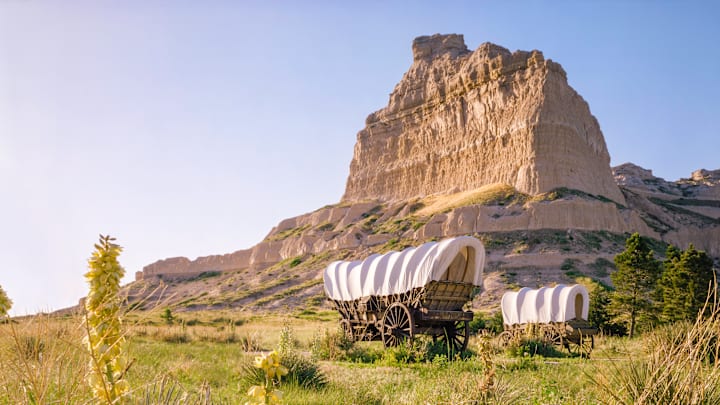
The Oregon Trail was used by Americans who wanted to travel west to the “New Country.” Besides some super early adopters, people really started taking it in the 1840s and continued to use it through the 1880s. They’d acquire a wagon and oxen, load up on supplies, and bring their families along on the months-long journey. Some estimates say half a million people used The Oregon Trail. In fact, it was so well traveled that to this day, you can see wagon ruts in all the states it went through.
But what are the things we get wrong about the infamous trail? Grab your food, ammunition, and spare wagon parts and get ready to debunk some myths about the Oregon Trail, as adapted from the above episode of Misconceptions on YouTube.
- Misconception: The Oregon Trail was full of constant dangers.
- Misconception: The Oregon Trail was a single trail travelers took to go west.
- Misconception: Emigrants hunted for buffalo—and if they didn’t, they went hungry.
- Misconception: It was an isolated journey.
- Misconception: People rode west in big Conestoga wagons pulled by horses.
- Misconception: Most emigrants were impoverished individuals who’d never left home.
Misconception: The Oregon Trail was full of constant dangers.

If you’ve spent hours playing The Oregon Trail on the computer, there’s probably one sentence you’ve seen a lot: “You have died of dysentery.” Nostalgia lovers can buy t-shirts, mugs, pins, and more with that phrase. Well, if you time travel back to the real Oregon Trail in the 1800s, leave your dysentery merch behind—that’s going to hit a little close to home for the travelers who’ve seen what the disease can do.
People usually caught dysentery—a gastrointestinal disease that can lead to death—when they drank bad water on the Oregon Trail. And it wasn’t the only disease to avoid on the Trail. People got cholera, typhoid, malaria, diphtheria, even scurvy. That’s not to mention all the deathly accidents, like drowning or getting run over by a wagon
But, it’s a misconception that death was looming around every corner. Real Oregon Trail travelers were much better at staying alive than 10-year-old kids playing the video game. Of the hundreds of thousands of emigrants, an estimated 4–10 percent died; the vast majority of people made it through.
You May Also Like ...
- Where Are They Now? Diseases That Killed You in ‘Oregon Trail’
- 10 Facts About the Oregon Trail
- Sally Died of Dysentery: A History of ‘The Oregon Trail’
Add Mental Floss as a preferred news source!
Misconception: The Oregon Trail was a single trail travelers took to go west.

People generally refer to “The Oregon Trail” when they’re talking about the around 2000-mile pilgrimage between Independence, Missouri, and Oregon City. The standard route went through Missouri, Kansas, Nebraska, Wyoming, Idaho, and Oregon. But this wasn’t just a single path that all wagons took to get to one endpoint.
The Trail changed from year to year, depending on things like weather and wagon traffic. And as people got to know the land better, some shortcuts popped up. Many different options emerged in Wyoming especially. Over the years, two shortcuts ended up being so effective that they became part of the main route, one in southwestern Wyoming and another in northern Oregon.
With shortcuts came risks, though. The infamous Donner-Reed party got a late start on their journey out west and was attempting to take one called the “Hastings Cutoff” when they got trapped in the Sierra Nevada mountains due to record snows and had to resort to desperate measures—cannibalism, to be more precise—to survive.
You can also imagine that people didn’t want to ride single file through the Great Plains. With all that space, that would’ve been a baffling choice. There was room to spread out—and they did. Two wagons traveling the Oregon Trail could technically be headed to the same place but miles apart from each other.
And many of them weren’t even headed to the same place. Plenty had no interest in Oregon. Only around 80,000 people actually settled in the Willamette Valley, which people tend to call the Oregon Trail’s end point; other travelers branched out to different routes to get to California or modern-day Utah.
And similarly, people were coming from all sorts of places other than Independence, Missouri. As the years went on, the Oregon Trail accommodated people hopping on from many different spots. And where you left from affected the route you’d take. Rather than a single path, you can think of the Oregon Trail as a kind of western moving web.
Misconception: Emigrants hunted for buffalo—and if they didn’t, they went hungry.

If you played the computer game, you hunted for food to survive. Buffalo (which are actually bison) and deer were the big ticket items, and they were pretty critical to making it to the Willamette Valley and winning the game.
In the early years of the Trail, this was more accurate. There were plenty of buffalo, and people in wagon trains might hunt and kill them every day on the plains. But, it was important to have hunters in the group. From the earliest days, we have women’s diaries that describe their husbands as terrible hunters; often these were farmers who didn’t have much hunting experience. Luckily, trade with local Indigenous people for fish and meat was an option.
And by the 1850s, buffalo herds were already thinning. They were overhunted, plus they migrated away from the areas where they were getting shot at daily. By the 1860s, some travelers’ diaries didn't mention buffalo at all. And by the mid-1880s, only about 325 wild buffalo were left in the United States.
People were encouraged to bring many “pounds of food.” The Emigrants' Guide to Oregon and California, a guidebook from 1845, recommended stocking up on between $300 and $600 worth of food, including 200 pounds of flour, 150 pounds of bacon, and 20 pounds of sugar. People also brought along dried fruit, beans, rice, cornmeal, and lots more to munch on.
Misconception: It was an isolated journey.

It’s easy to picture the travel days as peaceful, solo treks through the country, but at the peak of the Oregon Trail era, you probably wouldn't have made it a mile without seeing other people. Sometimes wagons stretched all the way to the horizon.
People typically joined wagon trains that could be made up of hundreds of wagons. Miriam Thompson, whose journey began in May 1845, started out in a train with 480 wagons. These wagon trains were led by people who helped make decisions about things like how to handle river crossings. And when there were flooded rivers, bad weather, or bad trail conditions, there might be literal wagon traffic jams.
As more people used the Trail, more forts and outposts were added alongside it. At forts, people could get food, medicine, and other supplies. The people operating Fort Kearny, in present-day Nebraska, and Fort Laramie, in Wyoming, kept track of how many people passed through: It could be hundreds in a single day.
Also as the years went on, the Trail contained lots of evidence of people, like the trash they left along the way. There was a lot of trash. Especially because some unethical merchants in Missouri started tricking travelers into buying way more supplies than they needed.
By the mid-1850s, Salt Lake City had anything a person might need, including even bathhouses and barber shops. And by 1861, telegraph poles serviced the entire length of the Trail, so travelers could even stay in touch with family back home.
Misconception: People rode west in big Conestoga wagons pulled by horses.

Those wagons were more common between 1820 and 1840. They were used on the East Coast to move goods from place to place, but they were too big and heavy to make the long journey west. Emigrants were already bringing up to 2500 pounds of stuff with them, so they didn’t need their wagon to be heavy, too. Instead, most people used lighter prairie schooners, which could more effectively carry a lot of weight over the uneven trail.
Prairie schooners got their name because the white tops kind of looked like sails from far away. Confusingly, Conestoga wagons are also often compared to boats because they had round, boatlike beds.
Men generally didn't ride in the wagon at all. They walked or rode on horses. Sometimes, women rode in the wagons, but the trail was pretty bumpy, so walking or horseback riding may have been preferable.
Prairie schooners weren't the only option, either. Some people just had handcarts for their belongings, and in the later years, some rode in stagecoaches.
Misconception: Most emigrants were impoverished individuals who’d never left home.

This is actually something the game gets right. In it, you get to choose your occupation. You can be a banker, doctor, farmer, merchant, or something else from a long list of choices. But still, it’s easy to look back on these 19th-century days and think of moving west as something people in poverty did to try to claw their way up the class chain.
In reality, if you wanted to take the Oregon Trail, you usually needed significant funds. In addition to the food, hunting supplies, and the wagon, people were also encouraged to bring plenty more, like tools, ovens, kettles, hatchets, bedding, clothes for all conditions, and so on. It’s estimated that in 1850, it would cost a family $800 to $1200 to acquire everything they needed for their time on the Trail. That’s about $32,000 to $48,000 in today’s money.
This wasn't feasible for the poorest people in the United States. And many of those who did go were landowners who saved up for years and still had to sell their land and a lot of their belongings to afford it.
In Lillian Schlissel’s book Women's Diaries of the Westward Journey, she calls the typical Oregon Trail journeyers “peasant proprietors.” They usually had owned land in the East and they would become landowners again once they landed in the West. As time went on, it became more common to see wealthy people on the Trail. Sometimes, they even brought staff to cook and deal with the animals.
Most of the emigrants had also moved before, usually brought somewhere by their parents when they were young. So this wasn’t a totally new experience. They knew what traveling and starting fresh looked like.