%20%20--%3E%0A%3Csvg%20version%3D%221.1%22%20id%3D%22Layer_1%22%20xmlns%3D%22http%3A%2F%2Fwww.w3.org%2F2000%2Fsvg%22%20xmlns%3Axlink%3D%22http%3A%2F%2Fwww.w3.org%2F1999%2Fxlink%22%20x%3D%220px%22%20y%3D%220px%22%0A%09%20viewBox%3D%220%200%20684.6%2068.1%22%20style%3D%22enable-background%3Anew%200%200%20684.6%2068.1%3B%22%20xml%3Aspace%3D%22preserve%22%3E%0A%3Cg%3E%0A%09%3Cpath%20d%3D%22M444.1%2C29.3h-17.4v14.5h17.4V29.3z%20M36.4%2C68.1l29.3-50.8V0H50.4L32.9%2C36.8L15.5%2C0H0v68.1h16.7V45.8l12.4%2C22.3H36.4z%0A%09%09%20M49.1%2C68.1h16.6V23.4L49.1%2C52.1V68.1z%20M76.6%2C68.1h45V53.8H93.3V41.6h21V27.1h-21V14.8h28.3V0.1h-45V68.1z%20M175.6%2C68.1h17.3v-68%0A%09%09h-16.5v40.3L150%2C0.1h-17.6v68h16.7V27.7L175.6%2C68.1z%20M235.8%2C14.8h15.4V0.1h-47.4v14.7H219v53.2h16.8V14.8z%20M290.3%2C45.9h-17.1%0A%09%09l7.5-15.6h2L290.3%2C45.9z%20M298.7%2C68.1h18l-32.2-68h-5.7l-32%2C68h18l3.3-7.1h27.1L298.7%2C68.1z%20M325.2%2C68.1h46.2V53.8h-29.6V0.1h-16.7%0A%09%09V68.1z%20M423.7%2C14.8h27.2V0.1H407v68h16.7V14.8z%20M462%2C68.1h46.2V53.8h-29.6V0.1H462V68.1z%20M564.8%2C34.1c0%2C10.7-7.2%2C19.2-18.5%2C19.2%0A%09%09c-11.4%2C0-18.5-8.5-18.5-19.2s7.1-19.2%2C18.5-19.2C557.6%2C14.9%2C564.8%2C23.4%2C564.8%2C34.1%20M580.6%2C34.1c0-19-14.2-34-34.3-34%0A%09%09c-20.2%2C0-34.3%2C15-34.3%2C34c0%2C19%2C14.1%2C34%2C34.3%2C34C566.4%2C68.1%2C580.6%2C53.1%2C580.6%2C34.1%20M604.8%2C20.5c0-4.1%2C3.3-6.2%2C6.7-6.2%0A%09%09c4.4%2C0%2C6.6%2C3%2C6.6%2C6.6h14.7C631.8%2C9.1%2C625.1%2C0.1%2C611%2C0.1c-12%2C0-21.7%2C9.3-21.7%2C20.6c0%2C10.9%2C5.9%2C15.9%2C16.7%2C19.8%0A%09%09c5.2%2C1.8%2C11.5%2C3.2%2C11.5%2C8c0%2C3.3-2.4%2C5.5-6.4%2C5.5c-3.6%2C0-6.6-3-6.6-6.7h-15.2c0%2C11.5%2C7.9%2C20.8%2C21.8%2C20.8c12%2C0%2C21.6-9.3%2C21.6-20.6%0A%09%09c0-10-5.3-16.4-16.7-19.8C610.6%2C26.1%2C604.8%2C25.3%2C604.8%2C20.5%20M670%2C20.9h14.7C683.8%2C9.1%2C677.1%2C0.1%2C663%2C0.1c-12%2C0-21.7%2C9.3-21.7%2C20.6%0A%09%09c0%2C10.9%2C5.9%2C15.9%2C16.7%2C19.8c5.2%2C1.8%2C11.5%2C3.2%2C11.5%2C8c0%2C3.3-2.4%2C5.5-6.4%2C5.5c-3.6%2C0-6.6-3-6.6-6.7h-15.2c0%2C11.5%2C7.9%2C20.8%2C21.8%2C20.8%0A%09%09c12%2C0%2C21.6-9.3%2C21.6-20.6c0-10-5.3-16.4-16.7-19.8c-5.4-1.6-11.3-2.4-11.3-7.2c0-4.1%2C3.3-6.2%2C6.7-6.2C667.7%2C14.4%2C670%2C17.3%2C670%2C20.9%0A%09%09%22%2F%3E%0A%3C%2Fg%3E%0A%3C%2Fsvg%3E%0A)

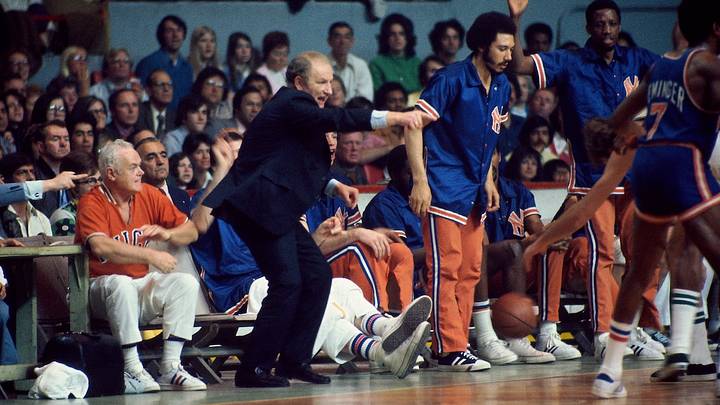
In the summer of 1973, New York City was riding a collective high—and you didn’t even have to walk through the Village to catch the drift. The real buzz that summer was a wave of sports euphoria. Ever since the Knicks clinched the NBA title on May 10, 1973, a semi-permanent celebratory state had settled over the five boroughs.
It was a season of shifts: downtown, a gleaming pair of skyscrapers completely rewrote the Manhattan skyline, while up in Midtown, rock royalty shook the rafters of Madison Square Garden. But before the music started and the concrete dried, the tone for the entire summer was set the moment the world-champion basketball team touched down at the airport.
From the sun-baked asphalt of the streetwide celebrations to the graffiti-stained trains down below, you could feel that signature '70s buzz on every single block—even in the midday Midtown rush. These 10 vintage photos capture the highlight reel of a season when the city truly ruled.
- JFK Jam
- Signs of the Times
- Sub-Culture
- The People’s Playground
- A Swing and a Miss
- Off the Record
- Live from New York
- Good as Gold
- The High-Rising Rivals
JFK Jam

Before the summer of 1973 even had a chance to heat up, the city was already boiling over. On May 12, the New York Knicks touched down at JFK International Airport after dethroning the Los Angeles Lakers on their own court to claim the NBA Championship. The reception was less of a welcome home and more of a glorious riot: Port Authority police found themselves in a full-court press just trying to keep the roaring crowd from swarming the tarmac. It set a manic, victorious tone for a legendary New York summer where the energy simply never simmered down.
Signs of the Times

Today, Times Square is a dizzying eyesore of electronic LED billboards, but back in the summer of 1973, the look was completely different. As seen in this snapshot from the first day of June, almost a month after the Knicks' historic win, the "Crossroads of the World" didn't have a single screen.
Instead of the glowing video animations we see today, the heart of the theater district featured stationary painted panels, flashing colored tubes, and neon signs advertising brands like Coca-Cola and Castro Convertibles. It was a much more mechanical, old-school version of New York’s most famous landmark.
Sub-Culture

From the late 1960s to the early 1970s, New York City's subway system became the ultimate canvas for an emerging generation of graffiti artists. Commuting to the office for transit riders meant routinely sitting inside rolling galleries of spray paint and marker tags, from graffiti pioneer JULIO 204 to the popular TAKI 183. Instead of clean, modern trains, the metallic bodies and glass windows of the Broadway Line served as a moving, city-wide art exhibition.
The People’s Playground

Further down the BMT lines, summer ‘73 was in full swing at the southernmost tip of Brooklyn. Coney Island offered a sun-baked escape from the city's concrete heat, framed by the towering wooden scaffolding of the legendary Cyclone roller coaster. It was a scene defined by boardwalk strollers, cracked pavement, and cheap thrills at the Haunted Mansion. The Knicks may have been ruling Manhattan’s climate-controlled arenas that year, but out here on the shoreline, Brooklynites had their own way of keeping cool.
A Swing and a Miss

While the Knicks were busy conquering the basketball world in mid-May, the city's baseball scene wasn't having quite as much luck. Here, beloved New York Mets first baseman Ed Kranepool takes a swing against the Houston Astros at Shea Stadium in Corona, Queens.
The Mets would go on to lose this May 5 matchup, a defeat that capped off a brutal four-game losing streak and tumbled them from first to third place in the NL East. Though the Mets famously turned things around later that year with their "Ya Gotta Believe" run to the World Series, early May 1973 belonged entirely to the champions over at Madison Square Garden.
Off the Record

In May 1973, John Lennon and Yoko Ono left their apartment in Greenwich Village to move into Manhattan’s iconic Dakota building. Their first weeks on the Upper West Side look like any typical move-in day: a clutter of boxes, electronics, and vinyl records scattered across the bare floor. But the fresh start was short-lived. Later that year, the pair separated, prompting Lennon to spend the next 18 months living in Los Angeles. Looks like the Knicks' win wasn't a fix-all for everything under the Manhattan sun after all.
Live from New York

As the midsummer heat peaked, English rock royalty took over Midtown. Led Zeppelin descended on Madison Square Garden for a legendary three-night stint that encapsulated the electric energy of the era. The final night on July 29 featured frontman Robert Plant and guitarist Jimmy Page commanding a stage that was being filmed for their landmark concert movie, The Song Remains the Same. It was a high-decibel finale to a historic summer in the arena. Apparently, between a Knicks championship banner and Jimmy Page’s double-neck Gibson, the Garden’s rafters were holding up a lot of heavy metal that year.
Good as Gold

Talk about securing the bag. Deep beneath the streets of Manhattan, the gold vault of the Federal Reserve Bank of New York was stacked with roughly $15 billion worth of gold bars in 1973. While that baseline total sounds mind-boggling on its own, the real kicker is how much the value of that subterranean treasure has skyrocketed.
In May 1973, the free market price of gold closed at roughly $100 per troy ounce, capping a colossal spike from the beginning of the year. If you were to calculate the value of that exact same physical haul at today's live spot price of over $4,300 an ounce, that same vault of treasure would be worth a whopping $1.5 trillion.
The High-Rising Rivals

By the summer of 1973, Manhattan's silhouette had been permanently rewritten. Having officially opened just weeks earlier on April 4, the Twin Towers of the World Trade Center now dominated the lower tip of the island, casting a futuristic glow across the harbor. The shiny new skyscrapers stood in stark contrast to the splintered, rotting wooden piers of the Brooklyn waterfront—a perfect snapshot of a city caught between two eras.
Although the newly-crowned concrete “kings” may have made the skyline look extra sparkly the night the Knicks won the championship, down on the hardwood, everyone knew who the real kings of New York were.