%20%20--%3E%0A%3Csvg%20version%3D%221.1%22%20id%3D%22Layer_1%22%20xmlns%3D%22http%3A%2F%2Fwww.w3.org%2F2000%2Fsvg%22%20xmlns%3Axlink%3D%22http%3A%2F%2Fwww.w3.org%2F1999%2Fxlink%22%20x%3D%220px%22%20y%3D%220px%22%0A%09%20viewBox%3D%220%200%20684.6%2068.1%22%20style%3D%22enable-background%3Anew%200%200%20684.6%2068.1%3B%22%20xml%3Aspace%3D%22preserve%22%3E%0A%3Cg%3E%0A%09%3Cpath%20d%3D%22M444.1%2C29.3h-17.4v14.5h17.4V29.3z%20M36.4%2C68.1l29.3-50.8V0H50.4L32.9%2C36.8L15.5%2C0H0v68.1h16.7V45.8l12.4%2C22.3H36.4z%0A%09%09%20M49.1%2C68.1h16.6V23.4L49.1%2C52.1V68.1z%20M76.6%2C68.1h45V53.8H93.3V41.6h21V27.1h-21V14.8h28.3V0.1h-45V68.1z%20M175.6%2C68.1h17.3v-68%0A%09%09h-16.5v40.3L150%2C0.1h-17.6v68h16.7V27.7L175.6%2C68.1z%20M235.8%2C14.8h15.4V0.1h-47.4v14.7H219v53.2h16.8V14.8z%20M290.3%2C45.9h-17.1%0A%09%09l7.5-15.6h2L290.3%2C45.9z%20M298.7%2C68.1h18l-32.2-68h-5.7l-32%2C68h18l3.3-7.1h27.1L298.7%2C68.1z%20M325.2%2C68.1h46.2V53.8h-29.6V0.1h-16.7%0A%09%09V68.1z%20M423.7%2C14.8h27.2V0.1H407v68h16.7V14.8z%20M462%2C68.1h46.2V53.8h-29.6V0.1H462V68.1z%20M564.8%2C34.1c0%2C10.7-7.2%2C19.2-18.5%2C19.2%0A%09%09c-11.4%2C0-18.5-8.5-18.5-19.2s7.1-19.2%2C18.5-19.2C557.6%2C14.9%2C564.8%2C23.4%2C564.8%2C34.1%20M580.6%2C34.1c0-19-14.2-34-34.3-34%0A%09%09c-20.2%2C0-34.3%2C15-34.3%2C34c0%2C19%2C14.1%2C34%2C34.3%2C34C566.4%2C68.1%2C580.6%2C53.1%2C580.6%2C34.1%20M604.8%2C20.5c0-4.1%2C3.3-6.2%2C6.7-6.2%0A%09%09c4.4%2C0%2C6.6%2C3%2C6.6%2C6.6h14.7C631.8%2C9.1%2C625.1%2C0.1%2C611%2C0.1c-12%2C0-21.7%2C9.3-21.7%2C20.6c0%2C10.9%2C5.9%2C15.9%2C16.7%2C19.8%0A%09%09c5.2%2C1.8%2C11.5%2C3.2%2C11.5%2C8c0%2C3.3-2.4%2C5.5-6.4%2C5.5c-3.6%2C0-6.6-3-6.6-6.7h-15.2c0%2C11.5%2C7.9%2C20.8%2C21.8%2C20.8c12%2C0%2C21.6-9.3%2C21.6-20.6%0A%09%09c0-10-5.3-16.4-16.7-19.8C610.6%2C26.1%2C604.8%2C25.3%2C604.8%2C20.5%20M670%2C20.9h14.7C683.8%2C9.1%2C677.1%2C0.1%2C663%2C0.1c-12%2C0-21.7%2C9.3-21.7%2C20.6%0A%09%09c0%2C10.9%2C5.9%2C15.9%2C16.7%2C19.8c5.2%2C1.8%2C11.5%2C3.2%2C11.5%2C8c0%2C3.3-2.4%2C5.5-6.4%2C5.5c-3.6%2C0-6.6-3-6.6-6.7h-15.2c0%2C11.5%2C7.9%2C20.8%2C21.8%2C20.8%0A%09%09c12%2C0%2C21.6-9.3%2C21.6-20.6c0-10-5.3-16.4-16.7-19.8c-5.4-1.6-11.3-2.4-11.3-7.2c0-4.1%2C3.3-6.2%2C6.7-6.2C667.7%2C14.4%2C670%2C17.3%2C670%2C20.9%0A%09%09%22%2F%3E%0A%3C%2Fg%3E%0A%3C%2Fsvg%3E%0A)

The astounding diversity of creatures that we see today is just a sample of nature’s creativity. Through evolution, the Earth has had many episodes of life, each adapted to the often alien-like environments that existed throughout deep time. Whether animals survived or died out depended on the efficiency of their adaptations and, sometimes, on pure luck—Mt. Everest-sized asteroid, anyone?
While all animals are majestic and none are inherently evil, the following prehistoric creatures are nonetheless likely to inspire nightmares.
- Anteosaurus, the Hippo-Sized “Terror Dog” Reptile
- Leedsichthys, the Gigantic Fish
- Kostensuchus, the Mega-Croc Relative That Likely Ate Dinosaurs
- Nanuqsaurus, the Polar Bear Tyrannosaur
- Palaeophis, the Ancient Aquatic Beetlejuice Snake
Anteosaurus, the Hippo-Sized “Terror Dog” Reptile
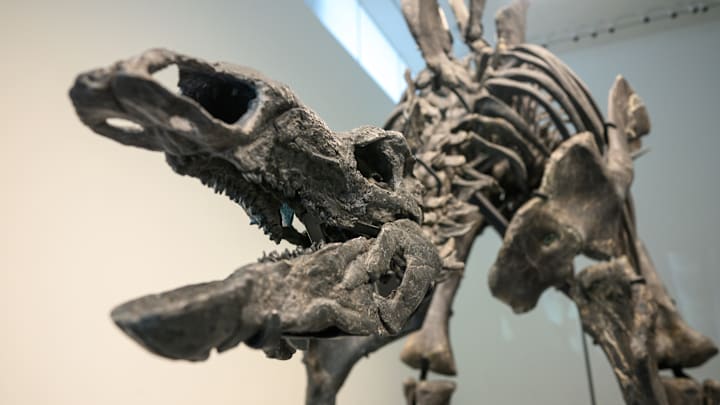
Despite the way its name sounds, Anteosaurus magnificus was not a dinosaur, but it would probably cause any actual dino to wet itself. This hippo-sized terror-beast lived during the middle Permian, circa 260 million to 265 million years ago, when rhinoceros-style reptiles ruled the Earth—a good 30-some million years before the first dinosaurs would emerge.
Anteosaurs were walking tanks with fangs, initially considered sluggish due to their historic size and thickness. But newer research has overturned that supposition. Scientists employed X-ray imaging and 3D modeling to reconstruct their hunting prowess based on their nervous system and sensory capabilities.
The conclusion? Anteosaurus was way more swift and agile than believed, with great tracking abilities, based on the size of certain brain regions. Eventually, the group of animals that Anteosaurs belonged to would evolve into the ancestors of mammals.
Leedsichthys, the Gigantic Fish
The behemoth Leedsichthys problematicus may be one of history’s largest fish. It thrived around 189 million to 144 million years ago, during the real Jurassic period, which featured neither T-Rex nor any velociraptors, which would arise much later.
In addition to its tongue-twisting first name (pronounced leeds-ick-thiss), its second name presents the problem of its size. Due to its fossils, size estimates for this phenomenal fish are contentious, ranging from 30 to more than 70 feet in length and over 50 tons.
Leedsichthys also sported 40,000 needle-like teeth. Yet for its prodigious size and toothiness, it was a gentle giant, like today’s (mammalian) whales. It's believed to have feasted on plankton, gulping up hundreds of gallons per second through its mammoth maw, then sieving it through plates at the back of its mouth to filter its tiny food sources.
This fish is also an outlier that stokes the flames of a modern mystery: why are there no gigantic bony fish today? For perspective, the biggest bony fish is the oddly proportioned ocean sunfish, which grows to about 2 tons. Compare that to the largest cartilaginous, the gentle giant whale shark, which attains more than 30 tons.
For another twist, 95% of fish species are bony. So what’s up with that? It may be that bony fish are “constrained by their metabolism,” as they may not be able to get enough oxygen to support their higher metabolic rate.
But Leedsichthys was apparently able to get enough water streaming through its gills while swimming at speeds of over 11 miles per hour. Compare that to today’s speediest swimmers, which max out at around 18 miles per hour. Therefore, theoretically, researchers conclude there's no reason that a Leedsichthys-sized fish couldn’t exist in modern times.
Kostensuchus, the Mega-Croc Relative That Likely Ate Dinosaurs
Dinosaurs weren’t always predators; sometimes, they were actually prey. To a gigantic crocodile-like hypercarnivore, in this case. For a preface, whenever you see the suffix “-suchus,” something gnarly is likely to follow because that suffix stems from the old-timey Greek “crocodile.”
So, fortunately for fans of gnarly prehistoric animals, a new “-suchus” just dropped: Kostensuchus atrox. This creature, and its kin, are actually relatives of crocodiles and crocodilian in form, or crocodyliform.
Kostensuchus was an apex predator that may have reached almost 12 feet in length and attained a bulk of 550 pounds. It was recently discovered, thanks to a fascinatingly well-preserved fossil from Patagonia, Argentina dating toward the end of the dinosaurian reign, circa 70 million years ago during the Cretaceous.
Then, the area was awash in humid floodplains, rather than the cooler, drier, modern landscape that inspired an expensive brand of puffer jackets. In fact, South America and Africa at this time were extremely crocodile-friendly environments, teeming with a variety of sizes and tastes, including herbivorous species, making these continents the “land of the crocs.”
You May Also Like:
Add Mental Floss as a preferred news source!
Nanuqsaurus, the Polar Bear Tyrannosaur
Before the lethal (but still friend-shaped) polar bears ruled the Arctic, an even more fearsome animal prowled these frozen environments: a polar bear tyrannosaur. Nanuqsaurus is a combination of two of evolution’s most finely tuned hunters, and the “Nanuq” in its name designates this dinosaur as the “polar bear lizard” in the Alaskan Inupiat language.
Even though it’s a tyrannosaurid dinosaur that’s “very closely” related to the almighty Tyrannosaurus rex, this polar version was half the size of its more notorious family member.
Yet that makes this polar pygmy no less terrifying. The National Park Service describes it as a 1,000-pound, 25-foot-long train car steaming at you.
Nanuqsaurus’ most interesting feature is one that’s widely hypothesized: some suggest that it may have been feathered, to some degree, to retain body heat in the chilly Arctic. Of course, said Arctic was a bit different back then.
The Cretaceous Arctic was warmer and more seasonal than it is today, so it wasn’t always snowy. And if any tyrannosaur had feathers, it may have been this one. It may have even molted its potential feathers during warmer, non-snowy seasons.
Palaeophis, the Ancient Aquatic Beetlejuice Snake
Over the past 200 million years, nature has garnished Earth with a treasure trove of weird snakes, including flying snakes, swimming snakes, tentacled snakes, and even snakes with teeny-tiny legs.
Yet nature’s most impressive anguine experiment, in sheer bulk, may be the Palaeophis (“ancient snake”) family, encompassing what may be the largest sea serpent ever: Palaeophis colossaeus, which could reach 40 feet in length.
Other species were smaller but may have resembled Beetlejuice sandworms to make up for it, at least according to one illustration.
These snakes were discovered in more northern climes like North Africa, North America, England, and France. A significant amount of their fossils (vertebrae) date back to the Eocene epoch, which lasted from 56 million to 33.9 million years ago, when the world saw a spectacular diversity of sea snakes with varying levels of aquatic adaptations in their sleekness.
Such snakes inhabited warm, shallow waters like the immense Tethys Sea, which separated the two major landmasses of Gondwana and Laurasia. In these ancient waters, the largest of the Palaeophis clan may have hunted whales, which were then much smaller, as they had recently descended from wolf-sized land prowlers that resembled large, possibly scruffy shrews.
Unfortunately for archaeologists, but most fortunately for surfers and beachgoers, this family of snakes is extinct. The most similar extant serpents, though they’re unrelated, are the semi-aquatic pythons and anacondas of today, which can’t quite reach such superlative lengths.