%20%20--%3E%0A%3Csvg%20version%3D%221.1%22%20id%3D%22Layer_1%22%20xmlns%3D%22http%3A%2F%2Fwww.w3.org%2F2000%2Fsvg%22%20xmlns%3Axlink%3D%22http%3A%2F%2Fwww.w3.org%2F1999%2Fxlink%22%20x%3D%220px%22%20y%3D%220px%22%0A%09%20viewBox%3D%220%200%20684.6%2068.1%22%20style%3D%22enable-background%3Anew%200%200%20684.6%2068.1%3B%22%20xml%3Aspace%3D%22preserve%22%3E%0A%3Cg%3E%0A%09%3Cpath%20d%3D%22M444.1%2C29.3h-17.4v14.5h17.4V29.3z%20M36.4%2C68.1l29.3-50.8V0H50.4L32.9%2C36.8L15.5%2C0H0v68.1h16.7V45.8l12.4%2C22.3H36.4z%0A%09%09%20M49.1%2C68.1h16.6V23.4L49.1%2C52.1V68.1z%20M76.6%2C68.1h45V53.8H93.3V41.6h21V27.1h-21V14.8h28.3V0.1h-45V68.1z%20M175.6%2C68.1h17.3v-68%0A%09%09h-16.5v40.3L150%2C0.1h-17.6v68h16.7V27.7L175.6%2C68.1z%20M235.8%2C14.8h15.4V0.1h-47.4v14.7H219v53.2h16.8V14.8z%20M290.3%2C45.9h-17.1%0A%09%09l7.5-15.6h2L290.3%2C45.9z%20M298.7%2C68.1h18l-32.2-68h-5.7l-32%2C68h18l3.3-7.1h27.1L298.7%2C68.1z%20M325.2%2C68.1h46.2V53.8h-29.6V0.1h-16.7%0A%09%09V68.1z%20M423.7%2C14.8h27.2V0.1H407v68h16.7V14.8z%20M462%2C68.1h46.2V53.8h-29.6V0.1H462V68.1z%20M564.8%2C34.1c0%2C10.7-7.2%2C19.2-18.5%2C19.2%0A%09%09c-11.4%2C0-18.5-8.5-18.5-19.2s7.1-19.2%2C18.5-19.2C557.6%2C14.9%2C564.8%2C23.4%2C564.8%2C34.1%20M580.6%2C34.1c0-19-14.2-34-34.3-34%0A%09%09c-20.2%2C0-34.3%2C15-34.3%2C34c0%2C19%2C14.1%2C34%2C34.3%2C34C566.4%2C68.1%2C580.6%2C53.1%2C580.6%2C34.1%20M604.8%2C20.5c0-4.1%2C3.3-6.2%2C6.7-6.2%0A%09%09c4.4%2C0%2C6.6%2C3%2C6.6%2C6.6h14.7C631.8%2C9.1%2C625.1%2C0.1%2C611%2C0.1c-12%2C0-21.7%2C9.3-21.7%2C20.6c0%2C10.9%2C5.9%2C15.9%2C16.7%2C19.8%0A%09%09c5.2%2C1.8%2C11.5%2C3.2%2C11.5%2C8c0%2C3.3-2.4%2C5.5-6.4%2C5.5c-3.6%2C0-6.6-3-6.6-6.7h-15.2c0%2C11.5%2C7.9%2C20.8%2C21.8%2C20.8c12%2C0%2C21.6-9.3%2C21.6-20.6%0A%09%09c0-10-5.3-16.4-16.7-19.8C610.6%2C26.1%2C604.8%2C25.3%2C604.8%2C20.5%20M670%2C20.9h14.7C683.8%2C9.1%2C677.1%2C0.1%2C663%2C0.1c-12%2C0-21.7%2C9.3-21.7%2C20.6%0A%09%09c0%2C10.9%2C5.9%2C15.9%2C16.7%2C19.8c5.2%2C1.8%2C11.5%2C3.2%2C11.5%2C8c0%2C3.3-2.4%2C5.5-6.4%2C5.5c-3.6%2C0-6.6-3-6.6-6.7h-15.2c0%2C11.5%2C7.9%2C20.8%2C21.8%2C20.8%0A%09%09c12%2C0%2C21.6-9.3%2C21.6-20.6c0-10-5.3-16.4-16.7-19.8c-5.4-1.6-11.3-2.4-11.3-7.2c0-4.1%2C3.3-6.2%2C6.7-6.2C667.7%2C14.4%2C670%2C17.3%2C670%2C20.9%0A%09%09%22%2F%3E%0A%3C%2Fg%3E%0A%3C%2Fsvg%3E%0A)

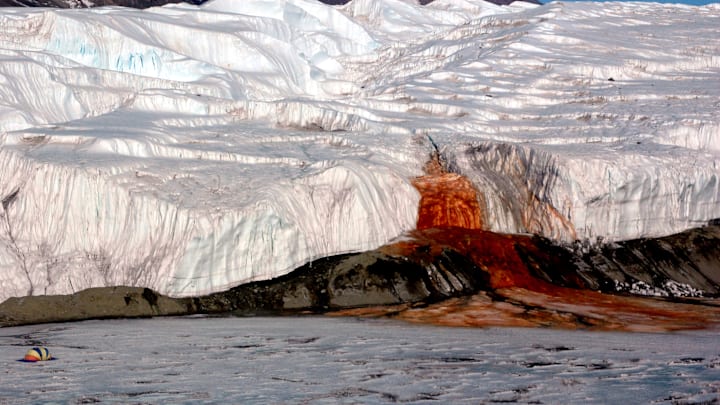

In 1911, a geologist on the ultimately doomed Terra Nova expedition to the South Pole discovered a five-story-tall, blood-red waterfall in the middle of the frozen Antarctic desert lands. The area, known as the McMurdo Dry Valleys, is the largest ice-free region on the continent, and one of the coldest, driest, most Mars-like places on Earth.
The so-called Blood Falls ooze from a crack in Taylor Glacier onto the ice-covered Lake Bonney. Twice as salty as seawater, the red brine never freezes. But why is it so red? It's because of the extremely rich presence of iron in the water, which oxidizes and turns crimson when exposed to air, as a research team led by microbiologist Jill Mikucki discovered in 2009. The team also identified 17 microorganisms in the surface brine. Before then, scientists thought a type of algae might be responsible for the red hue.
Further research discovered microscopic amorphous iron nanospheres in the iron-rich brine, which are packed with silicon, calcium, sodium, and aluminum. These little particles, which lack a crystalline structure, are actually what oxidize upon contact with the air and create the falls' red color, per a 2023 study published in Frontiers in Astronomy and Space Sciences.
Additional research by Mikucki, published in Nature Communications, discovered that the source of Blood Falls is a subglacial lake. They conducted the first-ever landscape-scale survey of subsurface resistivity in Antarctica. They mapped the region using a large airborne electromagnetic (AEM) system called SkyTEM, which was flown via helicopter. As Smithsonian notes, when water freezes, it has higher electrical resistivity. Salt-rich brine, on the other hand, has low resistivity.
You can see a short video of the AEM system here:
According to New Scientist, the sensor detected a 185-meter-long lake beneath the surface near Blood Falls. Nearly devoid of oxygen and trapped a quarter-mile down for 2 million years, the lake nevertheless harbors life, which appears to use sulfate instead of oxygen for respiration. Because the researchers detected large regions of low electrical resistivity beneath the surface, they believe the lake is one of two extensive subsurface brine systems.
As Mikucki told the Washington Post, "We found, as expected, that there was something sourcing Blood Falls…and we found that these brines were more widespread than previously thought. They appear to connect these surface lakes that appear separated on the ground. That means there's the potential for a much more extensive subsurface ecosystem, which I'm pretty jazzed about."
Further research has confirmed that the reason why some water never freezes at the Blood Falls is because some of the water is a hypersaline brine that originated when the Antarctic Ocean receded millions of years ago, which is salty enough to prevent it from freezing and allows it to pour out over the ice.
Most recently, a 2026 study published in Antarctic Science has solved one of the last remaining great mysteries about this strange phenomenon—what actually causes the blood-red jet of water to flow out. The study found that this scarlet stream results from pressure changes in the brine beneath the Taylor Glacier as it slowly hulks downstream. As the glacier moves, it puts immense pressure on the brine beneath it and occasionally causes stores of salty, iron-rich water to emerge and awe the world.
This story was originally published in 2015 and was updated in 2026.