%20%20--%3E%0A%3Csvg%20version%3D%221.1%22%20id%3D%22Layer_1%22%20xmlns%3D%22http%3A%2F%2Fwww.w3.org%2F2000%2Fsvg%22%20xmlns%3Axlink%3D%22http%3A%2F%2Fwww.w3.org%2F1999%2Fxlink%22%20x%3D%220px%22%20y%3D%220px%22%0A%09%20viewBox%3D%220%200%20684.6%2068.1%22%20style%3D%22enable-background%3Anew%200%200%20684.6%2068.1%3B%22%20xml%3Aspace%3D%22preserve%22%3E%0A%3Cg%3E%0A%09%3Cpath%20d%3D%22M444.1%2C29.3h-17.4v14.5h17.4V29.3z%20M36.4%2C68.1l29.3-50.8V0H50.4L32.9%2C36.8L15.5%2C0H0v68.1h16.7V45.8l12.4%2C22.3H36.4z%0A%09%09%20M49.1%2C68.1h16.6V23.4L49.1%2C52.1V68.1z%20M76.6%2C68.1h45V53.8H93.3V41.6h21V27.1h-21V14.8h28.3V0.1h-45V68.1z%20M175.6%2C68.1h17.3v-68%0A%09%09h-16.5v40.3L150%2C0.1h-17.6v68h16.7V27.7L175.6%2C68.1z%20M235.8%2C14.8h15.4V0.1h-47.4v14.7H219v53.2h16.8V14.8z%20M290.3%2C45.9h-17.1%0A%09%09l7.5-15.6h2L290.3%2C45.9z%20M298.7%2C68.1h18l-32.2-68h-5.7l-32%2C68h18l3.3-7.1h27.1L298.7%2C68.1z%20M325.2%2C68.1h46.2V53.8h-29.6V0.1h-16.7%0A%09%09V68.1z%20M423.7%2C14.8h27.2V0.1H407v68h16.7V14.8z%20M462%2C68.1h46.2V53.8h-29.6V0.1H462V68.1z%20M564.8%2C34.1c0%2C10.7-7.2%2C19.2-18.5%2C19.2%0A%09%09c-11.4%2C0-18.5-8.5-18.5-19.2s7.1-19.2%2C18.5-19.2C557.6%2C14.9%2C564.8%2C23.4%2C564.8%2C34.1%20M580.6%2C34.1c0-19-14.2-34-34.3-34%0A%09%09c-20.2%2C0-34.3%2C15-34.3%2C34c0%2C19%2C14.1%2C34%2C34.3%2C34C566.4%2C68.1%2C580.6%2C53.1%2C580.6%2C34.1%20M604.8%2C20.5c0-4.1%2C3.3-6.2%2C6.7-6.2%0A%09%09c4.4%2C0%2C6.6%2C3%2C6.6%2C6.6h14.7C631.8%2C9.1%2C625.1%2C0.1%2C611%2C0.1c-12%2C0-21.7%2C9.3-21.7%2C20.6c0%2C10.9%2C5.9%2C15.9%2C16.7%2C19.8%0A%09%09c5.2%2C1.8%2C11.5%2C3.2%2C11.5%2C8c0%2C3.3-2.4%2C5.5-6.4%2C5.5c-3.6%2C0-6.6-3-6.6-6.7h-15.2c0%2C11.5%2C7.9%2C20.8%2C21.8%2C20.8c12%2C0%2C21.6-9.3%2C21.6-20.6%0A%09%09c0-10-5.3-16.4-16.7-19.8C610.6%2C26.1%2C604.8%2C25.3%2C604.8%2C20.5%20M670%2C20.9h14.7C683.8%2C9.1%2C677.1%2C0.1%2C663%2C0.1c-12%2C0-21.7%2C9.3-21.7%2C20.6%0A%09%09c0%2C10.9%2C5.9%2C15.9%2C16.7%2C19.8c5.2%2C1.8%2C11.5%2C3.2%2C11.5%2C8c0%2C3.3-2.4%2C5.5-6.4%2C5.5c-3.6%2C0-6.6-3-6.6-6.7h-15.2c0%2C11.5%2C7.9%2C20.8%2C21.8%2C20.8%0A%09%09c12%2C0%2C21.6-9.3%2C21.6-20.6c0-10-5.3-16.4-16.7-19.8c-5.4-1.6-11.3-2.4-11.3-7.2c0-4.1%2C3.3-6.2%2C6.7-6.2C667.7%2C14.4%2C670%2C17.3%2C670%2C20.9%0A%09%09%22%2F%3E%0A%3C%2Fg%3E%0A%3C%2Fsvg%3E%0A)

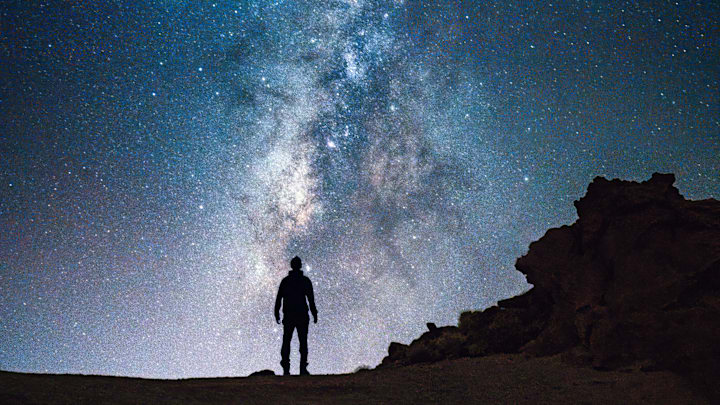
Space can be a tricky subject to wrap your head around. The below space facts—adapted from an episode of The List Show on YouTube—will likely warp your mind.
- Space isn’t that far away.
- You could hypothetically drive to the moon in under a year.
- The asteroid belt isn’t actually that densely packed with asteroids.
- There’s a lot of space junk traveling around Earth.
- Time works very differently in space.
- The sun is so big, it accounts for most of our solar system’s mass.
- We only know what a very small part of space is made of.
- Our galaxy contains an enormous supermassive black hole that could consume entire stars.
- It takes Earth a really, really long time to travel around our galaxy.
- Earth’s daily rotation is faster than you probably realize.
- The supernovas we see often happened thousands of years ago.
Space isn’t that far away.

Space is inaccessible to the vast majority of us, but it’s not as far away as you might think. The von Kármán Line, which is the official boundary between space and the Earth’s atmosphere, is only 62 miles above sea level. If you were somehow able to drive a car straight up at 50 miles per hour, you would reach space in an hour and 15 minutes. That’s shorter than some people’s daily commutes.
You could hypothetically drive to the moon in under a year.

Based on the perception-shifting space fact from the intro, you may be surprised to hear just how far away the moon really is. While the exact number varies throughout the lunar cycle, the average distance comes out to 238,855 miles. If you were to drive to the moon at the same speed posed in our last hypothetical, it would take you nearly 200 days to get there. To help you visualize that distance, imagine all the other planets in our solar system. Squeezed side-by-side, you could technically fit them all between the Earth and the moon—under the right conditions. They would only fit when the moon is at its apogee, or its farthest distance from our planet in its cycle. And no, Pluto is not included in this calculation.
You May Also Like ...
- 24 Fascinating Facts About the Solar System
- The Right Way to Pronounce ‘Uranus,’ According to Experts
- Quiz: Was This Object Left on the Moon?
Add Mental Floss as a preferred news source!
The asteroid belt isn’t actually that densely packed with asteroids.

Now that you’ve processed that distance, picture our solar system’s asteroid belt. Science fiction would have you believe that flying a spaceship through an asteroid field is a bit like sprinting through a minefield. In reality, traversing it would require little to no fancy maneuvering. That’s because the average distance between asteroids in the region is more than double the distance between the Earth and the moon. Every spacecraft that’s ventured to Jupiter and beyond has safely crossed it.
There’s a lot of space junk traveling around Earth.

But Earth has its own sorta minefield. In the Lower Earth Orbit or LEO, there is a ton of space junk flying around. And no, not a handful of giant pieces of broken satellites, literally millions of pieces of debris, most of which are too small to track. And if a cloud of space trash doesn’t sound too intimidating, just know that most are traveling roughly seven times as fast as a bullet.
Time works very differently in space.

The way time works in space is also hard to wrap your head around. Take Venus—our neighbor takes 225 Earth days to orbit the sun, which isn’t too dramatic of a difference from the 365 days it takes our planet. Things start to get trippy when you measure days on the second planet from the sun. It takes Venus 243 Earth days to complete one full rotation around its axis, which means its days are longer than its years.
The sun is so big, it accounts for most of our solar system’s mass.

The sun is obviously the largest body in our corner of the universe, but it’s difficult to comprehend just how massive it is. It accounts for 99.8 percent of all the mass in our solar system. That means all the planets, comets, and asteroids orbiting around it make up less than .2 percent. The sun’s mass exceeds the Earth’s more than 333,000 times over. To put things on a human scale, if the sun were the size of a basketball, the Earth would be no larger than a pinhead.
We only know what a very small part of space is made of.

When you think of space, you likely picture planets, stars, and comets. In reality, these visible celestial bodies make up just a fraction of the universe—4 percent, to be precise. So does that mean the other 96 percent is just empty space? Scientists used to think this was the case, but they now know that most of the universe is made up of dark matter and dark energy. These essential components of space don’t reflect, absorb, or radiate light, which makes them difficult to study. What they are exactly remains a mystery. One theory is that they’re made of totally new kinds of particles that science has yet to identify.
Our galaxy contains an enormous supermassive black hole that could consume entire stars.

At the center of our galaxy sits Sagittarius A*—a supermassive black hole capable of consuming entire stars. It’s 4 million times as massive as our sun. Crossing the black hole’s event horizon, or point of no return, would spell certain death for an unlucky space explorer—but fortunately we don’t have to worry about that on Earth. That region of our galaxy is located about 26,000 light-years away, which is more than a comfortably safe distance.
It takes Earth a really, really long time to travel around our galaxy.

Sagittarius A*’s impressive 14.6 million-mile diameter is just a small fraction of the galaxy’s total size. The Milky Way’s width adds up to 100,000 light-years. And just as the Earth makes its yearly orbit around the sun, our solar system is making its way around the galaxy—albeit on a much longer timeline. It takes us 225 million years to complete a full circuit. Since the sun formed 4.6 billion years ago, it’s only completed the trip 20 times. When dinosaurs roamed the Earth’s surface during the Cretaceous period, our planet was sitting on the opposite side of the galaxy from where it is today, and it will take another 100 million years to reach that spot again.
Earth’s daily rotation is faster than you probably realize.

Even not taking its odyssey around the Milky Way into consideration, Earth is constantly on the move. It makes its daily rotation at an approximate rate of 1000 mph at the equator, and slower as you move towards the poles. That means that even when you’re asleep in bed, you’re traveling faster than the speed of sound without realizing it. While our home planet rotates around its axis, it’s also revolving around the sun at a rate of 67,000 mph. If you were traveling that fast in a plane, it would take you 6 minutes to fly from Tokyo to New York City. Luckily the Earth moves at a constant rate, so this motion is imperceptible to us—but it’s still fun to imagine yourself riding a giant amusement park ride through space the next time you’re bored.
The supernovas we see often happened thousands of years ago.

Stargazers are occasionally treated to supernovas—or the brilliant explosions that occur at the end of a star’s life cycle. If you’re ever lucky enough to witness one of these celestial events, you’ll be viewing it not only through the vast expanse of space, but also through time. All the visible stars in the sky besides the sun are light years away, which means it takes their visual information a long time—in some cases, millennia—to reach our eyes. So a supernova that’s visible from Earth today is basically just a transmission of an event that happened thousands of years ago. In addition to making you feel small, space also has a way of making life feel very short.