%20%20--%3E%0A%3Csvg%20version%3D%221.1%22%20id%3D%22Layer_1%22%20xmlns%3D%22http%3A%2F%2Fwww.w3.org%2F2000%2Fsvg%22%20xmlns%3Axlink%3D%22http%3A%2F%2Fwww.w3.org%2F1999%2Fxlink%22%20x%3D%220px%22%20y%3D%220px%22%0A%09%20viewBox%3D%220%200%20684.6%2068.1%22%20style%3D%22enable-background%3Anew%200%200%20684.6%2068.1%3B%22%20xml%3Aspace%3D%22preserve%22%3E%0A%3Cg%3E%0A%09%3Cpath%20d%3D%22M444.1%2C29.3h-17.4v14.5h17.4V29.3z%20M36.4%2C68.1l29.3-50.8V0H50.4L32.9%2C36.8L15.5%2C0H0v68.1h16.7V45.8l12.4%2C22.3H36.4z%0A%09%09%20M49.1%2C68.1h16.6V23.4L49.1%2C52.1V68.1z%20M76.6%2C68.1h45V53.8H93.3V41.6h21V27.1h-21V14.8h28.3V0.1h-45V68.1z%20M175.6%2C68.1h17.3v-68%0A%09%09h-16.5v40.3L150%2C0.1h-17.6v68h16.7V27.7L175.6%2C68.1z%20M235.8%2C14.8h15.4V0.1h-47.4v14.7H219v53.2h16.8V14.8z%20M290.3%2C45.9h-17.1%0A%09%09l7.5-15.6h2L290.3%2C45.9z%20M298.7%2C68.1h18l-32.2-68h-5.7l-32%2C68h18l3.3-7.1h27.1L298.7%2C68.1z%20M325.2%2C68.1h46.2V53.8h-29.6V0.1h-16.7%0A%09%09V68.1z%20M423.7%2C14.8h27.2V0.1H407v68h16.7V14.8z%20M462%2C68.1h46.2V53.8h-29.6V0.1H462V68.1z%20M564.8%2C34.1c0%2C10.7-7.2%2C19.2-18.5%2C19.2%0A%09%09c-11.4%2C0-18.5-8.5-18.5-19.2s7.1-19.2%2C18.5-19.2C557.6%2C14.9%2C564.8%2C23.4%2C564.8%2C34.1%20M580.6%2C34.1c0-19-14.2-34-34.3-34%0A%09%09c-20.2%2C0-34.3%2C15-34.3%2C34c0%2C19%2C14.1%2C34%2C34.3%2C34C566.4%2C68.1%2C580.6%2C53.1%2C580.6%2C34.1%20M604.8%2C20.5c0-4.1%2C3.3-6.2%2C6.7-6.2%0A%09%09c4.4%2C0%2C6.6%2C3%2C6.6%2C6.6h14.7C631.8%2C9.1%2C625.1%2C0.1%2C611%2C0.1c-12%2C0-21.7%2C9.3-21.7%2C20.6c0%2C10.9%2C5.9%2C15.9%2C16.7%2C19.8%0A%09%09c5.2%2C1.8%2C11.5%2C3.2%2C11.5%2C8c0%2C3.3-2.4%2C5.5-6.4%2C5.5c-3.6%2C0-6.6-3-6.6-6.7h-15.2c0%2C11.5%2C7.9%2C20.8%2C21.8%2C20.8c12%2C0%2C21.6-9.3%2C21.6-20.6%0A%09%09c0-10-5.3-16.4-16.7-19.8C610.6%2C26.1%2C604.8%2C25.3%2C604.8%2C20.5%20M670%2C20.9h14.7C683.8%2C9.1%2C677.1%2C0.1%2C663%2C0.1c-12%2C0-21.7%2C9.3-21.7%2C20.6%0A%09%09c0%2C10.9%2C5.9%2C15.9%2C16.7%2C19.8c5.2%2C1.8%2C11.5%2C3.2%2C11.5%2C8c0%2C3.3-2.4%2C5.5-6.4%2C5.5c-3.6%2C0-6.6-3-6.6-6.7h-15.2c0%2C11.5%2C7.9%2C20.8%2C21.8%2C20.8%0A%09%09c12%2C0%2C21.6-9.3%2C21.6-20.6c0-10-5.3-16.4-16.7-19.8c-5.4-1.6-11.3-2.4-11.3-7.2c0-4.1%2C3.3-6.2%2C6.7-6.2C667.7%2C14.4%2C670%2C17.3%2C670%2C20.9%0A%09%09%22%2F%3E%0A%3C%2Fg%3E%0A%3C%2Fsvg%3E%0A)

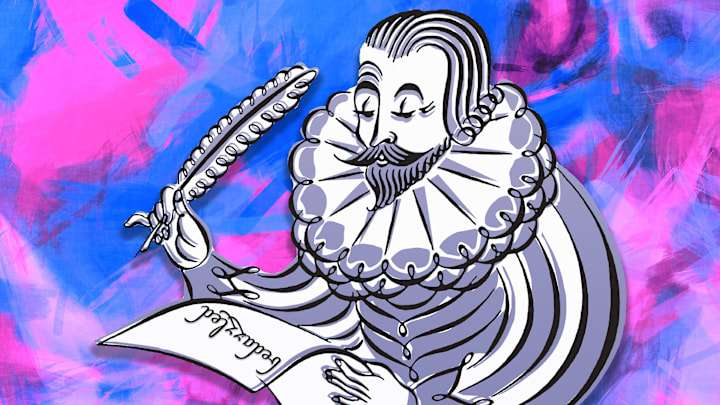
No high school English curriculum is complete without a mandatory dose of William Shakespeare, and no American teenager makes it to graduation without whining about how boring it is to learn about iambic pentameter. As contemporary speakers of the English language, however, they might be interested to learn how much the Bard of Avon had in common with the generations that popularized LOL and OMG and reinvented the early 20th century slang term hipster.
Shakespeare is the first known citation for over a thousand words and even more meanings—a diverse collection that has become a staple of everyday language. But just as OMG is older than you might think (it first appeared in a 1917 letter to Winston Churchill), the history of words is rarely straightforward, especially as more and more obscure old texts become easily searchable. Scholars continually update the OED, and new research occasionally shows that Shakespeare actually didn't originate some phrases, a trend that will likely continue over time.
With that in mind, here are 21 examples of words that Shakespeare is the oldest known source for—as well as four we used to attribute to him, but no longer do.
1. Advertising
Example: “As I was then advertising and holy to your business, not changing heart with habit, I am still attorneyed at your service.” —Duke Vincentio in Measure for Measure, Act V, Scene I
Shakespeare’s usage meant “attending, attentive.”
2. Arch-villain

Example: “You that way and you this, but two in company; each man apart, all single and alone, yet an arch-villain keeps him company.” —Timon in Timon of Athens, Act V, Scene I
With the added prefix of arch-, meaning “more extreme than others of the same type,” Shakespeare was able to distinguish the baddest of the bad.
3. Ballad-Monger
Example: “I had rather be a kitten and cry mew, than one of these same metre ballad-mongers.” —Hotspur in Henry IV, Part 1, Act III, Scene I
Step one: Bring back Elizabethan-era balladry. Step two: Bring back the word ballad-monger to describe their makers.
4. Bedazzled
Example: “Pardon, old father, my mistaking eyes, that have been so bedazzled with the sun that everything I look on seemeth green.” —Kate in The Taming of the Shrew, Act IV, Scene V
A word used to describe what the sun does to your eyesight is now used to sell rhinestone-embellished jeans. Huh.
5. Belongings
Example: “Thyself and thy belongings are not thine own so proper as to waste thyself upon thy virtues, they on thee.” —Duke Vincentio in Measure for Measure, Act I, Scene I
According to the Oxford English Dictionary, this isn’t belongings in the “stuff” sense—that’s a few centuries in the future—but instead means “A circumstance connected with a person or thing; something which relates to a person or thing.”
6. Cold-blooded
Example: “Thou cold-blooded slave, hast thou not spoke like thunder on my side, been sworn my soldier, bidding me depend upon thy stars, thy fortune and thy strength? And dost thou now fall over to my foes?” —Constance in King John, Act III, Scene I
Beyond its literal meaning, the play initiated a metaphorical use for the term cold-blooded that is now most often used to describe serial killers and vampires.
7. Disturbed
Example: “He sees her coming and begins to glow/Even as a dying coal revives with wind/And with his bonnet hides his angry brow/Looks on the dull earth with disturbed mind/Taking no notice that she is so nigh/For all askance he holds her in his eye.” —“Venus and Adonis,” 1593
Shakespeare was quite fond of dis- words, giving us discandy (“to melt”), disedge (“to blunt”), disorb (“to remove from its orb or sphere”), and disseat—not deceit, but to “remove someone from a seat.”
8. Eventful
Example: “Last scene of all, that ends this strange eventful history, is second childishness and mere oblivion, sans teeth, sans eyes, sans taste, sans everything.” —Jaques in As You Like It, Act II, Scene VII
If all the world’s a stage, it’s safe to assume that an event or two is taking place.
9. Eyeball

Example: “Go make thyself like a nymph o’ the sea: be subject to no sight but thine and mine, invisible to every eyeball else.” —Prospero in The Tempest, Act I, Scene II
Shakespeare’s protagonist Prospero, though no medical doctor, was at least able to see what he saw. (According to the OED, eyeball was used earlier to mean “the visible part of the eye,” but credit Shakespeare with first using the word to refer to the whole eyeball.)
10. Fashionable
Example: “For time is like a fashionable host that slightly shakes his parting guest by the hand, and with his arms outstretch’d, as he would fly, grasps in the comer: welcome ever smiles, and farewell goes out sighing.” —Ulysses in Troilus and Cressida, Act III, Scene III
And with just 11 letters, centuries of debate over what’s hot or not began.
11. And 12. Half-Blooded and Hot-Blooded
Example: “Half-blooded fellow, yes.” —Albany in King Lear, Act V, Scene III
Example: “Why, the hot-blooded France, that dowerless took our youngest born, I could as well be brought to knee his throne, and, squire-like; pension beg to keep base life afoot.” —Lear in King Lear, Act II, Scene IV
As is the tradition in Shakespearean tragedy, nearly everyone in King Lear dies, so the linguistic fascination with blood is unsurprising, to say the least.
13. Inaudible

Example: “Let’s take the instant by the forward top; for we are old, and on our quick’st decrees the inaudible and noiseless foot of Time steals ere we can effect them.” —King of France in All’s Well That Ends Well, Act V, Scene III
One of a number of words (including indistinguishable and inauspicious, among others) which Shakespeare invented only in the sense of adding a negative in- prefix where it had never been before.
14. Ladybird
Example: “What, lamb! What, ladybird! God forbid! Where’s this girl? What, Juliet!” —Nurse in Romeo and Juliet, Act I, Scene III
Although the OED notes that this particular term of endearment has fallen into disuse, maybe it’s about time for its comeback.
15. Misquote
Example: “Look how we can, or sad or merrily, interpretation will misquote our looks.” —Worcester in Henry IV, Part I, Act V, Scene II
Though it’s not quite the modern meaning (the OED defines this misquote as “To mark down or interpret incorrectly,” with the modern meaning coming decades later), for someone who is surely one of the misquoted authors of all time, there’s something oddly poetic about the first citation of this particular word being Shakespearean.
16. Multitudinous
Example: “No, this my hand will rather the multitudinous seas in incarnadine, making the green one red.” —Macbeth in Macbeth, Act II, Scene II
The OED cites Shakespeare as originating two different meanings of multitudinous; this one, which describes a body of water, and “Of or relating to the populace or common people,” in Coriolanus.
17. Outstay
Example: “If you outstay the time, upon mine honor/And in the greatness of my word, you die.” —Duke Frederick in As You Like It, Act I, Scene III
Next time you outstay your welcome, you can at least know you’re not being banished.
18. Pageantry

Example: “This, my last boon, give me, for such kindness must relieve me, that you aptly will suppose what pageantry, what feats, what shows, what minstrelsy, and pretty din, the regent made in Mytilene to greet the king.” —Gower in Pericles, Prince of Tyre, Act V, Scene II
Although modern scholars generally agree that Shakespeare only appears to have written the second half of Pericles, Prince of Tyre, this newly invented term for an extravagant ceremonial display appears in the section definitely authored by the Bard.
19. Scuffle
Example: “His captain’s heart, which in the scuffles of great fights hath burst the buckles on his breast, reneges all temper, and is become the bellows and the fan to cool a gipsy’s lust.” —Philo in Antony and Cleopatra, Act I, Scene I
An example of an existing verb that Shakespeare decided could stand up just as well as a noun.
20. Swagger

Example: “What hempen home-spuns have we swaggering here, so near the cradle of the fairy queen?” —Puck in A Midsummer Night’s Dream, Act III, Scene I
By extension, Shakespeare is responsible for Justin Bieber’s “swag.”
21. Uncomfortable
Example: “Despised, distressed, hated, martyr’d, kill’d! Uncomfortable time, why cam’st thou now to murder, murder our solemnity?” —Capulet in Romeo and Juliet, Act IV, Scene V
Un- was another prefix Shakespeare appended to adjectives with a liberal hand. In the case of Romeo and Juliet, a tragedy in which a father mourns his daughter’s suicide, uncomfortable seems to have originated with a slightly more drastic sense than how we use it now.
Just because the first written instances of these terms appeared in Shakespeare’s works doesn’t preclude the possibility that they existed prior to his recording them. Here are some words that were attributed to Shakespeare when we first published this piece, but are now traced back to a different source.
1. Addiction
Example: “It is Othello’s pleasure, our noble and valiant general, that, upon certain tidings now arrived, importing the mere perdition of the Turkish fleet, every man put himself into triumph; some to dance, some to make bonfires, each man to what sport and revels his addiction leads him.” —Herald in Othello, Act II, Scene II
The addiction Shakespeare speaks of isn’t the modern usage (the OED takes “The state or condition of being dedicated or devoted to a thing” back to around 1532) but rather an obsolete alternate definition meaning “predilection.” But Shakespeare has lost his title to even that sense, with the OED now saying historian John Foxe first used the term in 1570.
It gets worse for the Bard: The first printing of Macbeth in 1622 doesn’t have addiction at all—it’s “revels his minde leads him” (emphasis added). In 1623, minde became addition, and only became addiction in a 1630 printing of Othello, 14 years after Shakespeare’s death.
2. Assassination

Example: “If it were done when ’tis done, then ’twere well it were done quickly: if the assassination could trammel up the consequence, and catch with his surcease success.” —Macbeth in Macbeth, Act I, Scene VII
If you were to check your second edition of the OED (a.k.a. OED2), it would date the first known usage of assassination to Macbeth and 1605. But these days, the OED says that the first usage is in 1610’s lengthily titled A lamentable discourse, vpon the paricide and bloudy assasination: committed on the person of Henry the fourth (of famous memorie) King of France and Navarre. But it seems neither is right and the OED is missing the actual title holder. The OED’s first citation isn’t necessarily the first usage—or even the oldest usage—that researchers have uncovered. Historian K.J. Kesselring found a 1572 letter mentioning “treason, conspiracy, insurrection, assassination, empoisonment, and utter destruction to the state,” meaning the word likely predates the OED’s reference—and Shakespeare—by decades.
3. Dishearten
Example: “Therefore when he sees reason of fears, as we do, his fears, out of doubt, be of the same relish as ours are: yet, in reason, no man should possess him with any appearance of fear, lest he, by showing it, should dishearten his army.” —King Henry V in Henry V, Act IV, Scene I
The OED2’s first citation for dishearten is 1599’s Henry V, which is followed by William Warner’s 1606 A continuance of Albions England. But in the third edition of the OED (or OED3), Warner takes the lead, and Henry V is demoted to second place. This wasn’t due to a shocking Henry V related discovery; it was just a policy change. As OED expert Professor Charlotte Brewer explained it, “Plays cited from the first folio, published in 1623, are now dated ‘a1616’ (i.e. ‘before 1616,’ Shakespeare’s date of death), which means that a number of OED2’s first citations have been demoted on arguably artificial grounds” [PDF]. So while Henry V can be reasonably dated to 1599, because dishearten wasn’t published in a play in Shakespeare’s lifetime, it gets demoted. (This is also what happened to assassination, which now has a date of a1616.)
4. Manager

Example: “Where is our usual manager of mirth? What revels are in hand? Is there no play to ease the anguish of a torturing hour?” —Theseus in A Midsummer Night’s Dream, Act V, Scene I
The OED gives two citations for manager in 1598: One in Shakespeare’s Love’s Labour’s Lost, and one in John Florio’s A Worlde of Wordes. But this is a case where Shakespeare might have the better claim: Love's Labour's Lost says both (in modernized spelling), “As it was presented before her Highness this last Christmas” and “Newly corrected and augmented by W. Shakespeare.”
The reference to a performance for the Queen “last Christmas” suggests the play was performed at the 1597/8 Christmas season, while the “Newly corrected” is taken to mean that a lost text existed at some point. That view was given support in 2002, when it was discovered that, in the 17th century, one viscount's library contained a “Loves Labours Lost by W: Sha: 1597.”
Read More Articles About Shakespeare:
A version of this story ran in 2013; it has been updated for 2024.