%20%20--%3E%0A%3Csvg%20version%3D%221.1%22%20id%3D%22Layer_1%22%20xmlns%3D%22http%3A%2F%2Fwww.w3.org%2F2000%2Fsvg%22%20xmlns%3Axlink%3D%22http%3A%2F%2Fwww.w3.org%2F1999%2Fxlink%22%20x%3D%220px%22%20y%3D%220px%22%0A%09%20viewBox%3D%220%200%20684.6%2068.1%22%20style%3D%22enable-background%3Anew%200%200%20684.6%2068.1%3B%22%20xml%3Aspace%3D%22preserve%22%3E%0A%3Cg%3E%0A%09%3Cpath%20d%3D%22M444.1%2C29.3h-17.4v14.5h17.4V29.3z%20M36.4%2C68.1l29.3-50.8V0H50.4L32.9%2C36.8L15.5%2C0H0v68.1h16.7V45.8l12.4%2C22.3H36.4z%0A%09%09%20M49.1%2C68.1h16.6V23.4L49.1%2C52.1V68.1z%20M76.6%2C68.1h45V53.8H93.3V41.6h21V27.1h-21V14.8h28.3V0.1h-45V68.1z%20M175.6%2C68.1h17.3v-68%0A%09%09h-16.5v40.3L150%2C0.1h-17.6v68h16.7V27.7L175.6%2C68.1z%20M235.8%2C14.8h15.4V0.1h-47.4v14.7H219v53.2h16.8V14.8z%20M290.3%2C45.9h-17.1%0A%09%09l7.5-15.6h2L290.3%2C45.9z%20M298.7%2C68.1h18l-32.2-68h-5.7l-32%2C68h18l3.3-7.1h27.1L298.7%2C68.1z%20M325.2%2C68.1h46.2V53.8h-29.6V0.1h-16.7%0A%09%09V68.1z%20M423.7%2C14.8h27.2V0.1H407v68h16.7V14.8z%20M462%2C68.1h46.2V53.8h-29.6V0.1H462V68.1z%20M564.8%2C34.1c0%2C10.7-7.2%2C19.2-18.5%2C19.2%0A%09%09c-11.4%2C0-18.5-8.5-18.5-19.2s7.1-19.2%2C18.5-19.2C557.6%2C14.9%2C564.8%2C23.4%2C564.8%2C34.1%20M580.6%2C34.1c0-19-14.2-34-34.3-34%0A%09%09c-20.2%2C0-34.3%2C15-34.3%2C34c0%2C19%2C14.1%2C34%2C34.3%2C34C566.4%2C68.1%2C580.6%2C53.1%2C580.6%2C34.1%20M604.8%2C20.5c0-4.1%2C3.3-6.2%2C6.7-6.2%0A%09%09c4.4%2C0%2C6.6%2C3%2C6.6%2C6.6h14.7C631.8%2C9.1%2C625.1%2C0.1%2C611%2C0.1c-12%2C0-21.7%2C9.3-21.7%2C20.6c0%2C10.9%2C5.9%2C15.9%2C16.7%2C19.8%0A%09%09c5.2%2C1.8%2C11.5%2C3.2%2C11.5%2C8c0%2C3.3-2.4%2C5.5-6.4%2C5.5c-3.6%2C0-6.6-3-6.6-6.7h-15.2c0%2C11.5%2C7.9%2C20.8%2C21.8%2C20.8c12%2C0%2C21.6-9.3%2C21.6-20.6%0A%09%09c0-10-5.3-16.4-16.7-19.8C610.6%2C26.1%2C604.8%2C25.3%2C604.8%2C20.5%20M670%2C20.9h14.7C683.8%2C9.1%2C677.1%2C0.1%2C663%2C0.1c-12%2C0-21.7%2C9.3-21.7%2C20.6%0A%09%09c0%2C10.9%2C5.9%2C15.9%2C16.7%2C19.8c5.2%2C1.8%2C11.5%2C3.2%2C11.5%2C8c0%2C3.3-2.4%2C5.5-6.4%2C5.5c-3.6%2C0-6.6-3-6.6-6.7h-15.2c0%2C11.5%2C7.9%2C20.8%2C21.8%2C20.8%0A%09%09c12%2C0%2C21.6-9.3%2C21.6-20.6c0-10-5.3-16.4-16.7-19.8c-5.4-1.6-11.3-2.4-11.3-7.2c0-4.1%2C3.3-6.2%2C6.7-6.2C667.7%2C14.4%2C670%2C17.3%2C670%2C20.9%0A%09%09%22%2F%3E%0A%3C%2Fg%3E%0A%3C%2Fsvg%3E%0A)

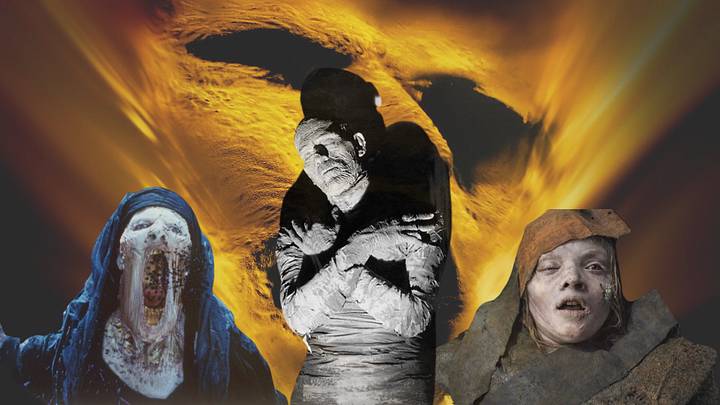
Few monsters in movie history have been resurrected quite as often as The Mummy. Since its 1932 debut as part of the Universal Monsters universe, the franchise has lurched from atmospheric horror to action-packed adventure to full-blown reboot territory, proving that some curses are harder to break than others.
With Lee Cronin’s The Mummy bringing the creature back once again—and The Mummy 4 already on the horizon—it's the perfect time to look back at the films that came before it, from Boris Karloff’s original performance to Brendan Fraser’s blockbuster reinvention—and all the gory, gritty entries (and entities) in between. Using critical reception and cultural impact as our guide, we’ve ranked the major Mummy movies from least to most cursed.
- The Mummy (1932)
- The Mummy (1999)
- The Mummy’s Hand (1940)
- Lee Cronin’s The Mummy (2026)
- The Mummy Returns (2001)
- Abbott and Costello Meet The Mummy (1955)
- The Mummy (2017)
- The Mummy: Tomb of The Dragon Emperor (2008)
The Mummy (1932)
The Mummy movie that started it all stars Boris Karloff as Imhotep, an ancient Egyptian priest resurrected in modern-day Cairo, blending supernatural horror with a tragic love story between the titular monster and Ankh-es-en-Amon (Zita Johann). Unlike later entries, the film leans into atmosphere and restraint, favoring slow-building dread over action.
Partly inspired by the discovery of King Tutankhamun’s tomb in 1922 and the "curse" lore that followed, the original Mummy movie helped define the Universal Monster era and set the template for decades of mummy-related storytelling. Widely regarded as a classic, the movie's eerie tone and Karloff’s iconic performance continue to hold up, making it one of the least cursed films in the franchise.
The Mummy (1999)
Stephen Sommers’s 1999 reboot of The Mummy trades slow-burn horror for Indiana Jones–esque action-adventure, following a group of explorers who accidentally awaken Imhotep (Arnold Vosloo). Led by Brendan Fraser as the charmingly reckless Rick O’Connell and Rachel Weisz as the whip-smart Evelyn Carnahan, the film leans into humor, mild gore, and just enough romance to keep things interesting. Although critics were mixed at the time, it became a box office hit and has since developed a cult following due to its rewatchability and charm.
The film’s success spawned multiple sequels and helped redefine the franchise as a blockbuster series, one where the real danger isn’t just ancient curses, but how quickly things can spiral into chaos.
The Mummy’s Hand (1940)
Serving as the first true sequel to the 1932 original, The Mummy’s Hand shifts toward a more adventure-driven tone, following archaeologists who uncover a dormant mummy—this time, Kharis—in Egypt. While it retains some horror elements, the film introduces a formula that future sequels would closely follow, from the recurring Kharis character to a lighter, more accessible tone that departs from the original’s somber atmosphere.
Notably less influential than The Mummy, the film was considered a B-movie and made on a tighter budget, recycling footage and music from earlier productions. Even so, it proved to be a commercial success, helping launch a string of increasingly repetitive sequels.
Lee Cronin’s The Mummy (2026)
Directed by Lee Cronin (Evil Dead Rise), this latest reboot takes the franchise in a darker direction, centering on a Cairo-based journalist whose young daughter mysteriously returns years after disappearing in the desert—now "mummified." Moving away from the action-adventure tone of earlier entries, the film leans into a more intimate, horror-driven approach, drawing comparisons to The Exorcist more than The Mummy.
Early reviews are mixed, with many critics praising its visceral gore and practical effects while noting its thin, derivative story and uneven pacing. As a result, Lee Cronin’s The Mummy stands apart from previous installments as one of the franchise’s most unsettling—and potentially most cursed—reimaginings.
The Mummy Returns (2001)
The second installment of the modern Mummy movies reunites its core cast while expanding the story with larger stakes, faster pacing, and more elaborate visual effects. As the O’Connells face both a resurrected Imhotep and the Scorpion King (Dwayne Johnson), The Mummy Returns leans further into blockbuster scale while maintaining the charm and chemistry between Fraser and Weisz that made the first film so beloved.
However, its overdependence on special effects drew criticism—particularly in its now-infamous final act—with critics noting that while they were impressive for the time, the characters often took a backseat to the film’s CGI spectacle. Despite mixed reviews, The Mummy Returns performed strongly at the box office, though it signaled the beginning of the franchise’s gradual slide into more chaotic territory.
Abbott and Costello Meet The Mummy (1955)
This horror-comedy pairs the famous duo Bud Abbott and Lou Costello with a reanimated mummy in a story centered on a cursed medallion and a series of misadventures. By this point, Universal’s monster cycle had largely shifted into parody, with the film leaning heavily on slapstick humor over scares. Abbott and Costello’s dynamic carries much of the film’s appeal.
While far removed from the franchise’s horror roots and widely seen as a step down from the duo’s earlier monster team-ups, Abbott and Costello Meet the Mummy remains an entertaining outlier—one that’s far less cursed than many of the flicks that followed.
The Mummy (2017)
Intended to launch Universal's "Dark Universe," this reboot stars Tom Cruise as Nick Morton, a soldier entangled in an ancient curse tied to a resurrected princess. Critics took issue with the film’s muddled tone and CGI-heavy spectacle, which struggles to balance action, horror, and humor, while its globe-trotting shift from Iraq to London distances it from the franchise’s Egyptian roots. The lack of romantic chemistry between its central characters didn’t help matters.
Many also felt the Mission: Impossible star was miscast for the supernatural horror material, with the film focusing more on him than on its own mummy, Ahmanet (Sofia Boutella). Despite its high-profile cast, The Mummy underperformed and effectively halted the planned cinematic universe, cementing its reputation as one of the franchise’s most cursed entries.
The Mummy: Tomb of The Dragon Emperor (2008)
The third installment is where the franchise begins to lose the plot—literally. The setting shifts from Egypt to China, where the O’Connells face a resurrected emperor and his supernatural army, cursed centuries earlier by a sorceress (Michelle Yeoh). With Rachel Weisz notably absent and a heavier reliance on CGI, the film struggles to recapture the chemistry and tone of its predecessors. Critics pointed to its weak script and lack of cohesion, though Roger Ebert offered faint praise, calling it "plain dumb fun."
Though it performed modestly at the box office, The Mummy: Tomb of the Dragon Emperor is often seen as a low point for the series, where the adventure gave way to something far more muddled and decidedly more cursed.