%20%20--%3E%0A%3Csvg%20version%3D%221.1%22%20id%3D%22Layer_1%22%20xmlns%3D%22http%3A%2F%2Fwww.w3.org%2F2000%2Fsvg%22%20xmlns%3Axlink%3D%22http%3A%2F%2Fwww.w3.org%2F1999%2Fxlink%22%20x%3D%220px%22%20y%3D%220px%22%0A%09%20viewBox%3D%220%200%20684.6%2068.1%22%20style%3D%22enable-background%3Anew%200%200%20684.6%2068.1%3B%22%20xml%3Aspace%3D%22preserve%22%3E%0A%3Cg%3E%0A%09%3Cpath%20d%3D%22M444.1%2C29.3h-17.4v14.5h17.4V29.3z%20M36.4%2C68.1l29.3-50.8V0H50.4L32.9%2C36.8L15.5%2C0H0v68.1h16.7V45.8l12.4%2C22.3H36.4z%0A%09%09%20M49.1%2C68.1h16.6V23.4L49.1%2C52.1V68.1z%20M76.6%2C68.1h45V53.8H93.3V41.6h21V27.1h-21V14.8h28.3V0.1h-45V68.1z%20M175.6%2C68.1h17.3v-68%0A%09%09h-16.5v40.3L150%2C0.1h-17.6v68h16.7V27.7L175.6%2C68.1z%20M235.8%2C14.8h15.4V0.1h-47.4v14.7H219v53.2h16.8V14.8z%20M290.3%2C45.9h-17.1%0A%09%09l7.5-15.6h2L290.3%2C45.9z%20M298.7%2C68.1h18l-32.2-68h-5.7l-32%2C68h18l3.3-7.1h27.1L298.7%2C68.1z%20M325.2%2C68.1h46.2V53.8h-29.6V0.1h-16.7%0A%09%09V68.1z%20M423.7%2C14.8h27.2V0.1H407v68h16.7V14.8z%20M462%2C68.1h46.2V53.8h-29.6V0.1H462V68.1z%20M564.8%2C34.1c0%2C10.7-7.2%2C19.2-18.5%2C19.2%0A%09%09c-11.4%2C0-18.5-8.5-18.5-19.2s7.1-19.2%2C18.5-19.2C557.6%2C14.9%2C564.8%2C23.4%2C564.8%2C34.1%20M580.6%2C34.1c0-19-14.2-34-34.3-34%0A%09%09c-20.2%2C0-34.3%2C15-34.3%2C34c0%2C19%2C14.1%2C34%2C34.3%2C34C566.4%2C68.1%2C580.6%2C53.1%2C580.6%2C34.1%20M604.8%2C20.5c0-4.1%2C3.3-6.2%2C6.7-6.2%0A%09%09c4.4%2C0%2C6.6%2C3%2C6.6%2C6.6h14.7C631.8%2C9.1%2C625.1%2C0.1%2C611%2C0.1c-12%2C0-21.7%2C9.3-21.7%2C20.6c0%2C10.9%2C5.9%2C15.9%2C16.7%2C19.8%0A%09%09c5.2%2C1.8%2C11.5%2C3.2%2C11.5%2C8c0%2C3.3-2.4%2C5.5-6.4%2C5.5c-3.6%2C0-6.6-3-6.6-6.7h-15.2c0%2C11.5%2C7.9%2C20.8%2C21.8%2C20.8c12%2C0%2C21.6-9.3%2C21.6-20.6%0A%09%09c0-10-5.3-16.4-16.7-19.8C610.6%2C26.1%2C604.8%2C25.3%2C604.8%2C20.5%20M670%2C20.9h14.7C683.8%2C9.1%2C677.1%2C0.1%2C663%2C0.1c-12%2C0-21.7%2C9.3-21.7%2C20.6%0A%09%09c0%2C10.9%2C5.9%2C15.9%2C16.7%2C19.8c5.2%2C1.8%2C11.5%2C3.2%2C11.5%2C8c0%2C3.3-2.4%2C5.5-6.4%2C5.5c-3.6%2C0-6.6-3-6.6-6.7h-15.2c0%2C11.5%2C7.9%2C20.8%2C21.8%2C20.8%0A%09%09c12%2C0%2C21.6-9.3%2C21.6-20.6c0-10-5.3-16.4-16.7-19.8c-5.4-1.6-11.3-2.4-11.3-7.2c0-4.1%2C3.3-6.2%2C6.7-6.2C667.7%2C14.4%2C670%2C17.3%2C670%2C20.9%0A%09%09%22%2F%3E%0A%3C%2Fg%3E%0A%3C%2Fsvg%3E%0A)

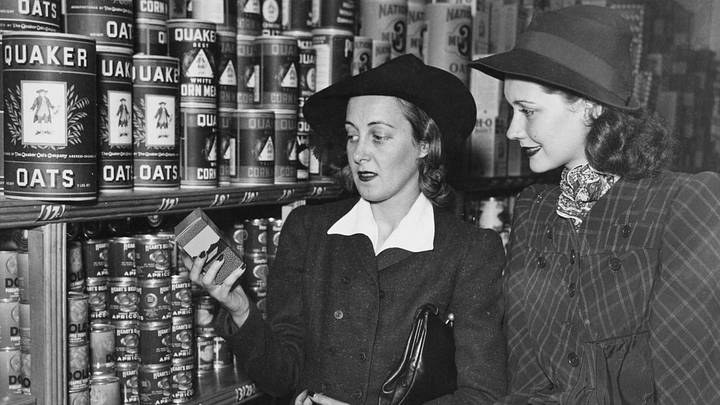
100 years ago, the "best thing since sliced bread" was not even an idiom yet, because store-bought bread did not come pre-sliced until 1928.
Supermarkets and refrigerators hadn’t become familiar comforts, and customers didn’t rely on frozen foods and plastics. Products bore little resemblance to what we're used to today, and lists were wooden "reminder boards” with movable pegs. Employees' duties were different, and prices were, well, less of a jump scare.
Let's travel back to 1926 to see what grocery shopping was really like before modern amenities.
GROCERY SHOPPING IN 1926

LISTS

Today: If you don't order groceries on a delivery app, and you still shop at the physical grocery store, do you make a list? Some take a few moments to jot down items they need in their iPhone Notes app. Others show up at the store and pick out the items they need by memory, an impressive feat. While it's increasingly rare to bring a physical list to the grocery store, some shoppers still put pen to paper to retrieve the items they need, nothing more, nothing less.
1926: Writing down grocery items you needed was much more common 100 years ago. Maybe you remember grocery runs with your grandparents and watching them get out a pencil to cross off items on a paper list. In 1926, some people used wooden pegged boards (not to be confused with the pocket-sized metal boards of the 1950s) to remind them what to pick up. And, when in doubt, a customer’s past purchases were recorded in a personalized ledger at the store.
COUNTER SERVICE

Today: If you don't rely on the modern conveniences of grocery delivery services like Instacart, DoorDash, or membership programs that bring groceries right to your door, you either drive to the store and wait in your car for an employee to bring them out, or you shop the old-fashioned way, grabbing a cart and meandering down each aisle to find what you need. At the end of your visit, the register records your purchases, sometimes emailed, sometimes printed, sometimes listed in your online account. For example, at Whole Foods, you can pay with your Amazon Prime account and, more recently, the palm of your hand.
1926: 100 years ago, bulk items and fully stocked shelves were just being introduced. Some grocery stores invited shoppers to walk down the aisles and pick out necessities, while at others, you'd hand your list to a clerk behind the counter who would retrieve items from the back. A ledger kept track of your purchased items, and you could pay "on account,” weekly or monthly. While today's delivery services seem advanced, families in 1926 could also have their groceries brought to their homes.
SUPERMARKETS

Today: It's hard to imagine a world without Super Target, Walmart, Kroger, Costco, or any other large grocery chain where you can get everything you need in one trip. If meat, eggs, spinach, bread, cookies, soda, napkins, and allergy medication are on your list, you can find them all at one of these chains. But this wasn't always the case.
1926: Supermarkets didn’t really exist before the 1930s, and they didn’t become mainstream until the 1950s, so a "one-stop shop" for all your goods wasn’t possible in the 1920s. Sure, some stores stocked a variety of items (the first Piggly Wiggly opened in 1916), but, for the most part, if you wanted to get all your groceries in one trip, you had to make separate stops at the butcher, the bakery, the pharmacy, or the fruit stand for fresh produce.
REFRIGERATORS

Today: Refrigerators are a convenience many of us grew up with and rarely think twice about. They keep perishables cool or frozen so we can enjoy them days, sometimes even months after purchase, making meat, dairy, and frozen foods essential. But what did people do before this luxury existed?
1926: For starters, food was fresh and in season, so grocery shopping was more frequent 100 years ago. You couldn’t just buy frozen pineapple chunks and store them for months; you had to buy a fresh, in-season pineapple and eat it before it spoiled (or throw it in the icebox). While some items were canned, many required self-canning or preservation techniques like pickling vegetables, salting meats, or utilizing the sun to dehydrate foods.
Icemen delivered ice to keep iceboxes (insulated spaces for temperature-controlled items) cold before refrigerators. Milkmen routinely delivered milk in glass bottles, since chemical preservatives weren’t used to keep it fresh.
PLASTICS

Today: In 2026, so many things are packaged in plastic that environmental groups continually protest against it. The environmental impacts are considered so detrimental that many companies have started using glass or cardboard packaging to be more eco-friendly. Still, a trip to the grocery store today looks overwhelmingly plastic: tubes, bottles, containers, bags. It’s largely unavoidable at a chain, even at stores that charge for plastic bags or offer cardboard alternatives.
1926: The first fully synthetic plastic was invented in 1907, but plastics didn’t become a household staple until the 1950s, following World War II and the postwar economic (and baby) boom. So a trip to the grocery store in 1926 meant items were packaged in paper, cardboard, metal (cans), or glass. As mentioned, milkmen delivered milk in glass bottles since milk cartons weren’t introduced until the 1930s, when wax-coated paper cartons became prevalent.
SLICED BREAD

Today: Admit it: you probably take sliced bread for granted, and there is no shame in it. In 2026, it’s trendy to feed starter and make sourdough bread at home, with total ingredient transparency (something that’s becoming increasingly valuable in a world full of chemicals and additives). But many of us still buy bread from the store expecting it to be sliced. When you picture the bread aisle, you probably see shelves full of loaves, wrapped in plastic and sliced into neat pieces, ready for the toaster.
1926: Bread didn’t come pre-sliced until 1928, thanks to Otto Frederick Rohwedder’s invention of the bread slicing machine. What an idea! So, in 1926, people typically made their own bread, or went to the baker to buy a loaf, brought it home, and sliced it themselves with a bread knife.
PRICES

Today: Bring up your grocery bill in 2026, and you’ll find plenty of consumers who agree that items are way too pricey, or at least much more expensive than they used to be. You put a handful of items in your cart, and suddenly you’re leaving with $100 worth of groceries. A pound of beef cost over $6, and a dozen eggs is around $2.27.
1926: There were probably still people who complained about the prices of grocery store items in 1926. It's nice to have something you can count on. But prices were obviously very different in the 1920s. A pound of beef cost around $0.29, and a dozen eggs ranged from $0.27 to $0.56. While grocery store bills were much smaller, the average salary was also substantially less than what the average American earns today.