%20%20--%3E%0A%3Csvg%20version%3D%221.1%22%20id%3D%22Layer_1%22%20xmlns%3D%22http%3A%2F%2Fwww.w3.org%2F2000%2Fsvg%22%20xmlns%3Axlink%3D%22http%3A%2F%2Fwww.w3.org%2F1999%2Fxlink%22%20x%3D%220px%22%20y%3D%220px%22%0A%09%20viewBox%3D%220%200%20684.6%2068.1%22%20style%3D%22enable-background%3Anew%200%200%20684.6%2068.1%3B%22%20xml%3Aspace%3D%22preserve%22%3E%0A%3Cg%3E%0A%09%3Cpath%20d%3D%22M444.1%2C29.3h-17.4v14.5h17.4V29.3z%20M36.4%2C68.1l29.3-50.8V0H50.4L32.9%2C36.8L15.5%2C0H0v68.1h16.7V45.8l12.4%2C22.3H36.4z%0A%09%09%20M49.1%2C68.1h16.6V23.4L49.1%2C52.1V68.1z%20M76.6%2C68.1h45V53.8H93.3V41.6h21V27.1h-21V14.8h28.3V0.1h-45V68.1z%20M175.6%2C68.1h17.3v-68%0A%09%09h-16.5v40.3L150%2C0.1h-17.6v68h16.7V27.7L175.6%2C68.1z%20M235.8%2C14.8h15.4V0.1h-47.4v14.7H219v53.2h16.8V14.8z%20M290.3%2C45.9h-17.1%0A%09%09l7.5-15.6h2L290.3%2C45.9z%20M298.7%2C68.1h18l-32.2-68h-5.7l-32%2C68h18l3.3-7.1h27.1L298.7%2C68.1z%20M325.2%2C68.1h46.2V53.8h-29.6V0.1h-16.7%0A%09%09V68.1z%20M423.7%2C14.8h27.2V0.1H407v68h16.7V14.8z%20M462%2C68.1h46.2V53.8h-29.6V0.1H462V68.1z%20M564.8%2C34.1c0%2C10.7-7.2%2C19.2-18.5%2C19.2%0A%09%09c-11.4%2C0-18.5-8.5-18.5-19.2s7.1-19.2%2C18.5-19.2C557.6%2C14.9%2C564.8%2C23.4%2C564.8%2C34.1%20M580.6%2C34.1c0-19-14.2-34-34.3-34%0A%09%09c-20.2%2C0-34.3%2C15-34.3%2C34c0%2C19%2C14.1%2C34%2C34.3%2C34C566.4%2C68.1%2C580.6%2C53.1%2C580.6%2C34.1%20M604.8%2C20.5c0-4.1%2C3.3-6.2%2C6.7-6.2%0A%09%09c4.4%2C0%2C6.6%2C3%2C6.6%2C6.6h14.7C631.8%2C9.1%2C625.1%2C0.1%2C611%2C0.1c-12%2C0-21.7%2C9.3-21.7%2C20.6c0%2C10.9%2C5.9%2C15.9%2C16.7%2C19.8%0A%09%09c5.2%2C1.8%2C11.5%2C3.2%2C11.5%2C8c0%2C3.3-2.4%2C5.5-6.4%2C5.5c-3.6%2C0-6.6-3-6.6-6.7h-15.2c0%2C11.5%2C7.9%2C20.8%2C21.8%2C20.8c12%2C0%2C21.6-9.3%2C21.6-20.6%0A%09%09c0-10-5.3-16.4-16.7-19.8C610.6%2C26.1%2C604.8%2C25.3%2C604.8%2C20.5%20M670%2C20.9h14.7C683.8%2C9.1%2C677.1%2C0.1%2C663%2C0.1c-12%2C0-21.7%2C9.3-21.7%2C20.6%0A%09%09c0%2C10.9%2C5.9%2C15.9%2C16.7%2C19.8c5.2%2C1.8%2C11.5%2C3.2%2C11.5%2C8c0%2C3.3-2.4%2C5.5-6.4%2C5.5c-3.6%2C0-6.6-3-6.6-6.7h-15.2c0%2C11.5%2C7.9%2C20.8%2C21.8%2C20.8%0A%09%09c12%2C0%2C21.6-9.3%2C21.6-20.6c0-10-5.3-16.4-16.7-19.8c-5.4-1.6-11.3-2.4-11.3-7.2c0-4.1%2C3.3-6.2%2C6.7-6.2C667.7%2C14.4%2C670%2C17.3%2C670%2C20.9%0A%09%09%22%2F%3E%0A%3C%2Fg%3E%0A%3C%2Fsvg%3E%0A)

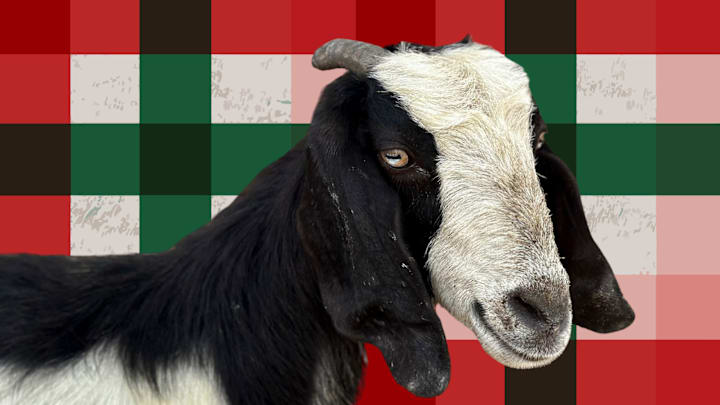
Whether it’s kissing under the mistletoe or first-footing after midnight at New Year, the holiday season comes with more than its fair share of superstitions and good-luck traditions.
Aside from all the ones we still know and follow today, though, the history books are full of all kinds of bizarre festive quirks and folklore, all intended to ensure a happy Christmas or long-lasting good luck into the year ahead. Five of the most peculiar and longest-forgotten of these are explored here.
The Yule Goat

Look closely enough at a Christmas tree in parts of Scandinavia, and you might see a small straw effigy of a goat, tied up in red ribbons, hanging from one of its frontmost branches. Wander the streets of a nearby town, meanwhile, and you might see a larger one outside a local business—or, in parts of Sweden at least, an enormous one in the town square.
This is the julbock, or “Yule goat”—a traditional decoration, often said to bring good luck and bounty in the year ahead. The origins of the julbock are thought to date back to pre-Christian times.
According to at least one version of this tale, the julbock is thought to be a nod to the Norse thunder god Thor, who was said to ride across the sky in a chariot drawn by two enormous horned goats, named Tanngrisnir and Tanngnjóstr (“teeth-barer” and “teeth-gnasher,” respectively). At the end of each day, Thor would slaughter the goats and eat their meat, and then use his hammer, Mjölnir, to resurrect them and continue his journey across the skies the following day. The goats, ultimately, came to symbolize sustenance and an eternally plentiful supply of food.
A similar idea was also maintained in Scandinavian folklore that the very final sheaf of grain from the autumn harvest was gifted with magical powers and contained the spirit of the harvest itself. This last sheaf was ultimately considered to be good luck, and so was kept from the end of harvest time until wintertime, when it was knotted and twisted into the shape of one of Thor’s goats, tied up in ribbons, and hung up in the festive home as a way of ensuring good luck and a good harvest for the following year.
Apple Wassailing

You’ve probably heard the word wassail before in connection to Christmas, either as the name of a kind of festive punch or as a verb relating to door-to-door caroling or merry-making. It’s a little less likely, though, that you’ve heard of the ancient English tradition of apple wassailing or orchard wassailing—a kind of Christmas or end-of-year ceremony, intended to protect the following year’s apple harvest.
Although different versions of the bizarre superstitious ritual abound across the UK, it’s thought that it originally started in the apple orchards of Cornwall and the other counties far southwest corner of England, where cider-making has long been practiced. Typically, a group of locals—traditionally, but not always, young men—would visit whatever orchard they wished to protect at Christmastime (or sometimes Twelfth Night) armed with drums, bells, horns, whistles, and all manner of noise-making tools and instruments.
These they would use to produce an impossibly loud racket (known as “howling”), intended to drive away the demons and evil spirits said to inhabit the apple trees. Gifts and offerings would often be left for the trees, and cider poured over their roots; in Cornwall’s neighboring county of Somerset, this was especially true of the tree considered the oldest in the orchard, which was believed to be responsible for the fertility and produce of all the other trees.
With those spirits banished, sometimes the apple wassail would continue with the group miming the act of harvesting or picking apples, apparently so that the trees would remember the harvesters when the time came to gather the fruits the following year. Often too, songs were sung in the trees’ honor, before the group continued their own merriment by downing often copious amounts of cider in celebration.
More Christmas Traditions:
Christmas Underwear

Many of the traditions we now associate with Christmastime—from hanging evergreen branches around the house to decorating Christmas trees—emerged in continental Europe, and in particular the European north. And as a result, a great many of these ancient traditions and superstitions were imported from northern Europe to the northeastern United States in the 17th and 18th centuries, where they gained a new life among Pennsylvania Dutch and German settlers.
Not all of these ancient superstitions, however, have stood the test of time—and judging by what many of the Pennsylvania Dutch once believed, that may well be for the good.
It was once considered bad luck, for instance, to bathe between Christmas and New Year; another version of this superstition claims that it was not only bad luck to wash yourself, but even changing clothes was off limits, and in particular, changing your underwear. Anyone who dared to don new underwear in this between-holiday period not only risked misfortune in the coming year, but apparently risked being plagued by boils, too.
Washing in the week between Christmas and New Year was likewise said to cause ill health, but it wasn’t just the human settlers who fell (quite literally) foul of this festive dislike for good hygiene: even cleaning out farmyard stables at this time of year risked the farmer having “trouble with witches.”
Christmas Morning’s Dew

Given the religious origin of Christmas, many of the natural occurrences of the season came to be superstitiously associated with the nativity and Jesus Christ, and as a result were considered good luck—not least among our old friends here, the Pennsylvania Dutch.
The dew and early-morning moisture of Christmas Eve, for instance, were long believed to have various magical health-giving properties in the early United States. As a result, mothers would sometimes leave a small piece (or traditionally, three pieces) of bread outside on Christmas Eve, so that by the following morning it was coated in dew. A small piece of this dew-coated bread would then be given to every member of the household to protect them from fevers in the year ahead.
Just as with the Pennsylvania Dutch’s dislike for cleanliness at Christmastime, however, this superstition also held true for livestock as well as members of the household. As a result, farmers would apparently leave a small quantity of hay aside on Christmas Eve so that it too would be coated in dew by the following morning. Feeding this moist hay to his cattle was ultimately believed to prevent any of the animals from perishing between then and the following Christmas.
Good Luck Pies

Food is a huge part of the Christmas period, naturally, and as a result, a huge number of festive superstitions have emerged over the years relating to Christmas food and drink.
Sweet mince pies, for instance, have long been a popular Christmas staple in England, where it was once believed that eating twelve of them—one each from twelve different friends or at twelve different houses—during the twelve days of Christmas was a means of guaranteeing twelve months of good luck in the following year. As a result, it was also considered bad luck to turn down a mince pie when offered one (as well as being bad luck to cut one with a knife).
Among England’s many other festive culinary superstitions, it was considered good luck to have every member of the household stir the Christmas cake mix as it was being prepared, and then save a small piece of it until next year. Bread should only be baked after dark at Christmastime, too, while if a batch of smaller Christmas cakes or buns were to be prepared, the cook should make sure to prepare at least one person, so that they could be named after every member of the household before they were baked.
In a somewhat macabre twist on the goodwill of the Christmas season, though, anyone whose cake split or was broken open in the oven could rather uncompromisingly expect to die sometime in the next 12 months. Perhaps, then, that’s a superstition not worth risking.
You May Also Like:
Add Mental Floss as a preferred news source!