%20%20--%3E%0A%3Csvg%20version%3D%221.1%22%20id%3D%22Layer_1%22%20xmlns%3D%22http%3A%2F%2Fwww.w3.org%2F2000%2Fsvg%22%20xmlns%3Axlink%3D%22http%3A%2F%2Fwww.w3.org%2F1999%2Fxlink%22%20x%3D%220px%22%20y%3D%220px%22%0A%09%20viewBox%3D%220%200%20684.6%2068.1%22%20style%3D%22enable-background%3Anew%200%200%20684.6%2068.1%3B%22%20xml%3Aspace%3D%22preserve%22%3E%0A%3Cg%3E%0A%09%3Cpath%20d%3D%22M444.1%2C29.3h-17.4v14.5h17.4V29.3z%20M36.4%2C68.1l29.3-50.8V0H50.4L32.9%2C36.8L15.5%2C0H0v68.1h16.7V45.8l12.4%2C22.3H36.4z%0A%09%09%20M49.1%2C68.1h16.6V23.4L49.1%2C52.1V68.1z%20M76.6%2C68.1h45V53.8H93.3V41.6h21V27.1h-21V14.8h28.3V0.1h-45V68.1z%20M175.6%2C68.1h17.3v-68%0A%09%09h-16.5v40.3L150%2C0.1h-17.6v68h16.7V27.7L175.6%2C68.1z%20M235.8%2C14.8h15.4V0.1h-47.4v14.7H219v53.2h16.8V14.8z%20M290.3%2C45.9h-17.1%0A%09%09l7.5-15.6h2L290.3%2C45.9z%20M298.7%2C68.1h18l-32.2-68h-5.7l-32%2C68h18l3.3-7.1h27.1L298.7%2C68.1z%20M325.2%2C68.1h46.2V53.8h-29.6V0.1h-16.7%0A%09%09V68.1z%20M423.7%2C14.8h27.2V0.1H407v68h16.7V14.8z%20M462%2C68.1h46.2V53.8h-29.6V0.1H462V68.1z%20M564.8%2C34.1c0%2C10.7-7.2%2C19.2-18.5%2C19.2%0A%09%09c-11.4%2C0-18.5-8.5-18.5-19.2s7.1-19.2%2C18.5-19.2C557.6%2C14.9%2C564.8%2C23.4%2C564.8%2C34.1%20M580.6%2C34.1c0-19-14.2-34-34.3-34%0A%09%09c-20.2%2C0-34.3%2C15-34.3%2C34c0%2C19%2C14.1%2C34%2C34.3%2C34C566.4%2C68.1%2C580.6%2C53.1%2C580.6%2C34.1%20M604.8%2C20.5c0-4.1%2C3.3-6.2%2C6.7-6.2%0A%09%09c4.4%2C0%2C6.6%2C3%2C6.6%2C6.6h14.7C631.8%2C9.1%2C625.1%2C0.1%2C611%2C0.1c-12%2C0-21.7%2C9.3-21.7%2C20.6c0%2C10.9%2C5.9%2C15.9%2C16.7%2C19.8%0A%09%09c5.2%2C1.8%2C11.5%2C3.2%2C11.5%2C8c0%2C3.3-2.4%2C5.5-6.4%2C5.5c-3.6%2C0-6.6-3-6.6-6.7h-15.2c0%2C11.5%2C7.9%2C20.8%2C21.8%2C20.8c12%2C0%2C21.6-9.3%2C21.6-20.6%0A%09%09c0-10-5.3-16.4-16.7-19.8C610.6%2C26.1%2C604.8%2C25.3%2C604.8%2C20.5%20M670%2C20.9h14.7C683.8%2C9.1%2C677.1%2C0.1%2C663%2C0.1c-12%2C0-21.7%2C9.3-21.7%2C20.6%0A%09%09c0%2C10.9%2C5.9%2C15.9%2C16.7%2C19.8c5.2%2C1.8%2C11.5%2C3.2%2C11.5%2C8c0%2C3.3-2.4%2C5.5-6.4%2C5.5c-3.6%2C0-6.6-3-6.6-6.7h-15.2c0%2C11.5%2C7.9%2C20.8%2C21.8%2C20.8%0A%09%09c12%2C0%2C21.6-9.3%2C21.6-20.6c0-10-5.3-16.4-16.7-19.8c-5.4-1.6-11.3-2.4-11.3-7.2c0-4.1%2C3.3-6.2%2C6.7-6.2C667.7%2C14.4%2C670%2C17.3%2C670%2C20.9%0A%09%09%22%2F%3E%0A%3C%2Fg%3E%0A%3C%2Fsvg%3E%0A)

Back in 1909, when Theodore Roosevelt left the White House for a year-long hunting expedition in Africa, he packed what he called the “Pigskin Library,” a case of books mostly bound in pigskin, which held up better than cloth against “blood, sweat, gun oil, dust, and ashes.”
He later printed the full list, then immediately warned readers not to treat it as a ranking: he cared for those books “neither more nor less than for those I left at home.” Roosevelt insisted, more than once, that “there is no such thing as a list of ‘the hundred best books,’” but between his autobiography, his essays and his letters to his kids, he left a detailed record of the books he couldn’t stop rereading.
Here are 12, in his own words.
- Guy Mannering and The Antiquary by Sir Walter Scott
- Thomas Babington Macaulay’s History of England, Critical and Historical Essays, and Poems
- Pendennis, The Newcomes, and Vanity Fair by William Makepeace Thackeray
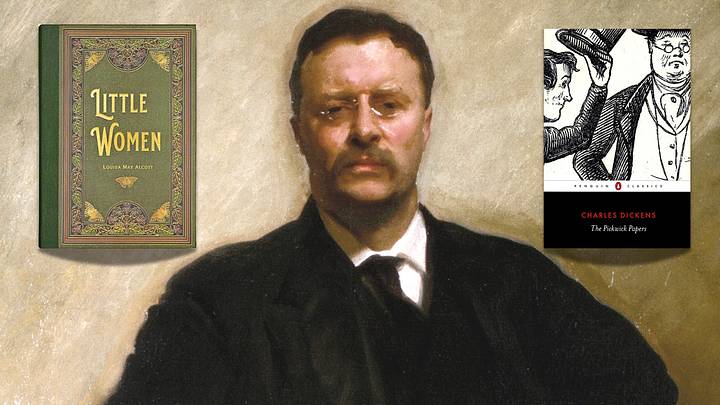
- The Pickwick Papers and Our Mutual Friend by Charles Dickens
- Macbeth by William Shakespeare
- “The Saga of King Olaf” by Henry Wadsworth Longfellow
- With Fire and Sword by Henryk Sienkiewicz
- Little Women by Louisa May Alcott
- Owen Wister’s Western Fiction
- The Poems of Algernon Charles Swinburne
- The Autocrat of the Breakfast-Table by Oliver Wendell Holmes
- The Semi-Attached Couple by Emily Eden
Guy Mannering and The Antiquary by Sir Walter Scott

Sir Walter Scott led the list of novels TR returned to year after year. In a 1915 essay, he wrote, “I read over and over again ‘Guy Mannering,’ ‘The Antiquary,’” and in his 1913 autobiography he said he still read “a number of Scott’s novels over and over again.” Five Scott novels went to Africa with him.
Thomas Babington Macaulay’s History of England, Critical and Historical Essays, and Poems
When Harvard’s former president Charles W. Eliot assembled his famous “Five-Foot Shelf” of essential books, the Rough Rider complained that Macaulay, like Scott, was “practically omitted,” adding, “they are the two nineteenth-century authors that I should most regret to lose.” All three Macaulay titles made the Pigskin Library.
Pendennis, The Newcomes, and Vanity Fair by William Makepeace Thackeray

In 1906, Roosevelt wrote from the White House to his son Kermit, “I am so glad you like Thackeray. ‘Pendennis’ and ‘The Newcomes’ and ‘Vanity Fair’ I can read over and over again.” Thackeray’s Henry Esmond, on the other hand, he found heavy going.
The Pickwick Papers and Our Mutual Friend by Charles Dickens

Roosevelt’s relationship with Charles Dickens was complicated. He reread both of these books and packed them for Africa, and in February 1908 he told Kermit that he was “very fond of him.” Six days later, in another letter to Kermit, he called Dickens “an ill-natured, selfish cad and boor, who had no understanding of what the word gentleman meant.” The books survived the verdict on the man.
Macbeth by William Shakespeare

“I happen to be devoted to Macbeth,” Roosevelt wrote in his autobiography, “whereas I very seldom read Hamlet (though I like parts of it).” He reread Othello too, but not King Lear.
“The Saga of King Olaf” by Henry Wadsworth Longfellow
As a boy, Roosevelt read Longfellow’s cycle of poems about a Norwegian king, “which absorbed me,” and which started a lifelong interest in Scandinavian literature. As an adult, he listed nine Longfellow poems by name and wrote, “I am exceedingly fond of these, and of many, many other poems of Longfellow.”
With Fire and Sword by Henryk Sienkiewicz

The Polish novelist’s most famous book, Quo Vadis, was one Roosevelt said he “cannot stand.” What he loved was Sienkiewicz’s historical trilogy, and he wrote that he would “never tire of” With Fire and Sword, Pan Michael and The Deluge.
Little Women by Louisa May Alcott

Roosevelt admitted in his autobiography that as a boy he “worshiped” Little Men, Little Women, and An Old-Fashioned Girl. He read them alongside Our Young Folks, a children’s magazine he called “the very best magazine in the world,” a belief he said he’d kept “to this day unchanged.”
Owen Wister’s Western Fiction
For the West Roosevelt had ranched in during the 1880s, he reached for the author of The Virginian: “To me Owen Wister is the writer I wish when I am hungry with the memories of lonely mountains, of vast sunny plains with seas of wind-rippled grass.”
The Poems of Algernon Charles Swinburne
An English poet known for his lush verse seems like an odd fit for the Dakota Badlands, but Roosevelt explained the appeal: “When I lived much in cow camps I often carried a volume of Swinburne, as a kind of antiseptic to alkali dust, tepid, muddy water, frying-pan bread, sow-belly bacon, and the too-infrequent washing of sweat-drenched clothing.”
The Autocrat of the Breakfast-Table by Oliver Wendell Holmes

Roosevelt called Holmes “the laughing philosopher, the humorist at his very highest,” and he took The Autocrat and its much later follow-up, Over the Teacups, to Africa. When Eliot left The Autocrat off his Five-Foot Shelf, Roosevelt called it “an incomprehensible choice from my stand-point.”
The Semi-Attached Couple by Emily Eden
The most obscure book on the list is a “little pre-Victorian novel or tale” Roosevelt kept on the shelves at Sagamore Hill. “It is told with much humor; it is a story of gentlefolk who are really gentlefolk; and to me it is altogether delightful.”
Not every classic got that kind of love: of Jane Austen, he wrote that when he finished one of her books, “I have a feeling that duty performed is a rainbow to the soul.”