%20%20--%3E%0A%3Csvg%20version%3D%221.1%22%20id%3D%22Layer_1%22%20xmlns%3D%22http%3A%2F%2Fwww.w3.org%2F2000%2Fsvg%22%20xmlns%3Axlink%3D%22http%3A%2F%2Fwww.w3.org%2F1999%2Fxlink%22%20x%3D%220px%22%20y%3D%220px%22%0A%09%20viewBox%3D%220%200%20684.6%2068.1%22%20style%3D%22enable-background%3Anew%200%200%20684.6%2068.1%3B%22%20xml%3Aspace%3D%22preserve%22%3E%0A%3Cg%3E%0A%09%3Cpath%20d%3D%22M444.1%2C29.3h-17.4v14.5h17.4V29.3z%20M36.4%2C68.1l29.3-50.8V0H50.4L32.9%2C36.8L15.5%2C0H0v68.1h16.7V45.8l12.4%2C22.3H36.4z%0A%09%09%20M49.1%2C68.1h16.6V23.4L49.1%2C52.1V68.1z%20M76.6%2C68.1h45V53.8H93.3V41.6h21V27.1h-21V14.8h28.3V0.1h-45V68.1z%20M175.6%2C68.1h17.3v-68%0A%09%09h-16.5v40.3L150%2C0.1h-17.6v68h16.7V27.7L175.6%2C68.1z%20M235.8%2C14.8h15.4V0.1h-47.4v14.7H219v53.2h16.8V14.8z%20M290.3%2C45.9h-17.1%0A%09%09l7.5-15.6h2L290.3%2C45.9z%20M298.7%2C68.1h18l-32.2-68h-5.7l-32%2C68h18l3.3-7.1h27.1L298.7%2C68.1z%20M325.2%2C68.1h46.2V53.8h-29.6V0.1h-16.7%0A%09%09V68.1z%20M423.7%2C14.8h27.2V0.1H407v68h16.7V14.8z%20M462%2C68.1h46.2V53.8h-29.6V0.1H462V68.1z%20M564.8%2C34.1c0%2C10.7-7.2%2C19.2-18.5%2C19.2%0A%09%09c-11.4%2C0-18.5-8.5-18.5-19.2s7.1-19.2%2C18.5-19.2C557.6%2C14.9%2C564.8%2C23.4%2C564.8%2C34.1%20M580.6%2C34.1c0-19-14.2-34-34.3-34%0A%09%09c-20.2%2C0-34.3%2C15-34.3%2C34c0%2C19%2C14.1%2C34%2C34.3%2C34C566.4%2C68.1%2C580.6%2C53.1%2C580.6%2C34.1%20M604.8%2C20.5c0-4.1%2C3.3-6.2%2C6.7-6.2%0A%09%09c4.4%2C0%2C6.6%2C3%2C6.6%2C6.6h14.7C631.8%2C9.1%2C625.1%2C0.1%2C611%2C0.1c-12%2C0-21.7%2C9.3-21.7%2C20.6c0%2C10.9%2C5.9%2C15.9%2C16.7%2C19.8%0A%09%09c5.2%2C1.8%2C11.5%2C3.2%2C11.5%2C8c0%2C3.3-2.4%2C5.5-6.4%2C5.5c-3.6%2C0-6.6-3-6.6-6.7h-15.2c0%2C11.5%2C7.9%2C20.8%2C21.8%2C20.8c12%2C0%2C21.6-9.3%2C21.6-20.6%0A%09%09c0-10-5.3-16.4-16.7-19.8C610.6%2C26.1%2C604.8%2C25.3%2C604.8%2C20.5%20M670%2C20.9h14.7C683.8%2C9.1%2C677.1%2C0.1%2C663%2C0.1c-12%2C0-21.7%2C9.3-21.7%2C20.6%0A%09%09c0%2C10.9%2C5.9%2C15.9%2C16.7%2C19.8c5.2%2C1.8%2C11.5%2C3.2%2C11.5%2C8c0%2C3.3-2.4%2C5.5-6.4%2C5.5c-3.6%2C0-6.6-3-6.6-6.7h-15.2c0%2C11.5%2C7.9%2C20.8%2C21.8%2C20.8%0A%09%09c12%2C0%2C21.6-9.3%2C21.6-20.6c0-10-5.3-16.4-16.7-19.8c-5.4-1.6-11.3-2.4-11.3-7.2c0-4.1%2C3.3-6.2%2C6.7-6.2C667.7%2C14.4%2C670%2C17.3%2C670%2C20.9%0A%09%09%22%2F%3E%0A%3C%2Fg%3E%0A%3C%2Fsvg%3E%0A)

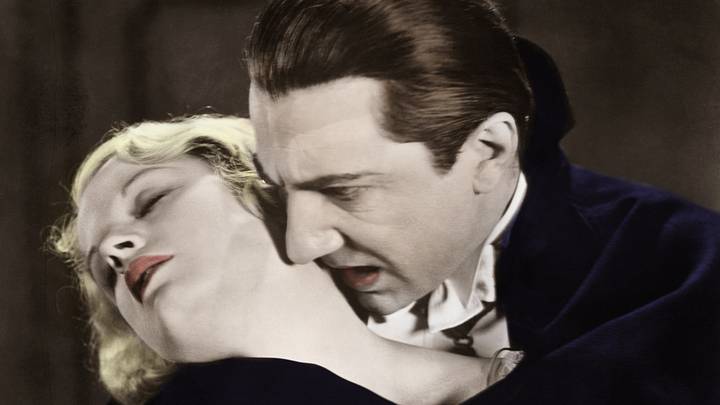
Although vampires have a long history in folklore, they didn’t burst onto the literary scene until 1819, when John Polidori published “The Vampyre” (which was inspired by a short fragment written by Lord Byron). Although Polidori’s vampire had a seductive streak that became a common characteristic of the creature, the fanged monster didn’t get a full romantic makeover until 2005 with Stephenie Meyer’s Twilight. But there are still plenty of terrifying vampires out there lurking between the covers of horror books. Here are 9 vampire novels with a little less sparkle and a little more bite.
- Dracula (1897) // Bram Stoker
- I Am Legend (1954) // Richard Matheson
- ‘Salem’s Lot (1975) // Stephen King
- Interview with the Vampire (1976) // Anne Rice
- Let the Right One In (2004) // John Ajvide Lindqvist
- The Passage (2010) // Justin Cronin
- The Lesser Dead (2014) // Christopher Buehlman
- The Southern Book Club’s Guide to Slaying Vampires (2020) // Grady Hendrix
- The Buffalo Hunter Hunter (2025) // Stephen Graham Jones
Dracula (1897) // Bram Stoker

Dracula hardly needs an introduction, being the most famous and influential vampire novel of all time. The epistolary story starts in Transylvania and follows along as the titular bloodsucker pursues Jonathan Harker and his friends and family in England. The book was an immediate hit and Dracula has become the most adapted literary character ever.
It’s hard to imagine Count Dracula going by any other name, but Bram Stoker actually had a different (and far less frightening) name in mind: Count Wampyr. Thankfully, the author changed his mind after reading the word “Dracula” in a library book while doing research in Whitby, an English seaside town that he featured as one of the novel’s settings.
I Am Legend (1954) // Richard Matheson

One vampire is scary enough as it is, but Richard Matheson imagined a world overrun by vampires in I Am Legend. Main character Robert Neville spends his days killing sleeping vampires and his nights sheltering in his barricaded house—a lonely existence that is starting to wear him down.
None of the three film adaptations—The Last Man on Earth (1964) with Vincent Price, The Omega Man (1971) with Charlton Heston, and I Am Legend (2007) with Will Smith—have managed to capture the brilliance of the book, and all of them have butchered the iconic ending. “I don’t know why they keep buying my books,” Matheson said in a 2012 interview with IGN. “They might as well have written something entirely new.”
‘Salem’s Lot (1975) // Stephen King

Hot on the heels of publishing his debut novel, Carrie (1974), Stephen King got to thinking about “what would happen if Dracula came back in the twentieth century.” He voiced the idea to his wife, Tabitha, who said, “He’d probably be run over by a Yellow Cab on Park Avenue and killed.” But the idea stuck and pretty soon ’Salem’s Lot was unleashed on the world.
The scary story follows writer Ben Mears, who returns to the town of Jerusalem’s Lot—where he lived as a kid—to find that the residents are slowly but surely being turned into vampires. ’Salem’s Lot wasn’t the only time King visited the vampire-infested Maine town, with the short stories “Jerusalem’s Lot” and “One for the Road” serving as a prequel and sequel respectively.
Interview with the Vampire (1976) // Anne Rice

Interview with the Vampire recounts the life of 200-year-old vampire Louis de Pointe du Lac, who was turned into an undead bloodsucker during the 18th century by Lestat de Lioncourt. The poetic, sensual, and bloody tale launched Anne Rice’s literary career, but it had a tragic inspiration: the death of her five-year-old daughter, Michele, in 1972. In a grief-stricken haze, Rice wrote the book in just five weeks, but the story was substantially added to once the publisher Knopf bought the rights. For instance, everything set at the Theater of Vampires was the product of this rewrite.
Let the Right One In (2004) // John Ajvide Lindqvist

Let the Right One In chronicles the friendship that develops between Oskar, a twelve-year-old boy who’s being bullied, and Eli, his new neighbor who turns out to be a decades-old vampire. Although the book is incredibly bleak, their tender friendship is the beating heart of the story.
The novel was originally published in Swedish in 2004—under the title Låt den rätte komma in—but when it was translated into English in 2007, the American publisher thought that the title was too long. “Their original suggestion for the title was Let Her In,” Lindqvist said in a 2008 interview. But Eli is deliberately androgynous, so he suggested Let Me In instead, which also became the name of the 2010 English-language film adaptation.
The Passage (2010) // Justin Cronin

Justin Cronin came up with the idea for The Passage after his nine-year-old daughter, Iris, asked him to write “about a girl who saves the world.” The story starts with six-year-old Amy Bellafonte being detained by FBI agents so that she can be used in a military experiment. The first half of the novel charts this experiment, which leads to a vampire outbreak and the downfall of civilization as we know it. The second half jumps forward almost a century in time to see how the remnants of humanity are surviving in this changed world. Cronin also penned two sequels: The Twelve (2012) and The City of Mirrors (2016).
The Lesser Dead (2014) // Christopher Buehlman

Christopher Buehlman was inspired to write The Lesser Dead from a single mental image: “a little girl with makeup on riding the subway in the 1970’s.” The story then grew from him “play[ing] around with different explanations of who she was, exactly what kind of vampire, and who it was that was seeing her.” The finished result is set in New York in 1978 and is told from the point of view of 14-year-old Joey Peacock, who was turned into a vampire a few decades earlier. While riding the subway one day, Joey encounters some out-of-control vampire children, and the story takes off from there. The Lesser Dead goes to some dark places, but it’s also absolutely hilarious.
The Southern Book Club’s Guide to Slaying Vampires (2020) // Grady Hendrix

Like many of Grady Hendrix’s other books, The Southern Book Club’s Guide to Slaying Vampires manages to be both a chilling horror tale and a fun, campy romp. Set in the ’90s, the story follows Charleston housewife Patricia Campbell—whose one joy in life is her true crime book club—as she begins to suspect that the charming new man in town is really a bloodthirsty vampire.
Hendrix drew the setting and characters from his own life. “Growing up, I hated my mum’s book club; I thought they were just a bunch of silly housewives, but when I got to know them as adults I realized I was the idiot,” he said in a 2020 interview. “These women had dealt with things I could barely even dream of handling and they’d done it while keeping their kids in the dark about the difficulties they’d faced.” Writing Southern Book Club was his way of reflecting on that realization and turning the housewives into vampire-slaying heroes.
The Buffalo Hunter Hunter (2025) // Stephen Graham Jones

Former President Barack Obama is a big fan of The Buffalo Hunter Hunter, having included it on his list of 2025 summer reads. The historical horror novel is told as a story within a story within a story. We start in 2012 with Professor Etsy Beaucarne finding a manuscript written in 1912 by her ancestor, a Lutheran pastor named Arthur. His manuscript details a dark and bloody story told to him by a Blackfeet Indian vampire called Good Stab.
At its heart, The Buffalo Hunter Hunter is a tale of revenge. “I did set out to come at the buffalo hunters, and I knew that I wanted to take them down on the page over and over again, just punish them the way they had punished the herds, and by association, us,” Stephen Graham Jones explained in a 2025 interview with Paste Magazine. Thanks to Good Stab, he certainly achieved that goal.