%20%20--%3E%0A%3Csvg%20version%3D%221.1%22%20id%3D%22Layer_1%22%20xmlns%3D%22http%3A%2F%2Fwww.w3.org%2F2000%2Fsvg%22%20xmlns%3Axlink%3D%22http%3A%2F%2Fwww.w3.org%2F1999%2Fxlink%22%20x%3D%220px%22%20y%3D%220px%22%0A%09%20viewBox%3D%220%200%20684.6%2068.1%22%20style%3D%22enable-background%3Anew%200%200%20684.6%2068.1%3B%22%20xml%3Aspace%3D%22preserve%22%3E%0A%3Cg%3E%0A%09%3Cpath%20d%3D%22M444.1%2C29.3h-17.4v14.5h17.4V29.3z%20M36.4%2C68.1l29.3-50.8V0H50.4L32.9%2C36.8L15.5%2C0H0v68.1h16.7V45.8l12.4%2C22.3H36.4z%0A%09%09%20M49.1%2C68.1h16.6V23.4L49.1%2C52.1V68.1z%20M76.6%2C68.1h45V53.8H93.3V41.6h21V27.1h-21V14.8h28.3V0.1h-45V68.1z%20M175.6%2C68.1h17.3v-68%0A%09%09h-16.5v40.3L150%2C0.1h-17.6v68h16.7V27.7L175.6%2C68.1z%20M235.8%2C14.8h15.4V0.1h-47.4v14.7H219v53.2h16.8V14.8z%20M290.3%2C45.9h-17.1%0A%09%09l7.5-15.6h2L290.3%2C45.9z%20M298.7%2C68.1h18l-32.2-68h-5.7l-32%2C68h18l3.3-7.1h27.1L298.7%2C68.1z%20M325.2%2C68.1h46.2V53.8h-29.6V0.1h-16.7%0A%09%09V68.1z%20M423.7%2C14.8h27.2V0.1H407v68h16.7V14.8z%20M462%2C68.1h46.2V53.8h-29.6V0.1H462V68.1z%20M564.8%2C34.1c0%2C10.7-7.2%2C19.2-18.5%2C19.2%0A%09%09c-11.4%2C0-18.5-8.5-18.5-19.2s7.1-19.2%2C18.5-19.2C557.6%2C14.9%2C564.8%2C23.4%2C564.8%2C34.1%20M580.6%2C34.1c0-19-14.2-34-34.3-34%0A%09%09c-20.2%2C0-34.3%2C15-34.3%2C34c0%2C19%2C14.1%2C34%2C34.3%2C34C566.4%2C68.1%2C580.6%2C53.1%2C580.6%2C34.1%20M604.8%2C20.5c0-4.1%2C3.3-6.2%2C6.7-6.2%0A%09%09c4.4%2C0%2C6.6%2C3%2C6.6%2C6.6h14.7C631.8%2C9.1%2C625.1%2C0.1%2C611%2C0.1c-12%2C0-21.7%2C9.3-21.7%2C20.6c0%2C10.9%2C5.9%2C15.9%2C16.7%2C19.8%0A%09%09c5.2%2C1.8%2C11.5%2C3.2%2C11.5%2C8c0%2C3.3-2.4%2C5.5-6.4%2C5.5c-3.6%2C0-6.6-3-6.6-6.7h-15.2c0%2C11.5%2C7.9%2C20.8%2C21.8%2C20.8c12%2C0%2C21.6-9.3%2C21.6-20.6%0A%09%09c0-10-5.3-16.4-16.7-19.8C610.6%2C26.1%2C604.8%2C25.3%2C604.8%2C20.5%20M670%2C20.9h14.7C683.8%2C9.1%2C677.1%2C0.1%2C663%2C0.1c-12%2C0-21.7%2C9.3-21.7%2C20.6%0A%09%09c0%2C10.9%2C5.9%2C15.9%2C16.7%2C19.8c5.2%2C1.8%2C11.5%2C3.2%2C11.5%2C8c0%2C3.3-2.4%2C5.5-6.4%2C5.5c-3.6%2C0-6.6-3-6.6-6.7h-15.2c0%2C11.5%2C7.9%2C20.8%2C21.8%2C20.8%0A%09%09c12%2C0%2C21.6-9.3%2C21.6-20.6c0-10-5.3-16.4-16.7-19.8c-5.4-1.6-11.3-2.4-11.3-7.2c0-4.1%2C3.3-6.2%2C6.7-6.2C667.7%2C14.4%2C670%2C17.3%2C670%2C20.9%0A%09%09%22%2F%3E%0A%3C%2Fg%3E%0A%3C%2Fsvg%3E%0A)

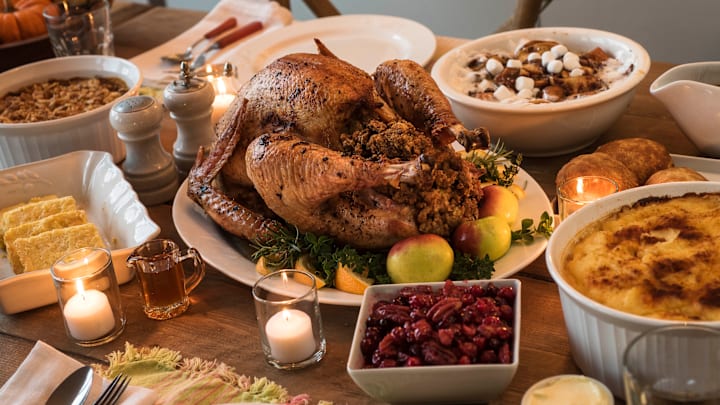
When Americans sit down with their families for Thanksgiving dinner, most of them will probably gorge themselves on the same traditional menu, with turkey, cranberry sauce, stuffing, and pumpkin pie taking up the most real estate on the plates. How did these dishes become the national “what you eat on Thanksgiving” options, though? Let’s take a look at the history of Thanksgiving foods.
Why do we eat turkey on Thanksgiving?

It’s not necessarily because the Pilgrims did it. Turkey may not have been on the menu at the 1621 celebration by the Pilgrims of Plymouth that is considered the first Thanksgiving. There were wild turkeys in the Plymouth area, though, as colonist William Bradford noted in his book Of Plymouth Plantation.
However, the best existing account of the Pilgrims’ harvest feast comes from colonist Edward Winslow, the primary author of Mourt’s Relation: A Journal of the Pilgrims at Plymouth. Winslow’s first-hand account of the first Thanksgiving included no explicit mention of turkey. He does, however, mention the Pilgrims gathering wild fowl for the meal, although that could just as likely have meant ducks or geese.
When it comes to why we eat turkey on Thanksgiving today, it helps to know a bit about the history of the holiday. While the idea of giving thanks and celebrating the harvest was popular in certain parts of the country, it was by no means an annual national holiday until the 19th century. Presidents would occasionally declare a Thanksgiving Day celebration, but the holiday hadn’t completely caught on nationwide. Many of these early celebrations included turkey; Alexander Hamilton once remarked, “No citizen of the U.S. shall refrain from turkey on Thanksgiving Day.”
When Bradford’s journals were reprinted in 1856 after being lost for at least half a century, they found a receptive audience with advocates who wanted Thanksgiving turned into a national holiday. Because Bradford wrote of how the colonists had hunted wild turkeys during the autumn of 1621 and because turkey is a uniquely North American (and scrumptious) bird, it gained traction as the Thanksgiving meal of choice for Americans after President Abraham Lincoln declared Thanksgiving a national holiday in 1863.
Moreover, there were pragmatic reasons for eating turkey rather than, say, chicken at a feast like Thanksgiving. The birds are large enough that they can feed a table full of hungry family members, and unlike chickens or cows, they don’t serve an additional purpose like laying eggs or making milk. Unlike pork, turkey wasn’t so common that it seemed like an unsuitable choice for a special occasion, either.
Did the Pilgrims have cranberry sauce on Thanksgiving?

While the cranberries the Pilgrims needed were probably easy to come by, making cranberry sauce requires sugar. Sugar was a rare luxury at the time of the first Thanksgiving, so while revelers may have eaten cranberries, it’s unlikely that the feast featured the divisive sauce. What’s more, it’s not even entirely clear that cranberry sauce had been invented yet.
It was not until 1663 that visitors to the area started commenting on a sweet sauce made of boiled cranberries that accompanied meat. Amelia Simmons suggested serving cranberry sauce with roast turkey in American Cookery, the first American cookbook, in 1796. After Ocean Spray developed its mass harvest techniques—which damaged a lot of the fruit—the company began smushing the cranberries into the jiggly canned delight you’ll find on many Thanksgiving tables today.
Why do people put marshmallows on sweet potato casserole?

Neither sweet potatoes nor white potatoes were available to the colonists in 1621, so the Pilgrims definitely didn’t feast on everyone’s favorite tubers. And they certainly weren’t putting marshmallows on them.
Simmons’s cookbook did feature a recipe for “potato pudding” that mixed a pound of boiled potatoes with half a pound of sugar; a different cookbook published a recipe for candied sweet potatoes a century later. The Angelus Marshmallows company is to thank (or blame, depending on your preferences) for the strange combination of gooey marshmallows and creamy sweet potatoes. In the 1900s, his team hired Boston Cooking School Magazine founder Janet McKenzie Hill to create a recipe booklet starring marshmallows. Her recipe for “mashed sweet potatoes baked with a marshmallow topping” became a hit.
Why do we eat green bean casserole at Thanksgiving?
Green bean casserole comes not from an 18th-century cookbook, but from the back of a Campbell’s soup can. Dorcas Reilly, a Campbell’s test kitchen supervisor, devised the recipe in 1955. Her job involved creating recipes that used Campbell’s canned soups and other ready-made products as ingredients. Her idea for a green bean casserole that included the company’s cream of mushroom soup was included in a 1955 Associated Press story about Thanksgiving, and the dish has remained a part of many holiday feasts ever since.
Did the first Thanksgiving feature pumpkin pie?

It may be the flagship dessert at modern Thanksgiving dinners, but pumpkin pie didn’t make an appearance at the first Thanksgiving. The Pilgrims probably lacked the butter and flour needed to make a pie crust, and it’s not clear that they even had an oven in which they could have baked a pumpkin pie. That doesn’t mean pumpkins weren’t available for the meal, though; they were probably served after being baked in the coals of a fire or stewed.
Until the 18th century, pumpkin pie was actually more popular in Europe than it was in the Americas. Simmons’s American Cookery contained two recipes for “pompkin pudding,” which instructed readers to mix “stewed and strained” pumpkin with nutmeg, ginger, and allspice.
Sarah Josepha Hale, the so-called “mother of Thanksgiving” is responsible for pumpkin pie’s prominence as a Turkey Day dessert. Her novel Northwood included the dish in a description of Thanksgiving foods; Hale herself lobbied to make the celebration a national holiday.
A version of this article originally ran in 2008; it has been updated for 2023.