%20%20--%3E%0A%3Csvg%20version%3D%221.1%22%20id%3D%22Layer_1%22%20xmlns%3D%22http%3A%2F%2Fwww.w3.org%2F2000%2Fsvg%22%20xmlns%3Axlink%3D%22http%3A%2F%2Fwww.w3.org%2F1999%2Fxlink%22%20x%3D%220px%22%20y%3D%220px%22%0A%09%20viewBox%3D%220%200%20684.6%2068.1%22%20style%3D%22enable-background%3Anew%200%200%20684.6%2068.1%3B%22%20xml%3Aspace%3D%22preserve%22%3E%0A%3Cg%3E%0A%09%3Cpath%20d%3D%22M444.1%2C29.3h-17.4v14.5h17.4V29.3z%20M36.4%2C68.1l29.3-50.8V0H50.4L32.9%2C36.8L15.5%2C0H0v68.1h16.7V45.8l12.4%2C22.3H36.4z%0A%09%09%20M49.1%2C68.1h16.6V23.4L49.1%2C52.1V68.1z%20M76.6%2C68.1h45V53.8H93.3V41.6h21V27.1h-21V14.8h28.3V0.1h-45V68.1z%20M175.6%2C68.1h17.3v-68%0A%09%09h-16.5v40.3L150%2C0.1h-17.6v68h16.7V27.7L175.6%2C68.1z%20M235.8%2C14.8h15.4V0.1h-47.4v14.7H219v53.2h16.8V14.8z%20M290.3%2C45.9h-17.1%0A%09%09l7.5-15.6h2L290.3%2C45.9z%20M298.7%2C68.1h18l-32.2-68h-5.7l-32%2C68h18l3.3-7.1h27.1L298.7%2C68.1z%20M325.2%2C68.1h46.2V53.8h-29.6V0.1h-16.7%0A%09%09V68.1z%20M423.7%2C14.8h27.2V0.1H407v68h16.7V14.8z%20M462%2C68.1h46.2V53.8h-29.6V0.1H462V68.1z%20M564.8%2C34.1c0%2C10.7-7.2%2C19.2-18.5%2C19.2%0A%09%09c-11.4%2C0-18.5-8.5-18.5-19.2s7.1-19.2%2C18.5-19.2C557.6%2C14.9%2C564.8%2C23.4%2C564.8%2C34.1%20M580.6%2C34.1c0-19-14.2-34-34.3-34%0A%09%09c-20.2%2C0-34.3%2C15-34.3%2C34c0%2C19%2C14.1%2C34%2C34.3%2C34C566.4%2C68.1%2C580.6%2C53.1%2C580.6%2C34.1%20M604.8%2C20.5c0-4.1%2C3.3-6.2%2C6.7-6.2%0A%09%09c4.4%2C0%2C6.6%2C3%2C6.6%2C6.6h14.7C631.8%2C9.1%2C625.1%2C0.1%2C611%2C0.1c-12%2C0-21.7%2C9.3-21.7%2C20.6c0%2C10.9%2C5.9%2C15.9%2C16.7%2C19.8%0A%09%09c5.2%2C1.8%2C11.5%2C3.2%2C11.5%2C8c0%2C3.3-2.4%2C5.5-6.4%2C5.5c-3.6%2C0-6.6-3-6.6-6.7h-15.2c0%2C11.5%2C7.9%2C20.8%2C21.8%2C20.8c12%2C0%2C21.6-9.3%2C21.6-20.6%0A%09%09c0-10-5.3-16.4-16.7-19.8C610.6%2C26.1%2C604.8%2C25.3%2C604.8%2C20.5%20M670%2C20.9h14.7C683.8%2C9.1%2C677.1%2C0.1%2C663%2C0.1c-12%2C0-21.7%2C9.3-21.7%2C20.6%0A%09%09c0%2C10.9%2C5.9%2C15.9%2C16.7%2C19.8c5.2%2C1.8%2C11.5%2C3.2%2C11.5%2C8c0%2C3.3-2.4%2C5.5-6.4%2C5.5c-3.6%2C0-6.6-3-6.6-6.7h-15.2c0%2C11.5%2C7.9%2C20.8%2C21.8%2C20.8%0A%09%09c12%2C0%2C21.6-9.3%2C21.6-20.6c0-10-5.3-16.4-16.7-19.8c-5.4-1.6-11.3-2.4-11.3-7.2c0-4.1%2C3.3-6.2%2C6.7-6.2C667.7%2C14.4%2C670%2C17.3%2C670%2C20.9%0A%09%09%22%2F%3E%0A%3C%2Fg%3E%0A%3C%2Fsvg%3E%0A)

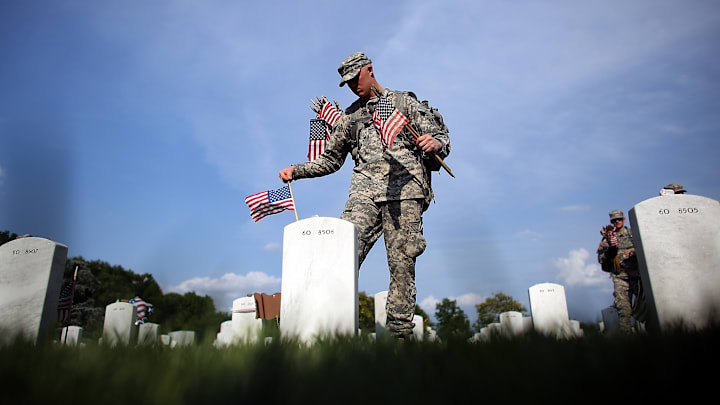
Memorial Day—May 27 in 2024—is much more than just a three-day weekend and a chance to get the year’s first sunburn. It’s a time to remember the people who sacrificed their lives for their country. Here are some facts to gain a new perspective on what this holiday really represents.
- Memorial Day began as a response to the Civil War.
- Major General John A. Logan made Memorial Day official.
- Memorial Day was originally known as Decoration Day.
- Memorial Day is more of a franchise than a national holiday.
- In 1868, future president James Garfield delivered a very, very long speech on the importance of Memorial Day.
- CBS helped identify one of the Unknown Soldiers.
- A Vietnam veterans’ rights group held a virtual motorcycle ride to honor Memorial Day in 2020.
- Memorial Day has its own set of customs.
- Some states still celebrate a Confederate Memorial Day.
- Each Memorial Day is a little different.
Memorial Day began as a response to the Civil War.

Memorial Day was a response to the unprecedented carnage of the Civil War. The tremendous loss of life and its effect on communities led to several spontaneous commemorations of the dead.
In 1864, women from Boalsburg, Pennsylvania, put flowers on the graves of their fallen soldiers from the just-fought Battle of Gettysburg. The next year, a group of women decorated the graves of soldiers buried in a Vicksburg, Mississippi, cemetery.
Two years later, women from Columbus, Mississippi, laid flowers on the graves of both Union and Confederate soldiers. In the same month, in Carbondale, Illinois, 219 Civil War veterans marched through town to Woodlawn Cemetery in memory of the fallen, where Union hero Major General John A. Logan delivered the principal address. The ceremony gave Carbondale its claim to the first organized, community-wide Memorial Day observance.
Waterloo, New York, began holding an annual community service on May 5, 1866. Although many towns claimed the title, it was Waterloo that won congressional recognition as the “Birthplace of Memorial Day.”
Major General John A. Logan made Memorial Day official.

General Logan, the speaker at the Carbondale gathering, was also commander of the Grand Army of the Republic, an organization of Union veterans. On May 5, 1868, he issued General Order No. 11, which set aside May 30, 1868, “for the purpose of strewing with flowers, or otherwise decorating the graves of comrades who died in defense of their country during the late rebellion.”
The orders expressed hope that the observance would be “kept up from year to year while a survivor of the war remains to honor the memory of his departed comrades.”
Memorial Day was originally known as Decoration Day.

The holiday was long known as Decoration Day thanks to the practice of decorating graves with flowers, wreaths, and flags. The name Memorial Day goes back to 1882, but the older name didn’t completely disappear until after World War II. It wasn’t until 1967 that federal law declared Memorial Day the official name.
Memorial Day is more of a franchise than a national holiday.

Calling Memorial Day a “national holiday” is a bit of a misnomer. While there have been 11 federal holidays created by Congress—including Memorial Day and Juneteenth—they apply only to federal employees and the District of Columbia. Federal Memorial Day, established in 1888, allowed Civil War veterans, many of whom were drawing a government paycheck, to honor their fallen comrades without being docked a day’s pay.
For the rest of us, our holidays were enacted state by state. New York was the first state to designate Memorial Day a legal holiday, in 1873. Most northern states had followed suit by the 1890s. The states of the former Confederacy were unenthusiastic about a holiday memorializing those who, in General Logan’s words, “united to suppress the late rebellion.” The South didn’t adopt the May 30 Memorial Day until after World War I, by which time its purpose had been broadened to include those who died in all the country’s wars.
In 1971, the Uniform Monday Holiday Act shifted Memorial Day from May 30 to the last Monday in May.
In 1868, future president James Garfield delivered a very, very long speech on the importance of Memorial Day.

On May 30, 1868, President Ulysses S. Grant presided over the first Memorial Day ceremony at Arlington National Cemetery—which, until 1864, was on Confederate General Robert E. Lee’s plantation.
Some 5000 people attended on a spring day which, The New York Times reported, was “somewhat too warm for comfort.” The principal speaker was James A. Garfield, a Civil War general, Republican congressman from Ohio, and future president.
“I am oppressed with a sense of the impropriety of uttering words on this occasion,” Garfield began, and then continued to utter them. “If silence is ever golden, it must be beside the graves of fifteen-thousand men, whose lives were more significant than speech, and whose death was a poem the music of which can never be sung.” It went on like that for pages and pages, lasting almost two hours.
As the songs, speeches, and sermons ended, the participants helped to decorate the graves of the Union and Confederate soldiers buried in the cemetery.
CBS helped identify one of the Unknown Soldiers.

“Here rests in honored glory an American soldier known but to God.” That is the inscription on the Tomb of the Unknowns, established at Arlington National Cemetery to inter the remains of the first Unknown Soldier, a World War I fighter, on November 11, 1921. Unknown soldiers from World War II and the Korean War were subsequently interred in the tomb on Memorial Day 1958.
An emotional President Ronald Reagan presided over the interment of six bones, the remains of an unidentified Vietnam War soldier, on May 28, 1984, a.k.a. Memorial Day. Fourteen years later, spurred by an investigation by CBS News, the Defense Department removed the remains from the Tomb of the Unknowns for DNA testing.
The once-unknown fighter was identified as Air Force pilot Lieutenant Michael Joseph Blassie, whose jet crashed in South Vietnam in 1972. “The CBS investigation suggested that the military review board that had changed the designation on Lt. Blassie’s remains to ‘unknown’ did so under pressure from veterans’ groups to honor a casualty from the Vietnam War,” The New York Times reported in 1998.
Lieutenant Blassie was reburied near his hometown of St. Louis. His crypt at Arlington remains permanently empty.
A Vietnam veterans’ rights group held a virtual motorcycle ride to honor Memorial Day in 2020.

On Memorial Day weekend in 1988, 2500 motorcyclists rode into Washington, D.C. for the first Rolling Thunder rally to draw attention to Vietnam War soldiers still missing in action and prisoners of war. By 2002, the ride had swelled to 300,000 bikers, many of them veterans, and in 2018, the numbers were likely closer to half a million.
Though it was reported that 2019 would be the group’s last Memorial Day ride, the organization American Veterans (AMVETS) continued the tradition in the midst of the COVID-19 pandemic, according to WUSA9. Known as Rolling to Remember, 2020’s ride was a bit different—instead of hundreds of thousands of riders going through Washington, D.C., organizers asked participants to ride 22 miles through their own community for a virtual Memorial Day demonstration on Sunday, May 24. Riders could track and share their progress using the REVER app.
Traveling 22 miles is significant, because, in addition to raising awareness for soldiers missing in action and prisoners of war, AMVETS wanted to bring attention to the average of 22 veterans who die by suicide every day.
In 2024, the Ride for Freedom will occur throughout the U.S.
Memorial Day has its own set of customs.

General Order No. 11 stated that “in this observance no form of ceremony is prescribed,” but over time, several customs and symbols became associated with the holiday. Most notably, it is customary on Memorial Day to fly the flag at half-staff until noon, and then raise it to the top of the staff until sunset [PDF].
The World War I poem “In Flanders Fields,” by John McCrae, inspired the Memorial Day custom of wearing red artificial poppies. In 1915, a Georgia teacher and volunteer war worker named Moina Michael began a campaign to make the poppy a symbol of tribute to veterans and for “keeping the faith with all who died.” The sale of poppies has supported the work of the Veterans of Foreign Wars.
Some states still celebrate a Confederate Memorial Day.

Several Southern states continue to set aside a day for honoring the Confederate dead, which is usually called Confederate Memorial Day. It’s on the fourth Monday in April in Alabama and the last Monday in April in Mississippi. States like Texas and Tennessee observe Confederate Heroes Day on January 19 and Confederate Decoration Day on June 3, respectively, but they don’t outright declare them state holidays.
Each Memorial Day is a little different.

There’s no question that Memorial Day is a solemn event. Still, don’t feel too guilty about doing something frivolous (like hosting a barbecue) over the weekend. After all, you weren’t the one who instituted the Indianapolis 500 on May 30, 1911. That credit goes to Indianapolis businessman Carl Fisher. The winning driver that day was Ray Harroun, who averaged 74.6 mph and completed the race in six hours and 42 minutes.
Gravitas returned on May 30, 1922, when the Lincoln Memorial was dedicated. Supreme Court chief justice (and former president) William Howard Taft dedicated the monument before a crowd of 50,000 people, segregated by race, and which included a row of Union and Confederate veterans. Lincoln’s surviving son, Robert Todd Lincoln, also attended.
In 2000, Congress established a National Moment of Remembrance, which asks Americans to pause for one minute at 3 p.m. in an act of national unity. The time was chosen because 3 p.m. “is the time when most Americans are enjoying their freedoms on the national holiday.”
Read More Articles About Memorial Day:
A version of this story originally ran in 2019; it has been updated for 2024.