%20%20--%3E%0A%3Csvg%20version%3D%221.1%22%20id%3D%22Layer_1%22%20xmlns%3D%22http%3A%2F%2Fwww.w3.org%2F2000%2Fsvg%22%20xmlns%3Axlink%3D%22http%3A%2F%2Fwww.w3.org%2F1999%2Fxlink%22%20x%3D%220px%22%20y%3D%220px%22%0A%09%20viewBox%3D%220%200%20684.6%2068.1%22%20style%3D%22enable-background%3Anew%200%200%20684.6%2068.1%3B%22%20xml%3Aspace%3D%22preserve%22%3E%0A%3Cg%3E%0A%09%3Cpath%20d%3D%22M444.1%2C29.3h-17.4v14.5h17.4V29.3z%20M36.4%2C68.1l29.3-50.8V0H50.4L32.9%2C36.8L15.5%2C0H0v68.1h16.7V45.8l12.4%2C22.3H36.4z%0A%09%09%20M49.1%2C68.1h16.6V23.4L49.1%2C52.1V68.1z%20M76.6%2C68.1h45V53.8H93.3V41.6h21V27.1h-21V14.8h28.3V0.1h-45V68.1z%20M175.6%2C68.1h17.3v-68%0A%09%09h-16.5v40.3L150%2C0.1h-17.6v68h16.7V27.7L175.6%2C68.1z%20M235.8%2C14.8h15.4V0.1h-47.4v14.7H219v53.2h16.8V14.8z%20M290.3%2C45.9h-17.1%0A%09%09l7.5-15.6h2L290.3%2C45.9z%20M298.7%2C68.1h18l-32.2-68h-5.7l-32%2C68h18l3.3-7.1h27.1L298.7%2C68.1z%20M325.2%2C68.1h46.2V53.8h-29.6V0.1h-16.7%0A%09%09V68.1z%20M423.7%2C14.8h27.2V0.1H407v68h16.7V14.8z%20M462%2C68.1h46.2V53.8h-29.6V0.1H462V68.1z%20M564.8%2C34.1c0%2C10.7-7.2%2C19.2-18.5%2C19.2%0A%09%09c-11.4%2C0-18.5-8.5-18.5-19.2s7.1-19.2%2C18.5-19.2C557.6%2C14.9%2C564.8%2C23.4%2C564.8%2C34.1%20M580.6%2C34.1c0-19-14.2-34-34.3-34%0A%09%09c-20.2%2C0-34.3%2C15-34.3%2C34c0%2C19%2C14.1%2C34%2C34.3%2C34C566.4%2C68.1%2C580.6%2C53.1%2C580.6%2C34.1%20M604.8%2C20.5c0-4.1%2C3.3-6.2%2C6.7-6.2%0A%09%09c4.4%2C0%2C6.6%2C3%2C6.6%2C6.6h14.7C631.8%2C9.1%2C625.1%2C0.1%2C611%2C0.1c-12%2C0-21.7%2C9.3-21.7%2C20.6c0%2C10.9%2C5.9%2C15.9%2C16.7%2C19.8%0A%09%09c5.2%2C1.8%2C11.5%2C3.2%2C11.5%2C8c0%2C3.3-2.4%2C5.5-6.4%2C5.5c-3.6%2C0-6.6-3-6.6-6.7h-15.2c0%2C11.5%2C7.9%2C20.8%2C21.8%2C20.8c12%2C0%2C21.6-9.3%2C21.6-20.6%0A%09%09c0-10-5.3-16.4-16.7-19.8C610.6%2C26.1%2C604.8%2C25.3%2C604.8%2C20.5%20M670%2C20.9h14.7C683.8%2C9.1%2C677.1%2C0.1%2C663%2C0.1c-12%2C0-21.7%2C9.3-21.7%2C20.6%0A%09%09c0%2C10.9%2C5.9%2C15.9%2C16.7%2C19.8c5.2%2C1.8%2C11.5%2C3.2%2C11.5%2C8c0%2C3.3-2.4%2C5.5-6.4%2C5.5c-3.6%2C0-6.6-3-6.6-6.7h-15.2c0%2C11.5%2C7.9%2C20.8%2C21.8%2C20.8%0A%09%09c12%2C0%2C21.6-9.3%2C21.6-20.6c0-10-5.3-16.4-16.7-19.8c-5.4-1.6-11.3-2.4-11.3-7.2c0-4.1%2C3.3-6.2%2C6.7-6.2C667.7%2C14.4%2C670%2C17.3%2C670%2C20.9%0A%09%09%22%2F%3E%0A%3C%2Fg%3E%0A%3C%2Fsvg%3E%0A)

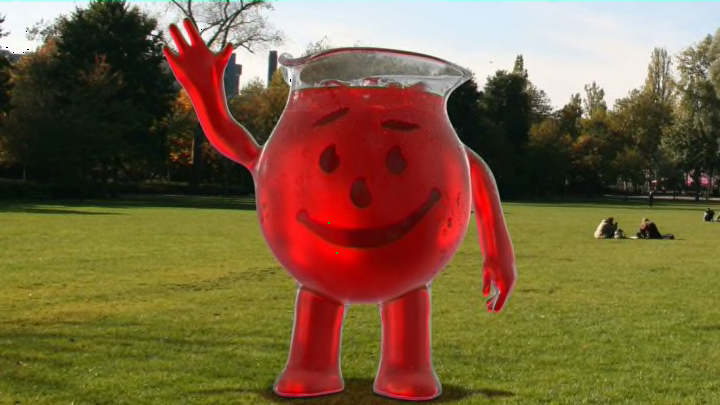
When Robert Skollar joined the General Foods marketing team at Grey Advertising in 1988, it didn’t take him long to realize that there were certain perks that came with the job. As the executive behind the Kool-Aid ad campaign, Skollar inherited the Kool-Aid Man, the anthropomorphic pitcher of sugar water that had been a staple of the brand for more than a decade.
Two stories stand out: The first, Skollar says, is when he was working late one night and decided to try on the Kool-Aid Man’s fiberglass costume for himself. It was like being inside a Christmas ornament. “It’s hard to hear anything in there,” Skollar tells Mental Floss. “You just hope you don’t fall down.”
The second was when Skollar got caught up in the trend of New York professionals putting on elaborate birthday parties for their kids. Skollar asked Richard Berg, the voice of Kool-Aid Man’s “Oh, Yeah!” catchphrase, to actually wear the costume for a personal appearance at his son’s sixth birthday party. (Normally, Berg just recorded the line.) “It was the voice in the costume, which was a first,” Skollar says. “And half the kids were frightened to death.”
Fortunately, that was hardly the typical reaction. Introduced in 1975, Kool-Aid Man became one of the most beloved characters in advertising history, with a recognition factor that sometimes outpaced that of Ronald McDonald. He got his own video game, his own comic book, and his own museum display in Hastings, Nebraska.
Not bad for someone who started out as a disembodied head.
By the time advertising executive Marvin Potts created a sentient pitcher of Kool-Aid in 1954, the powdered soft drink mix had been on shelves for 27 years. Conceived by Edwin Perkins in Hastings, Nebraska, as an alternative to glass bottle drinks—which were expensive to ship—what was then known as “Kool-Ade” became a cheap, popular way to flavor water.
When Perkins sold the brand to General Foods in 1953, their contracted advertising firm of Foote, Cone & Belding trialed a few different television spots. Potts’s idea—a large, bulbous container of Kool-Aid with an animated mouth and eyes named Pitcher Man—was the most popular. (Company lore says Perkins came up with the idea after watching his kid draw a smiley face on the condensation of a window.)
In the 1960s, Kool-Aid opted for celebrity spokespeople like The Monkees and Bugs Bunny, relegating Pitcher Man to the sidelines. “I think they found out Bugs was overwhelming the whole campaign,” Skollar says. “Kids would remember him but forget the ad was for Kool-Aid.”
That ceased to be a problem in 1975, when Alan Kupchick and Harold Karp at Grey Advertising developed the idea for Kool-Aid Man, an evolution of Pitcher Man. His face stopped moving, but the addition of arms and legs gave the character a more bombastic personality. It also allowed him to commit sensational acts of property destruction.
Skollar recalls that the iconic breaking-through-the-wall sequence wasn’t necessarily planned. “From what I’ve heard, someone on set said that Kool-Aid Man really had to make an entrance, and someone else, maybe a producer, suggested he come through the wall.” Breakaway bricks were set up, and the character's fiberglass shell—“the same material used for a Corvette Stingray,” Skollar says—effectively became a wrecking ball.
Although he was never officially named Kool-Aid Man at the time, the mascot helped propel sales of the drink mix. “It was a phenomenon,” Skollar says. “Here you had this 50-year-old product that’s not really convenient and not particularly healthy, and it’s huge.”
As Kool-Aid Man’s star grew, so did his opportunities to branch out. The property got its own Marvel comic—The Adventures of Kool-Aid Man—as well as an Atari 2600 video game. The latter could be redeemed with 125 points earned from purchasing Kool-Aid, which amounts to about 62.5 gallons of sugar water. (You could also send $10 with 30 points.)
When Skollar was handed control of the campaign in 1988, the advice was pretty clear. “It was basically: Don’t screw it up,” he says, “and make it more contemporary.”
Skollar says he took inspiration from Pee-wee’s Playhouse and the Peter Gabriel music video for "Sledgehammer" to conceive of an entire Kool-Aid Man universe—one bursting with frenetic activity that kids would find exciting and adults would find impenetrable.
“Most kid ads had a storyline at the time,” he says. “This didn’t. It was just surreal.”
This Lynchian Kool-Aid Man was no longer 7 years old, as previous marketing campaigns had implied, but 14 years old—old enough to play guitar and surf. Once naked, he now sported jeans and cool shirts. Skollar believes that the kinetic spots helped usher in a new wave of kid advertising that relied more on visceral, MTV-style cuts.
Not all of Kool-Aid’s efforts were focused on hyperactive kids, however. The drink mix was not without its controversies, having once been associated with the Jonestown massacre in 1978, where cult leader Jim Jones coerced his followers into drinking Kool-Aid and Flavor Ade laced with cyanide. There was also the matter of Kool-Aid suggesting gobs of sugar be added to the drink for flavor.
“We did a campaign targeted to moms, ‘Having Kids Means Having Kool-Aid,’” Skollar says. “And we told them they could control the amount of sugar they used. We also pushed that Kool-Aid had Vitamin C.”
Under Skollar, Kool-Aid sales shot to third place in the soft drink category—behind only Coke and Pepsi.

Skollar stayed on the Kool-Aid campaign through 1994, at which point the account was passed to Ogilvy & Mather. Eventually, the fiberglass costume became nylon and computer effects began to enhance his features.
CG was something Skollar had already started to experiment with, but eventually discarded it for the analog outfit. “There was something about that rawness, that awkward-looking pitcher breaking through walls,” he says.
One of the original costumes from 1975 sits in the Hastings Museum of Natural and Cultural History in Hastings, Nebraska, a testament to the character’s enduring appeal. Skollar says he once had research data supporting the fact that over 90 percent of kids could recognize Kool-Aid Man on sight.
The same wasn’t necessarily true of adults. “I remember one time we were shooting an ad where Kool-Aid Man was walking over a hill at sunset, holding hands with a little girl,” he says. “And a junior brand executive taps me on the shoulder and says, ‘We can’t see his face. How will we know who he is?’”