%20%20--%3E%0A%3Csvg%20version%3D%221.1%22%20id%3D%22Layer_1%22%20xmlns%3D%22http%3A%2F%2Fwww.w3.org%2F2000%2Fsvg%22%20xmlns%3Axlink%3D%22http%3A%2F%2Fwww.w3.org%2F1999%2Fxlink%22%20x%3D%220px%22%20y%3D%220px%22%0A%09%20viewBox%3D%220%200%20684.6%2068.1%22%20style%3D%22enable-background%3Anew%200%200%20684.6%2068.1%3B%22%20xml%3Aspace%3D%22preserve%22%3E%0A%3Cg%3E%0A%09%3Cpath%20d%3D%22M444.1%2C29.3h-17.4v14.5h17.4V29.3z%20M36.4%2C68.1l29.3-50.8V0H50.4L32.9%2C36.8L15.5%2C0H0v68.1h16.7V45.8l12.4%2C22.3H36.4z%0A%09%09%20M49.1%2C68.1h16.6V23.4L49.1%2C52.1V68.1z%20M76.6%2C68.1h45V53.8H93.3V41.6h21V27.1h-21V14.8h28.3V0.1h-45V68.1z%20M175.6%2C68.1h17.3v-68%0A%09%09h-16.5v40.3L150%2C0.1h-17.6v68h16.7V27.7L175.6%2C68.1z%20M235.8%2C14.8h15.4V0.1h-47.4v14.7H219v53.2h16.8V14.8z%20M290.3%2C45.9h-17.1%0A%09%09l7.5-15.6h2L290.3%2C45.9z%20M298.7%2C68.1h18l-32.2-68h-5.7l-32%2C68h18l3.3-7.1h27.1L298.7%2C68.1z%20M325.2%2C68.1h46.2V53.8h-29.6V0.1h-16.7%0A%09%09V68.1z%20M423.7%2C14.8h27.2V0.1H407v68h16.7V14.8z%20M462%2C68.1h46.2V53.8h-29.6V0.1H462V68.1z%20M564.8%2C34.1c0%2C10.7-7.2%2C19.2-18.5%2C19.2%0A%09%09c-11.4%2C0-18.5-8.5-18.5-19.2s7.1-19.2%2C18.5-19.2C557.6%2C14.9%2C564.8%2C23.4%2C564.8%2C34.1%20M580.6%2C34.1c0-19-14.2-34-34.3-34%0A%09%09c-20.2%2C0-34.3%2C15-34.3%2C34c0%2C19%2C14.1%2C34%2C34.3%2C34C566.4%2C68.1%2C580.6%2C53.1%2C580.6%2C34.1%20M604.8%2C20.5c0-4.1%2C3.3-6.2%2C6.7-6.2%0A%09%09c4.4%2C0%2C6.6%2C3%2C6.6%2C6.6h14.7C631.8%2C9.1%2C625.1%2C0.1%2C611%2C0.1c-12%2C0-21.7%2C9.3-21.7%2C20.6c0%2C10.9%2C5.9%2C15.9%2C16.7%2C19.8%0A%09%09c5.2%2C1.8%2C11.5%2C3.2%2C11.5%2C8c0%2C3.3-2.4%2C5.5-6.4%2C5.5c-3.6%2C0-6.6-3-6.6-6.7h-15.2c0%2C11.5%2C7.9%2C20.8%2C21.8%2C20.8c12%2C0%2C21.6-9.3%2C21.6-20.6%0A%09%09c0-10-5.3-16.4-16.7-19.8C610.6%2C26.1%2C604.8%2C25.3%2C604.8%2C20.5%20M670%2C20.9h14.7C683.8%2C9.1%2C677.1%2C0.1%2C663%2C0.1c-12%2C0-21.7%2C9.3-21.7%2C20.6%0A%09%09c0%2C10.9%2C5.9%2C15.9%2C16.7%2C19.8c5.2%2C1.8%2C11.5%2C3.2%2C11.5%2C8c0%2C3.3-2.4%2C5.5-6.4%2C5.5c-3.6%2C0-6.6-3-6.6-6.7h-15.2c0%2C11.5%2C7.9%2C20.8%2C21.8%2C20.8%0A%09%09c12%2C0%2C21.6-9.3%2C21.6-20.6c0-10-5.3-16.4-16.7-19.8c-5.4-1.6-11.3-2.4-11.3-7.2c0-4.1%2C3.3-6.2%2C6.7-6.2C667.7%2C14.4%2C670%2C17.3%2C670%2C20.9%0A%09%09%22%2F%3E%0A%3C%2Fg%3E%0A%3C%2Fsvg%3E%0A)

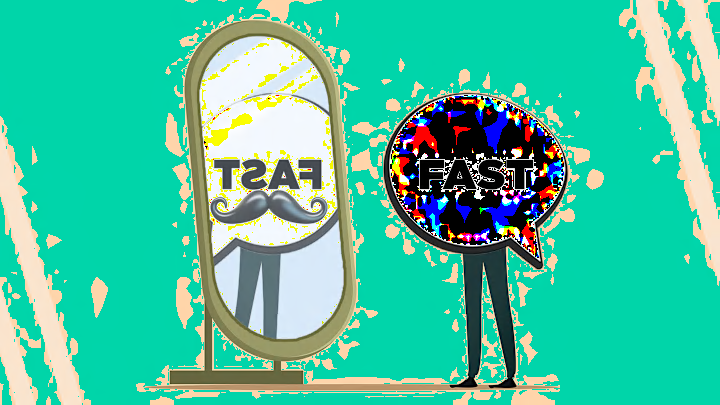
Here’s an ambiguous sentence for you: “Because of the agency’s oversight, the corporation’s behavior was sanctioned.” Does that mean, “Because the agency oversaw the company’s behavior, they imposed a penalty for some transgression,” or does it mean, “Because the agency was inattentive, they overlooked the misbehavior and gave it their approval by default”? We’ve stumbled into the looking-glass world of contronyms—words that are their own antonyms.
The contronym (also spelled “contranym”) goes by many names, including auto-antonym, antagonym, enantiodrome, self-antonym, antilogy, and Janus word (from the Roman god of beginnings and endings, often depicted with two faces looking in opposite directions). Here are a few of them.
1. Sanction
Sanction—which came to English via French, from Latin sanctio(n-) and sancire, “to ratify,”—can mean “give official permission or approval for (an action)” or conversely, “impose a penalty on.”
2. Oversight
Oversight is the noun form of two verbs with contrary meanings: “oversee” and “overlook.” Oversee, from Old English ofersēon (“look at from above”) means “supervise” (medieval Latin for the same thing: super-, “over” plus videre, “to see”). Overlook usually means the opposite: “to fail to see or observe; to pass over without noticing; to disregard, ignore,” according to the Oxford English Dictionary.
3. Left
Left can mean either remaining or departed. If the gentlemen have withdrawn to the drawing room for after-dinner cigars, who’s left? (The gentlemen have left and the ladies are left.)
4. Dust

Dust, along with the next two words, is a noun turned into a verb meaning either to add or to remove the thing in question. Only the context will tell you which it is. When you dust are you applying dust or removing it? It depends whether you’re dusting the crops or the furniture.
5. Seed
Seed can also go either way. If you seed the lawn you add seeds, but if you seed a tomato you remove them.
6. Stone
Stone is another verb to use with caution. You can stone some peaches, but please don’t stone your neighbor (even if he says he likes to get stoned).
7. Trim

Trim as a verb predates the noun, but it can also mean either adding or taking away. Arising from an Old English word meaning “to make firm or strong; to settle, arrange,” according to the OED, trim came to mean “to prepare, make ready.” Depending on whom or what was being readied, it could mean either of two contradictory things: “to decorate [something] with ribbons, laces, or the like ... to give it a finished appearance” or “to cut off the [outgrowths] or irregularities of.” And the context doesn’t always make it clear. If you’re trimming the tree are you using tinsel or a chain saw?
8. Cleave
Cleave can be cleaved into two homographs, words with different origins that end up spelled the same. Cleave, meaning “to cling to or adhere,” comes from an Old English word that took the forms cleofian, clifian, or clīfan. Cleave, with the contrary meaning “to split or sever (something)”—as you might do with a cleaver—comes from a different Old English word, clēofan. The past participle has taken various forms: cloven, which survives in the phrase “cloven hoof,” “cleft,” as in a “cleft palate” or “cleaved.”
9. Fast

Fast can mean “moving rapidly,” as in running fast, or “fixed, unmoving,” as in holding fast. If colors are fast they will not run. The meaning “firm, steadfast” came first; the adverb took on the sense “strongly, vigorously,” which evolved into “quickly,” a meaning that spread to the adjective.
10. Off
Off means “deactivated,” as in to turn off, but also “activated,” as in the alarm went off.
11. Weather
Weather can mean “to withstand or come safely through” (as in the company weathered the recession) or it can mean “to be worn away” (the rock was weathered).
12. Screen

Screen can mean “to show” (a movie) or “to hide” (an unsightly view).
13. Help
Help means “assist,” unless you can’t help doing something, when it means “prevent.”
14. Clip

Clip can mean “to bind together” or “to separate.” You clip sheets of paper to together or separate part of a page by clipping something out. Clip is a pair of homographs, words with different origins spelled the same. Old English clyppan, which means “to clasp with the arms, embrace, hug,” led to our current meaning, “to hold together with a clasp.” The other clip, “to cut or snip (a part) away,” is from Old Norse klippa, which may come from the sound of a shears.
15. Continue
Continue usually means “to persist in doing something,” but as a legal term it means “to stop a proceeding temporarily.”
16. Fight With

Fight with can be interpreted three ways. “He fought with his mother-in-law” could mean “They argued,” “They served together in the war,” or “He used the old battle-ax as a weapon.” (Thanks to linguistics professor Robert Hertz for this idea.)
17. Flog
Flog, meaning “to punish by caning or whipping,” showed up in school slang of the 17th century, but now it can have the contrary meaning, “to promote persistently,” as in “flogging a new book.” Perhaps that meaning arose from the sense “to urge (a horse, etc.) forward by whipping,” which grew out of the earliest meaning.
18. Go
Go means “to proceed,” but also “give out or fail,” i.e., “This car could really go until it started to go.”
19. Hold Up

Hold up can mean “to support” or “to hinder”: “What a friend! When I’m struggling to get on my feet, he’s always there to hold me up.”
20. Out
Out can mean “visible” or “invisible.” For example, “It’s a good thing the full moon was out when the lights went out.”
21. Out Of
Out of means “outside” or “inside”: “I hardly get out of the house because I work out of my home.”
22. Toss Out

Toss out could be either “to suggest” or “to discard”: “I decided to toss out the idea.”
23. Peer
Peer is a person of equal status (as in a jury of one’s peers), but some peers are more equal than others, like the members of the peerage, the British or Irish nobility.
24. Original
According to Dictionary.com, original can mean either “belonging to the beginning of something” or “new, fresh, inventive.”
25. Literally
The uproar was literally earth-shattering in 2013 when the editors of the Merriam-Webster Dictionary announced that literally could mean its opposite: figuratively. Well, remember: Dictionaries don’t legislate what words should mean; they just describe how speakers of a language use them. And, as the Oxford English Dictionary notes, literally has been used colloquially to mean figuratively for literally eons. As Frances Brooke wrote in 1769: “He is a fortunate man to be introduced to such a party of fine women at his arrival; it is literally to feed among the lilies.”
26. Apology

It’s not really an apology unless you say you’re sorry for something you did, right? But what if you’re not the least bit sorry and you make a reasoned defense of your actions or anything else you feel is misunderstood or unappreciated, like Philip Sidney’s An Apology for Poetry? Who’s sorry now?
27. Cull
To cull means either to pick the best (now usually said of a literary selection) or to remove the worst or weakest (in forestry or wildlife management).
28. Dike
A dike can be either a wall to prevent flooding or a ditch.
29. Enjoin
Enjoin means to urge someone to do something or to prohibit someone from doing something by issuing an injunction. “He enjoined him to return to his duties” vs. “the miners were enjoined from striking.”
30. Fine

Superb or meh? Fine, which was borrowed from French, can either mean “excellent” (for example, a fine wine) or “barely acceptable” (“OK. That’s fine. Whatever”).
31. First Degree
First degree means “least severe” in reference to a burn, but “most severe” in the case of a murder charge.
32. Garnish
Garnish means “to add a decorative touch,” such as a lemon slice, to food, but it can also mean “to take away,” as with wages.
33. Handicap
Handicap can refer to either a disadvantage that prevents equal achievement or an advantage provided to ensure equality.
34. Reservation

A reservation could be either a firm commitment or a hesitation about something. “Will you be dining with us tonight?” “Yes, we have reservations.” Or is it, “No, we have reservations”?
35. Secrete
When a cell or organ secretes something, it brings it forth, but when people secrete treasure or a document, they hide it. In a 2012 Word Snooper post, Lexie Kahn divulged the secret origin of secrete.
36. Stakeholder
Stakeholder can refer to someone who has a stake in an enterprise, or a bystander who holds the stake for those placing a bet.
37. Top

Top means “to put something on top” or “to take the top off.” She topped the tree so it wouldn’t brush the ceiling, then she topped it with a star.
38. Trip
A trip is either a journey or a stumble. If you take a trip running for the plane, you’re not going anywhere.
19. Variety
Variety can refer to a particular type of thing, or many types. The large nursery offers a variety of roses, but the smaller place has only one variety.
40. Wind Up

When you wind something up are you preparing it to start or stop? That depends on whether it’s an old fashioned clock or a long-winded speech.
A version of this piece ran in 2013 and 2015; it has been updated for 2023.