%20%20--%3E%0A%3Csvg%20version%3D%221.1%22%20id%3D%22Layer_1%22%20xmlns%3D%22http%3A%2F%2Fwww.w3.org%2F2000%2Fsvg%22%20xmlns%3Axlink%3D%22http%3A%2F%2Fwww.w3.org%2F1999%2Fxlink%22%20x%3D%220px%22%20y%3D%220px%22%0A%09%20viewBox%3D%220%200%20684.6%2068.1%22%20style%3D%22enable-background%3Anew%200%200%20684.6%2068.1%3B%22%20xml%3Aspace%3D%22preserve%22%3E%0A%3Cg%3E%0A%09%3Cpath%20d%3D%22M444.1%2C29.3h-17.4v14.5h17.4V29.3z%20M36.4%2C68.1l29.3-50.8V0H50.4L32.9%2C36.8L15.5%2C0H0v68.1h16.7V45.8l12.4%2C22.3H36.4z%0A%09%09%20M49.1%2C68.1h16.6V23.4L49.1%2C52.1V68.1z%20M76.6%2C68.1h45V53.8H93.3V41.6h21V27.1h-21V14.8h28.3V0.1h-45V68.1z%20M175.6%2C68.1h17.3v-68%0A%09%09h-16.5v40.3L150%2C0.1h-17.6v68h16.7V27.7L175.6%2C68.1z%20M235.8%2C14.8h15.4V0.1h-47.4v14.7H219v53.2h16.8V14.8z%20M290.3%2C45.9h-17.1%0A%09%09l7.5-15.6h2L290.3%2C45.9z%20M298.7%2C68.1h18l-32.2-68h-5.7l-32%2C68h18l3.3-7.1h27.1L298.7%2C68.1z%20M325.2%2C68.1h46.2V53.8h-29.6V0.1h-16.7%0A%09%09V68.1z%20M423.7%2C14.8h27.2V0.1H407v68h16.7V14.8z%20M462%2C68.1h46.2V53.8h-29.6V0.1H462V68.1z%20M564.8%2C34.1c0%2C10.7-7.2%2C19.2-18.5%2C19.2%0A%09%09c-11.4%2C0-18.5-8.5-18.5-19.2s7.1-19.2%2C18.5-19.2C557.6%2C14.9%2C564.8%2C23.4%2C564.8%2C34.1%20M580.6%2C34.1c0-19-14.2-34-34.3-34%0A%09%09c-20.2%2C0-34.3%2C15-34.3%2C34c0%2C19%2C14.1%2C34%2C34.3%2C34C566.4%2C68.1%2C580.6%2C53.1%2C580.6%2C34.1%20M604.8%2C20.5c0-4.1%2C3.3-6.2%2C6.7-6.2%0A%09%09c4.4%2C0%2C6.6%2C3%2C6.6%2C6.6h14.7C631.8%2C9.1%2C625.1%2C0.1%2C611%2C0.1c-12%2C0-21.7%2C9.3-21.7%2C20.6c0%2C10.9%2C5.9%2C15.9%2C16.7%2C19.8%0A%09%09c5.2%2C1.8%2C11.5%2C3.2%2C11.5%2C8c0%2C3.3-2.4%2C5.5-6.4%2C5.5c-3.6%2C0-6.6-3-6.6-6.7h-15.2c0%2C11.5%2C7.9%2C20.8%2C21.8%2C20.8c12%2C0%2C21.6-9.3%2C21.6-20.6%0A%09%09c0-10-5.3-16.4-16.7-19.8C610.6%2C26.1%2C604.8%2C25.3%2C604.8%2C20.5%20M670%2C20.9h14.7C683.8%2C9.1%2C677.1%2C0.1%2C663%2C0.1c-12%2C0-21.7%2C9.3-21.7%2C20.6%0A%09%09c0%2C10.9%2C5.9%2C15.9%2C16.7%2C19.8c5.2%2C1.8%2C11.5%2C3.2%2C11.5%2C8c0%2C3.3-2.4%2C5.5-6.4%2C5.5c-3.6%2C0-6.6-3-6.6-6.7h-15.2c0%2C11.5%2C7.9%2C20.8%2C21.8%2C20.8%0A%09%09c12%2C0%2C21.6-9.3%2C21.6-20.6c0-10-5.3-16.4-16.7-19.8c-5.4-1.6-11.3-2.4-11.3-7.2c0-4.1%2C3.3-6.2%2C6.7-6.2C667.7%2C14.4%2C670%2C17.3%2C670%2C20.9%0A%09%09%22%2F%3E%0A%3C%2Fg%3E%0A%3C%2Fsvg%3E%0A)

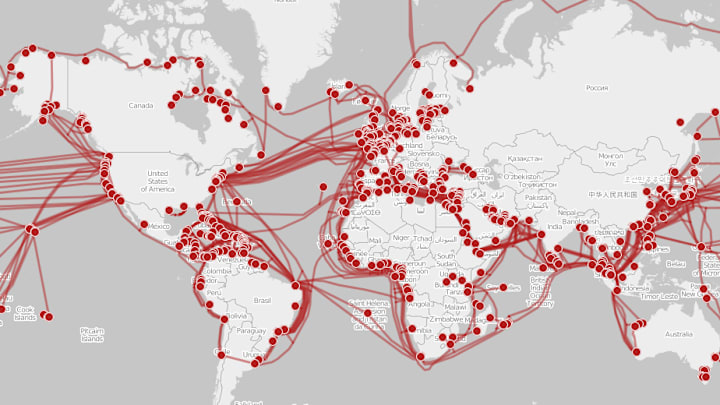
In describing the system of wires that comprises the internet, Neal Stephenson once compared Earth to a computer motherboard. From telephone poles suspending bundles of cable to signs posted warning of buried fiber optic lines, we are surrounded by evidence that at a basic level, the internet is really just a spaghetti-work of really long wires. But what we see is just a small part of the physical makeup of the net. The rest of it can be found in the coldest depths of the ocean. Here are 10 things you might not know about the internet’s system of undersea cables.
1. Cable installation is slow and expensive.
More than 95 percent of international data is transmitted by wires at the bottom of the ocean called submarine communications cables. In total, they are hundreds of thousands of miles long and can lie 8000 meters below the surface—as deep as Mount Everest is tall. The cables are installed by special boats called cable-layers. It’s more than a matter of dropping wires with anvils attached to them—the cables must generally be run across flat surfaces of the ocean floor, and care is taken to avoid coral reefs, sunken ships, fish beds, and other ecological habitats and general obstructions.
The diameter of a shallow water cable is about the same as a soda can, while deep water cables are much thinner—about the size of a Magic Marker. The size difference is related to simple vulnerability—there’s not much going on 8000 feet below sea level; consequently, there’s less need for galvanized shielding wire. Cables located at shallow depths are buried beneath the ocean floor using high pressure water jets. Though per-mile prices for installation change depending on total length and destination, running a cable across the ocean invariably costs hundreds of millions of dollars.
2. Sharks have tried to eat the internet.
There’s disagreement as to why, exactly, sharks occasionally gnaw on submarine communications cables. Maybe it has something to do with electromagnetic fields. Maybe they’re just curious. Maybe they’re trying to disrupt our communications infrastructure before mounting a land-based assault. The point remains that sharks have been discovered chewing on the internet, and they sometimes damage it—but “fish bites” account for less than 1 percent of cable faults in the industry’s history, according to the International Cable Protection Committee. Still, companies such as Google have shielded their cables in shark-proof wrappers.
3. The internet as as vulnerable underwater as it is underground.
It seems like every couple of years, some well-meaning construction worker puts his bulldozer in gear and kills Netflix for the whole continent. While the ocean is free of construction equipment that might otherwise combine to form Devastator, there are many ongoing aquatic threats to the submarine cables. Sharks aside, the internet is ever at risk of being disrupted by boat anchors, trawling by fishing vessels, and natural disasters. A Toronto-based company has proposed running a cable through the Arctic that connects Tokyo and London. This was previously considered impossible, but climate change and receding ice have moved the proposal firmly into the doable-but-really-expensive category.
4. Connecting the world through undersea cables isn’t a new idea.

In 1854, installation began on the first transatlantic telegraph cable, which connected Newfoundland and Ireland. Four years later the first transmission was sent, reading: “Laws, Whitehouse received five minutes signal. Coil signals too weak to relay. Try drive slow and regular. I have put intermediate pulley. Reply by coils.” This is, admittedly, not very inspiring. (“Whitehouse” referred to Wildman Whitehouse, the chief electrician of the Atlantic Telegraph Company.)
For historical context: During those four years of cable construction, Charles Dickens was still writing novels; Walt Whitman published Leaves of Grass; a small settlement called Dallas was formally incorporated in Texas; and Abraham Lincoln, candidate for the U.S. Senate, gave his “House Divided” speech.
5. Spies love underwater cables.
During the height of the Cold War, the USSR often transmitted weakly encoded messages between two of its major naval bases. Soviet officials thought strong encryption was a bother—and also overkill—because the bases were directly linked by an undersea cable located in sensor-laden Soviet territorial waters. No way would the Americans risk World War III by trying to somehow access and tap that cable.
They didn’t count on the U.S.S. Halibut, a specially fitted submarine capable of slipping by Soviet defenses. The American submarine found the cable and installed a giant wiretap, returning monthly to gather the transmissions it had recorded. This operation, called IVY BELLS, was later compromised by a former NSA analyst named Ronald Pelton, who sold information on the mission to the Soviets. Today, tapping submarine communications cables is standard operating procedure for spy agencies.
6. Governments are turning to submarine cables to avoid spies.

With respect to electronic espionage, one big advantage held by the United States is the key role its scientists, engineers, and corporations played in inventing and building large parts of the global telecommunications infrastructure. Major lines of data tend to cross into American borders and territorial waters, making wiretapping a breeze, relatively speaking. When documents stolen by former NSA analyst Edward Snowden came to light, many countries were outraged to learn the extent to which American spy agencies were intercepting foreign data. As a result, some countries are reconsidering the infrastructure of the internet itself. Brazil, for example, launched a project to build a submarine communications cable to Portugal that not only bypassed the United States entirely, but also specifically excludes U.S. companies from involvement.
7. Submarine communications cables are faster and cheaper than satellites.
As of 2022, there were more than 5000 satellites in orbit. We’re landing probes on comets, we’re deflecting asteroids so they don’t collide with Earth, and we’re planning missions to Mars. We’re living in the future! It just seems self-evident that space would be a better way to virtually “wire” the internet than our current method of running really long cables along the ocean floor. Surely satellites would be better than a technology invented before the invention of the telephone—right?
As it turns out, no. Though fiber optic cables and communications satellites were both developed in the 1960s, satellites have a two-fold problem: latency and bit loss. Sending and receiving signals to and from space takes time. Meanwhile, researchers have developed optical fibers that can transmit information at 99.7 percent the speed of light. For an idea of what the internet would be like without undersea cables, visit Antarctica, the only continent without a physical connection to the net. The continent relies on satellites, and bandwidth is at a premium [PDF] which is no small problem when one considers the important, data-intensive climate research underway. Today, Antarctic research stations produce more data than they can transmit through space.
8. To take down the internet, you’ll need scuba gear and a pair of wire cutters.

The good news is that it’s hard to cut through a submarine communications cable due to the thousands of very lethal volts running through each of them. The bad news is that it is possible, as seen in Egypt in 2013. There, just north of Alexandria, men in wetsuits intentionally cut through the South-East-Asia-Middle-East-West-Europe 4 cable, which runs 12,500 miles and connects three continents. Internet speeds in Egypt plunged by 60 percent until the line could be repaired.
9. Underwater cables are not easy to repair, but after 150 years, we’ve learned a trick or two.
If you think replacing that one ethernet cable you can’t quite reach behind your desk is a pain, try replacing a solid, broken garden hose at the bottom of the ocean. When a submarine cable is damaged, special repair ships are dispatched. If the cable is located in shallow waters, robots are deployed to grab the cable and haul it to the surface. If the cable is in deep waters (6500 feet or greater), the ships lower specially designed grapnels that grab onto the cable and hoist it up for mending. To make things easier, grapnels sometimes cut the damaged cable in two, and repair ships raise each end separately for patching above the water.
10. The internet’s undersea network is built to last for 25 years.
As of 2023 there were more than 500 communications cables at the bottom of the ocean. Submarine cables have a life expectancy of 25 years, during which time they are considered economically viable from a capacity standpoint. But global data consumption has exploded. In 2013, internet traffic was 5 gigabytes per capita. In 2023, Finland has the world’s highest rate of data consumption, at nearly 36 gigabytes per month for each broadband subscription in the country. Fortunately, techniques in phase modulation and improvements in submarine line terminal equipment (SLTE) have boosted capacity of existing cables in some places by as much as 8000 percent. The wires we have are more than ready for today's traffic.
A version of this story ran in 2015; it has been updated for 2023.