%20%20--%3E%0A%3Csvg%20version%3D%221.1%22%20id%3D%22Layer_1%22%20xmlns%3D%22http%3A%2F%2Fwww.w3.org%2F2000%2Fsvg%22%20xmlns%3Axlink%3D%22http%3A%2F%2Fwww.w3.org%2F1999%2Fxlink%22%20x%3D%220px%22%20y%3D%220px%22%0A%09%20viewBox%3D%220%200%20684.6%2068.1%22%20style%3D%22enable-background%3Anew%200%200%20684.6%2068.1%3B%22%20xml%3Aspace%3D%22preserve%22%3E%0A%3Cg%3E%0A%09%3Cpath%20d%3D%22M444.1%2C29.3h-17.4v14.5h17.4V29.3z%20M36.4%2C68.1l29.3-50.8V0H50.4L32.9%2C36.8L15.5%2C0H0v68.1h16.7V45.8l12.4%2C22.3H36.4z%0A%09%09%20M49.1%2C68.1h16.6V23.4L49.1%2C52.1V68.1z%20M76.6%2C68.1h45V53.8H93.3V41.6h21V27.1h-21V14.8h28.3V0.1h-45V68.1z%20M175.6%2C68.1h17.3v-68%0A%09%09h-16.5v40.3L150%2C0.1h-17.6v68h16.7V27.7L175.6%2C68.1z%20M235.8%2C14.8h15.4V0.1h-47.4v14.7H219v53.2h16.8V14.8z%20M290.3%2C45.9h-17.1%0A%09%09l7.5-15.6h2L290.3%2C45.9z%20M298.7%2C68.1h18l-32.2-68h-5.7l-32%2C68h18l3.3-7.1h27.1L298.7%2C68.1z%20M325.2%2C68.1h46.2V53.8h-29.6V0.1h-16.7%0A%09%09V68.1z%20M423.7%2C14.8h27.2V0.1H407v68h16.7V14.8z%20M462%2C68.1h46.2V53.8h-29.6V0.1H462V68.1z%20M564.8%2C34.1c0%2C10.7-7.2%2C19.2-18.5%2C19.2%0A%09%09c-11.4%2C0-18.5-8.5-18.5-19.2s7.1-19.2%2C18.5-19.2C557.6%2C14.9%2C564.8%2C23.4%2C564.8%2C34.1%20M580.6%2C34.1c0-19-14.2-34-34.3-34%0A%09%09c-20.2%2C0-34.3%2C15-34.3%2C34c0%2C19%2C14.1%2C34%2C34.3%2C34C566.4%2C68.1%2C580.6%2C53.1%2C580.6%2C34.1%20M604.8%2C20.5c0-4.1%2C3.3-6.2%2C6.7-6.2%0A%09%09c4.4%2C0%2C6.6%2C3%2C6.6%2C6.6h14.7C631.8%2C9.1%2C625.1%2C0.1%2C611%2C0.1c-12%2C0-21.7%2C9.3-21.7%2C20.6c0%2C10.9%2C5.9%2C15.9%2C16.7%2C19.8%0A%09%09c5.2%2C1.8%2C11.5%2C3.2%2C11.5%2C8c0%2C3.3-2.4%2C5.5-6.4%2C5.5c-3.6%2C0-6.6-3-6.6-6.7h-15.2c0%2C11.5%2C7.9%2C20.8%2C21.8%2C20.8c12%2C0%2C21.6-9.3%2C21.6-20.6%0A%09%09c0-10-5.3-16.4-16.7-19.8C610.6%2C26.1%2C604.8%2C25.3%2C604.8%2C20.5%20M670%2C20.9h14.7C683.8%2C9.1%2C677.1%2C0.1%2C663%2C0.1c-12%2C0-21.7%2C9.3-21.7%2C20.6%0A%09%09c0%2C10.9%2C5.9%2C15.9%2C16.7%2C19.8c5.2%2C1.8%2C11.5%2C3.2%2C11.5%2C8c0%2C3.3-2.4%2C5.5-6.4%2C5.5c-3.6%2C0-6.6-3-6.6-6.7h-15.2c0%2C11.5%2C7.9%2C20.8%2C21.8%2C20.8%0A%09%09c12%2C0%2C21.6-9.3%2C21.6-20.6c0-10-5.3-16.4-16.7-19.8c-5.4-1.6-11.3-2.4-11.3-7.2c0-4.1%2C3.3-6.2%2C6.7-6.2C667.7%2C14.4%2C670%2C17.3%2C670%2C20.9%0A%09%09%22%2F%3E%0A%3C%2Fg%3E%0A%3C%2Fsvg%3E%0A)

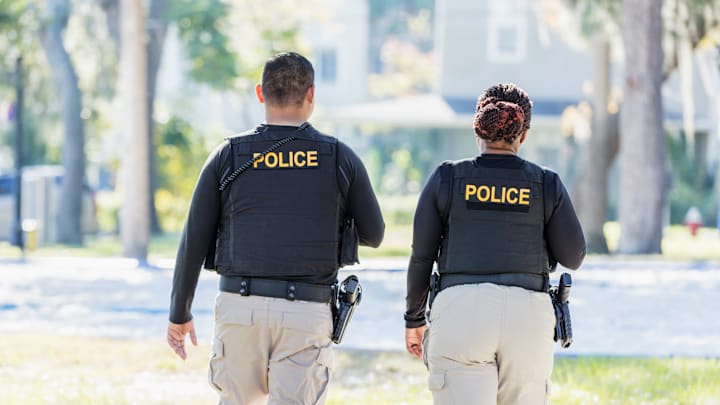
Two cops in different parts of the country might wear similar uniforms and share the same title, but their day-to-day reality—from their bank accounts to their safety—can look like two entirely different careers.
While movies and TV shows suggest the job is the same everywhere, the actual "fine print" of law enforcement is largely written at the state level. These local decisions on funding, training requirements, and legal protections create a massive disparity in how the job functions. To see where those gaps are widest, WalletHub analyzed all 50 states and the District of Columbia across 30 key metrics to find the best and worst places to be a police officer in 2026.
What’s Under the Hood

To build the ranking, the study grouped 30 indicators measuring how favorable each state is for police officers into three main categories: career opportunity, professional preparation, and working conditions.
It wasn’t just about base salary. The analysis looked at "adjusted" pay—how far a paycheck actually goes after accounting for local cost of living. It also accounted for the demands of the job itself, incorporating factors such as violent crime rates and the presence of "Blue Alert" systems, which notify the public when an officer is injured or killed in the line of duty.
Beyond compensation and risk, the study also examined how officers are trained for the job. It compared required training hours across states and whether continuing education is mandated in areas like de-escalation and crisis response, which have become increasingly central to modern policing standards.
The full state-by-state breakdown is shown in the table below:
Rank | State | Score | Opportunity Rank | Training Requirements Rank | Safety Rank |
|---|---|---|---|---|---|
1 | California | 59.33 | 11 | 2 | 14 |
2 | Connecticut | 56.73 | 51 | 1 | 2 |
3 | Illinois | 56.07 | 18 | 5 | 10 |
4 | Maryland | 54.57 | 38 | 6 | 8 |
5 | District of Columbia | 54.02 | 1 | 8 | 50 |
6 | Colorado | 52.17 | 36 | 7 | 20 |
7 | Minnesota | 52.11 | 19 | 18 | 3 |
8 | Washington | 51.80 | 13 | 13 | 15 |
9 | Tennessee | 51.77 | 4 | 3 | 43 |
10 | Ohio | 51.06 | 40 | 4 | 27 |
11 | Massachusetts | 50.36 | 26 | 12 | 17 |
12 | Georgia | 47.87 | 34 | 10 | 28 |
13 | New York | 47.46 | 3 | 40 | 4 |
14 | Maine | 46.97 | 45 | 17 | 9 |
15 | Texas | 46.75 | 14 | 11 | 39 |
16 | South Dakota | 46.46 | 20 | 9 | 40 |
17 | Rhode Island | 45.57 | 50 | 21 | 5 |
18 | Indiana | 45.41 | 23 | 14 | 34 |
19 | Virginia | 44.87 | 7 | 28 | 22 |
20 | Iowa | 44.73 | 12 | 30 | 11 |
21 | Delaware | 44.72 | 33 | 24 | 16 |
22 | Idaho | 44.06 | 24 | 20 | 32 |
23 | Missouri | 43.92 | 31 | 19 | 31 |
24 | Florida | 43.62 | 9 | 42 | 7 |
25 | Oklahoma | 43.30 | 25 | 15 | 42 |
26 | Utah | 43.19 | 48 | 25 | 6 |
27 | Pennsylvania | 42.52 | 37 | 26 | 23 |
28 | New Hampshire | 42.46 | 30 | 44 | 1 |
29 | North Carolina | 41.93 | 39 | 27 | 19 |
30 | North Dakota | 41.60 | 2 | 49 | 25 |
31 | Michigan | 41.50 | 32 | 23 | 36 |
32 | Nebraska | 41.50 | 8 | 46 | 12 |
33 | New Jersey | 41.17 | 27 | 39 | 13 |
34 | Arizona | 39.62 | 21 | 32 | 29 |
35 | Wyoming | 38.96 | 29 | 22 | 47 |
36 | Wisconsin | 38.91 | 41 | 31 | 24 |
37 | New Mexico | 38.43 | 5 | 16 | 51 |
38 | South Carolina | 38.21 | 16 | 33 | 35 |
39 | Kentucky | 38.15 | 10 | 29 | 44 |
40 | Montana | 38.14 | 17 | 35 | 33 |
41 | Kansas | 37.97 | 28 | 34 | 30 |
42 | Mississippi | 37.69 | 6 | 37 | 45 |
43 | Vermont | 37.58 | 44 | 38 | 21 |
44 | Oregon | 35.22 | 46 | 41 | 26 |
45 | West Virginia | 34.05 | 15 | 45 | 41 |
46 | Alabama | 33.06 | 22 | 47 | 38 |
47 | Louisiana | 31.81 | 35 | 43 | 46 |
48 | Arkansas | 30.89 | 43 | 36 | 48 |
49 | Nevada | 30.48 | 42 | 48 | 37 |
50 | Hawaii | 29.83 | 49 | 51 | 18 |
51 | Alaska | 25.90 | 47 | 50 | 49 |
Note: 51 locations are included in WalletHub’s list because of the addition of Washington, D.C.
The Top of the Force

At the top of the list, California ranks first overall for 2026, marking a consistent streak of high performance. The Golden State combines high adjusted wages—the third-highest in the country—with significant investment in police technology and training.
Just behind it, Connecticut comes in second and is defined less by pay and more by preparation. The state requires more than 1,300 hours of basic training for new recruits—far above what many states require—making it one of the most training-intensive systems in the country.
Illinois follows in third place, driven largely by compensation, with the highest median pay for police officers: nearly $101,700. When adjusted for cost of living, officer pay in the "Land of Lincoln" is considerably sky-high, making it a powerhouse for career opportunities.
Other top-tier states include Maryland, Washington D.C., and Colorado, all of which benefit from a combination of high per-capita spending on police and robust legal protections for officers.
The Lower Ranks

At the quite literal other end of the map, Alaska comes in last. While the state actually spends its fair share on police protection, it struggles with high rates of officer fatalities and injuries, coupled with a high violent crime rate that affects overall working conditions.
Following Alaska are Hawaii, Nevada, Arkansas, and Louisiana. These states often suffer from a double whammy: lower salaries relative to the cost of living and higher-than-average safety risks. In Hawaii and Nevada, for example, the high cost of housing significantly devalues what might otherwise look like a competitive paycheck.
Connecting the Dots
The takeaway from the 2026 data is that a police officer's experience is heavily dictated by geography. In some states, a high-risk job is offset by high-reward protections and extensive preparation. In others, officers are asked to do more with less support and lower real-world pay. Those differences ultimately affect not just recruitment and retention, but the day-to-day reality of the profession itself.
Every officer takes the same oath, but the fine print changes at the state line. From the hours spent in the academy to the digits on a retirement check, a cop’s zip code is just as vital as the radio on their belt or the vest on their back.