%20%20--%3E%0A%3Csvg%20version%3D%221.1%22%20id%3D%22Layer_1%22%20xmlns%3D%22http%3A%2F%2Fwww.w3.org%2F2000%2Fsvg%22%20xmlns%3Axlink%3D%22http%3A%2F%2Fwww.w3.org%2F1999%2Fxlink%22%20x%3D%220px%22%20y%3D%220px%22%0A%09%20viewBox%3D%220%200%20684.6%2068.1%22%20style%3D%22enable-background%3Anew%200%200%20684.6%2068.1%3B%22%20xml%3Aspace%3D%22preserve%22%3E%0A%3Cg%3E%0A%09%3Cpath%20d%3D%22M444.1%2C29.3h-17.4v14.5h17.4V29.3z%20M36.4%2C68.1l29.3-50.8V0H50.4L32.9%2C36.8L15.5%2C0H0v68.1h16.7V45.8l12.4%2C22.3H36.4z%0A%09%09%20M49.1%2C68.1h16.6V23.4L49.1%2C52.1V68.1z%20M76.6%2C68.1h45V53.8H93.3V41.6h21V27.1h-21V14.8h28.3V0.1h-45V68.1z%20M175.6%2C68.1h17.3v-68%0A%09%09h-16.5v40.3L150%2C0.1h-17.6v68h16.7V27.7L175.6%2C68.1z%20M235.8%2C14.8h15.4V0.1h-47.4v14.7H219v53.2h16.8V14.8z%20M290.3%2C45.9h-17.1%0A%09%09l7.5-15.6h2L290.3%2C45.9z%20M298.7%2C68.1h18l-32.2-68h-5.7l-32%2C68h18l3.3-7.1h27.1L298.7%2C68.1z%20M325.2%2C68.1h46.2V53.8h-29.6V0.1h-16.7%0A%09%09V68.1z%20M423.7%2C14.8h27.2V0.1H407v68h16.7V14.8z%20M462%2C68.1h46.2V53.8h-29.6V0.1H462V68.1z%20M564.8%2C34.1c0%2C10.7-7.2%2C19.2-18.5%2C19.2%0A%09%09c-11.4%2C0-18.5-8.5-18.5-19.2s7.1-19.2%2C18.5-19.2C557.6%2C14.9%2C564.8%2C23.4%2C564.8%2C34.1%20M580.6%2C34.1c0-19-14.2-34-34.3-34%0A%09%09c-20.2%2C0-34.3%2C15-34.3%2C34c0%2C19%2C14.1%2C34%2C34.3%2C34C566.4%2C68.1%2C580.6%2C53.1%2C580.6%2C34.1%20M604.8%2C20.5c0-4.1%2C3.3-6.2%2C6.7-6.2%0A%09%09c4.4%2C0%2C6.6%2C3%2C6.6%2C6.6h14.7C631.8%2C9.1%2C625.1%2C0.1%2C611%2C0.1c-12%2C0-21.7%2C9.3-21.7%2C20.6c0%2C10.9%2C5.9%2C15.9%2C16.7%2C19.8%0A%09%09c5.2%2C1.8%2C11.5%2C3.2%2C11.5%2C8c0%2C3.3-2.4%2C5.5-6.4%2C5.5c-3.6%2C0-6.6-3-6.6-6.7h-15.2c0%2C11.5%2C7.9%2C20.8%2C21.8%2C20.8c12%2C0%2C21.6-9.3%2C21.6-20.6%0A%09%09c0-10-5.3-16.4-16.7-19.8C610.6%2C26.1%2C604.8%2C25.3%2C604.8%2C20.5%20M670%2C20.9h14.7C683.8%2C9.1%2C677.1%2C0.1%2C663%2C0.1c-12%2C0-21.7%2C9.3-21.7%2C20.6%0A%09%09c0%2C10.9%2C5.9%2C15.9%2C16.7%2C19.8c5.2%2C1.8%2C11.5%2C3.2%2C11.5%2C8c0%2C3.3-2.4%2C5.5-6.4%2C5.5c-3.6%2C0-6.6-3-6.6-6.7h-15.2c0%2C11.5%2C7.9%2C20.8%2C21.8%2C20.8%0A%09%09c12%2C0%2C21.6-9.3%2C21.6-20.6c0-10-5.3-16.4-16.7-19.8c-5.4-1.6-11.3-2.4-11.3-7.2c0-4.1%2C3.3-6.2%2C6.7-6.2C667.7%2C14.4%2C670%2C17.3%2C670%2C20.9%0A%09%09%22%2F%3E%0A%3C%2Fg%3E%0A%3C%2Fsvg%3E%0A)

Old maps are rife with phantom islands. Sometimes these nonexistent landmasses come about because of mistakes made by sailors or cartographers; sometimes they can be traced back to folklore or legends; and sometimes there’s an optical illusion at play.
Let’s explore all manner of phantom islands, from lands supposedly spotted by famous explorers to the Isle of Demons, as adapted from the above episode of The List Show on YouTube.
- Bermeja
- Crocker Land
- Bradley Land
- Byers’s Island
- Isle of Demons
- Sannikov Land
- Hy-Brasil
- Frisland
- Elizabeth Island
Bermeja

In the late 1990s, the Mexican government sent an expedition to a small, uninhabited island in the Gulf of Mexico known as Bermeja, which had been appearing on maps of the region since the 16th century. The country was in the midst of negotiating a treaty with the United States, and Bermeja was important to establishing Mexico’s maritime boundary—and the rights to any oil that might exist within that boundary.
But when the ships got to Bermeja’s supposed location, they found … zilch. Nada. nothing but empty sea.
Theories abound about what happened to Bermeja. Some have suggested that it was covered by rising sea levels. Others believe that it was taken out by a geological landslide. Conspiracy theorists think there was a plot by the U.S. government or the CIA to destroy the island to increase the maritime territory and oil rights of the United States.
But analysis in the late 2000s, when Mexico searched for the island again, showed that there hadn’t been an island in that location for more than 5000 years, which means that it’s possible those 16th-century cartographers were wrong. They drew an island that never existed.
Crocker Land

Robert Peary really, really wanted to be the first person to make it to the North Pole. The Arctic explorer tried in 1893–1895, 1898–1902, and again in 1905–1906. When the third expedition failed, Peary wanted to make another go at it basically right away, but he couldn’t because he was out of money. He approached his previous backers again, even naming a previously undiscovered landmass after one of them. George Crocker became the namesake of Crocker Land, which was located 130 miles northwest of Cape Thomas Hubbard.
Unfortunately for Peary, Crocker didn’t cough up any cash; instead, he used his money to aid San Francisco after its devastating 1906 earthquake. Peary did make it back to the Arctic, however, and ultimately claimed to have made it to the North Pole in 1909—though his claim was met with some serious polar explorer drama.
Before Peary could publicly claim victory in the race for the pole, a rival explorer, Frederick Cook, stated he’d gotten to the Pole a year before Peary said he did. The two men duked it out in the press for months, with Cook ultimately saying that not only did Peary not make the Pole—Crocker Land also didn’t exist.
Peary’s people were not going to take this lying down. Donald MacMillan, who had served as an assistant to Peary the year he said he’d reached the Pole, put together an expedition to prove Crocker Land’s existence.
Macmillan and his crew searched without luck for Crocker Land until one day in April, when a member of the expedition finally spotted a new landmass. Macmillan later wrote: “We ran to the top of the highest mound. There could be no doubt about it. Great heavens! What a land! Hills, valleys, snow-capped peaks extending through at least one hundred and twenty degrees of the horizon.”
Imagine how they must have felt when that long sought-for island began to shift and change before their eyes until, eventually, it disappeared completely. What they had seen was a fata morgana, a mirage caused by light bending through air of different temperatures.
A lot more happened after that—including the murder of an Indigenous guide by a member of the expedition that was covered up—but the tl;dr is that Macmillan and some of his men ultimately ended up stuck in the Arctic for years before they were eventually rescued. They never found Crocker Land.
As for what Peary saw … some think he didn’t see anything at all, and instead made Crocker Land up in a bid to get funding. His notes from that day don’t mention the landmass; neither did the diaries of any of the others on the expedition. And perhaps most tellingly, neither did drafts of Nearest the Pole. The island only popped up in the final book.
You May Also Like ...
- 20 Maps That Changed the World
- How a Scottish Swindler Lured His Countrymen to a Fake City of Untold Riches
- 20 of the Strangest Maps Ever Created
Add Mental Floss as a preferred news source!
Bradley Land

Cook also said he saw a new landmass in 1908 as he was trying for the pole, which he dubbed Bradley Land after one of his financial backers. It was supposedly a few degrees to the north of Crocker Land and consisted of two landmasses, which Cook described as “snow covered, ice-sheeted and desolate. But it was real land with all the sense of security solid earth can offer.”
Spoiler alert: It was not real land. Like Crocker Land, Bradley Land did not exist.
Byers’s Island

In his 1832 book A Narrative of Four Voyages: to the South Sea, North and South Pacific Ocean, Chinese sea, Ethiopic and southern Atlantic Ocean, Indian and Antarctic Ocean from the year 1822 to 1831, captain Benjamin Morrell dubbed himself “the discoverer of countries the very existence of which was before unknown to the civilized world.” One of the things he claimed to have discovered in the Pacific Ocean was Byers Island, likely named after one of his financiers. Morrell described the island as “moderately elevated” and “about four miles in circumference” with “some bushes and spots of vegetation.” Among the wildlife found on the island were sea birds, green turtles, and what he called “sea elephants,” which were probably elephant seals.
The island did appear on a few maps along with a question mark, and though it warranted mention in an 1899 guidebook, that book also noted that Byers’s Island—along with another island Morrell discovered that was named after him—had not “been seen for many years, and it is quite possible that the discoverers’ positions were so much in error that what they really western islands of the Hawaiian Group.” It’s also possible that they were simply made up, along with many of the other things featured in Morrell’s book, which was probably ghostwritten.
What’s most fascinating about this story is Morrell himself: In 1830, he found himself in the Carteret Islands, where long story short, he declared war on the native population. On different islands, he took two locals prisoner and dragged them on the voyage with him all the way back to New York, where—heavily in debt—Morrell put his two captives on stage in a show called “Two Cannibals of the Islands of the South Pacific.” A few years later, he went back to sea, got accused of piracy, and eventually died a fugitive in the late 1830s, though some believe he may have staged his own death.
Isle of Demons

The Isle of Demons first showed up on 16th-century maps, where it sat off the coast of Newfoundland. It was said to be shrouded in mist, and as André Thevet wrote in his 1575 book Universal Cosmography, anyone who came near was “buffeted by a great tempest and they heard in the air, about the tops and the masts of their vessels, human voices making a great din, but there was no form to their speech, only such a murmuring as you might hear in the middle of a public hall on a market day.” One map made in 1556 by Giacomo Gastaldi showed an abundance of life on the island, including trees, birds, and little horned and winged demons that, according to legend, would attack passing ships.
In 1542, a noblewoman named Marguerite de La Rocque and her lover (alongside her servant) ended up on the island when they were kicked off their ship after their affair was discovered. They built a hut, and later recounted how the island’s demons, disguised as terrifying beasts, attempted to rip it down. At night, they heard otherworldly screeching. Everyone but Marguerite eventually died; she was rescued by passing a fishing boat after living alone for a year.
Sailors wholeheartedly believed the island was haunted, so they were obviously terrified of it and avoided it at all costs. The island remained on maps for a century or so before people realized it didn’t exist, though there are theories that it might have been an island in the area like Quirpon Island. Some have theorized that the inhuman voices sailors heard may have been colonies of seabirds. And the beasts Marguerite encountered? Wild animals like walruses, which she was likely never to have seen before.
Sannikov Land

Russian explorer Yakov Sannikov thought he spotted a large landmass near the New Siberian Islands in the early 1800s, which would come to be called “Sannikov Land.” In 1886, another Russian explorer named Eduard von Toll also spotted land in that area describing “the sharp outlines of four truncated cones[,] like table mountains, from which a low foreland extended towards the east.” He later organized an expedition to find the island, but he never did—and neither did any of the other people who looked for it. Still, Sannikov Land showed up on maps into the 20th century, when it was finally proven to not exist—though there are some who believe it did exist and disappeared due to environmental factors. Real or not, the island served as inspiration for Vladimir Obruchev’s 1924 adventure novel Sannikov Land, which was also adapted into a movie.
Hy-Brasil

This small island was said to sit off the west coast of Ireland. According to legend, it was visible just once every seven years, after which it was cloaked by fog. Hy-Brasil—which also went by names like Brazil, O’Brasil, The Enchanted Island, and The Isle of the Blessed—may or may not have originated in Irish folklore. It first appeared on a 14th-century Italian map, but it’s become deeply associated with Ireland.
Sailors who saw it while at sea reported attempting to approach it through the fog but never being able to make it to shore. According to one bit of hearsay, a crew got lost in the fog and ended up on the island, where they found a castle; they knocked on the door, but no one answered. The next day, they were approached by “a very ancient grave gentleman” and his servants, who threw them a feast and proclaimed that “the island was called O’Brazile; that his ancestors were sometimes princes of it, telling them also, that he and several persons of quality, by the malicious diabolical art of a great Negromancer, had been tyrannically shut up in the castle they knockt at yesterday.” The gentleman helped to get them out of Hy-Brazil’s harbor and back on their way.
Unfortunately for Hy-Brazil, its days were numbered. According to a post by Cynthia Smith, a reference specialist in the Geography and Map Division at the Library of Congress, “As maritime traffic increased, cartographers began to doubt [its] existence.” British cartographer Thomas Jefferys called it the “Imaginary Isle of O Brazil” on a 1753 map, but even then, it remained on maps for another 120 years before finally disappearing—and not just for seven years this time.
Frisland

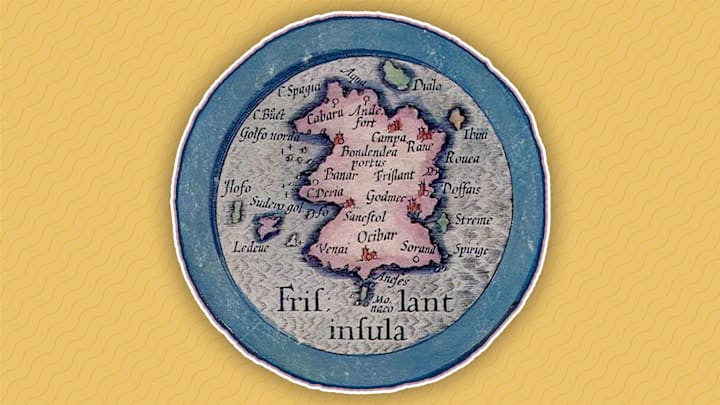
In the 16th and 17th centuries, cartographers studying maps of the North Atlantic would have seen an island south of Iceland called Frisland. How this island, which does not exist, came to be is a fascinating story.
It starts with the Venetian senator Nicolò Zeno, who in 1558 anonymously published the story of his forebears Nicoloand Antonio, who were navigators in the 14th century.
Writing to Antonio, Nicolo recounted how his ship had wrecked on Frisland, which was ruled by a man named Zichmni. He promptly made Nicolo the admiral of his fleet and ordered him to invade Iceland. He failed at that mission, but apparently attacked a few other islands and eventually made it all the way to Greenland. Nicolo invited Antonio to come and live on Frisland with him, and Antonio accepted.
In the second set of letters, Antonio—writing to their brother Carlo, a Venetian merchant—described his adventures as admiral of Zichmni’s fleet after Nicolo’s death. (Yes, those adventures include cannibals.) The book also included a map that would come to be known as the Zeno map. Some believe the book proves that the Zeno brothers made it to North America 100 years before Columbus.
Although there are a number of theories floating around out there about Frisland—including that Zichmni was a Scottish nobleman named Henry Sinclair, Earl of Orkney—it seems more probable that the whole thing was a hoax. In his book The European discovery of America : the northern voyages, A.D. 500-1600, maritime historian Samuel Eliot Morison dismissed the Sinclair story outright and noted that Frederick W. Lucas published an entire book that “raked the Zeno-Zichmni craft fore and aft with historical and geographical facts, reducing the story to shreds as far as reputable history is concerned” in 1898.
Hoax or no, the Zeno map would prove to be hugely influential: Many famous cartographers incorporated it into their own maps, including Gerardus Mercator, the guy behind the Mercator Projection. According to Morison, “the Zeno map befuddled cartographers for over a century.”
Elizabeth Island

This phantom island was reported by one of the most famous explorers of all time. In December 1577, Sir Frances Drake left England on the Pelican (soon renamed the Golden Hind) on a mission to “find out places meet to have traffic.” For the next three-ish years, he circumnavigated the globe, stopping in plenty of far-flung locales while indulging in a bit of piracy not officially authorized by the Crown. When he made his way through the southern tip of South America through the Strait of Magellan in August 1578, he and his crew encountered severe storms, forcing Drake to take cover near an island that became known as Elizabeth Island.
Elizabeth Island was added to maps and stayed there until the mid-18th century, but other explorers making their way through the Strait of Magellan never saw it. Some think that Drake actually landed on Hornos Island, but in his 1939 book Cape Horn, marine historian Felix Reisenberg hypothesized that Drake had found Elizabeth Island and it vanished later:
“Recent earthquakes in Chile … show what might have easily happened at the southernmost peak of that huge chain of craters. The Island of Elizabeth might have been blown to Kingdom Come a year or so after Francis Drake left its haven,” Reisenberg wrote. “The second alternative is that the centuries, having already reduced the peak, might have ground it away under bombardment of the heaviest and hardest icebergs of the seas, pounding against it relentlessly in the huge Cape Horn seas.”