%20%20--%3E%0A%3Csvg%20version%3D%221.1%22%20id%3D%22Layer_1%22%20xmlns%3D%22http%3A%2F%2Fwww.w3.org%2F2000%2Fsvg%22%20xmlns%3Axlink%3D%22http%3A%2F%2Fwww.w3.org%2F1999%2Fxlink%22%20x%3D%220px%22%20y%3D%220px%22%0A%09%20viewBox%3D%220%200%20684.6%2068.1%22%20style%3D%22enable-background%3Anew%200%200%20684.6%2068.1%3B%22%20xml%3Aspace%3D%22preserve%22%3E%0A%3Cg%3E%0A%09%3Cpath%20d%3D%22M444.1%2C29.3h-17.4v14.5h17.4V29.3z%20M36.4%2C68.1l29.3-50.8V0H50.4L32.9%2C36.8L15.5%2C0H0v68.1h16.7V45.8l12.4%2C22.3H36.4z%0A%09%09%20M49.1%2C68.1h16.6V23.4L49.1%2C52.1V68.1z%20M76.6%2C68.1h45V53.8H93.3V41.6h21V27.1h-21V14.8h28.3V0.1h-45V68.1z%20M175.6%2C68.1h17.3v-68%0A%09%09h-16.5v40.3L150%2C0.1h-17.6v68h16.7V27.7L175.6%2C68.1z%20M235.8%2C14.8h15.4V0.1h-47.4v14.7H219v53.2h16.8V14.8z%20M290.3%2C45.9h-17.1%0A%09%09l7.5-15.6h2L290.3%2C45.9z%20M298.7%2C68.1h18l-32.2-68h-5.7l-32%2C68h18l3.3-7.1h27.1L298.7%2C68.1z%20M325.2%2C68.1h46.2V53.8h-29.6V0.1h-16.7%0A%09%09V68.1z%20M423.7%2C14.8h27.2V0.1H407v68h16.7V14.8z%20M462%2C68.1h46.2V53.8h-29.6V0.1H462V68.1z%20M564.8%2C34.1c0%2C10.7-7.2%2C19.2-18.5%2C19.2%0A%09%09c-11.4%2C0-18.5-8.5-18.5-19.2s7.1-19.2%2C18.5-19.2C557.6%2C14.9%2C564.8%2C23.4%2C564.8%2C34.1%20M580.6%2C34.1c0-19-14.2-34-34.3-34%0A%09%09c-20.2%2C0-34.3%2C15-34.3%2C34c0%2C19%2C14.1%2C34%2C34.3%2C34C566.4%2C68.1%2C580.6%2C53.1%2C580.6%2C34.1%20M604.8%2C20.5c0-4.1%2C3.3-6.2%2C6.7-6.2%0A%09%09c4.4%2C0%2C6.6%2C3%2C6.6%2C6.6h14.7C631.8%2C9.1%2C625.1%2C0.1%2C611%2C0.1c-12%2C0-21.7%2C9.3-21.7%2C20.6c0%2C10.9%2C5.9%2C15.9%2C16.7%2C19.8%0A%09%09c5.2%2C1.8%2C11.5%2C3.2%2C11.5%2C8c0%2C3.3-2.4%2C5.5-6.4%2C5.5c-3.6%2C0-6.6-3-6.6-6.7h-15.2c0%2C11.5%2C7.9%2C20.8%2C21.8%2C20.8c12%2C0%2C21.6-9.3%2C21.6-20.6%0A%09%09c0-10-5.3-16.4-16.7-19.8C610.6%2C26.1%2C604.8%2C25.3%2C604.8%2C20.5%20M670%2C20.9h14.7C683.8%2C9.1%2C677.1%2C0.1%2C663%2C0.1c-12%2C0-21.7%2C9.3-21.7%2C20.6%0A%09%09c0%2C10.9%2C5.9%2C15.9%2C16.7%2C19.8c5.2%2C1.8%2C11.5%2C3.2%2C11.5%2C8c0%2C3.3-2.4%2C5.5-6.4%2C5.5c-3.6%2C0-6.6-3-6.6-6.7h-15.2c0%2C11.5%2C7.9%2C20.8%2C21.8%2C20.8%0A%09%09c12%2C0%2C21.6-9.3%2C21.6-20.6c0-10-5.3-16.4-16.7-19.8c-5.4-1.6-11.3-2.4-11.3-7.2c0-4.1%2C3.3-6.2%2C6.7-6.2C667.7%2C14.4%2C670%2C17.3%2C670%2C20.9%0A%09%09%22%2F%3E%0A%3C%2Fg%3E%0A%3C%2Fsvg%3E%0A)

The 1970s saw the introduction of a number of everyday essentials, from the first commercially successful home video game, Pong, to the world’s first email, sent way back in 1971. Nearly 50 years ago, though, 1976 in particular saw a number of iconic brands, groundbreaking inventions, and cultural landmarks, from best-selling albums to breakfast cereals.
10 of these iconic things celebrating their golden anniversary in 2026 are listed here.
- 5¼-Inch Floppy Disk
- Big Gulp
- Breakout
- Digital Camera
- Everlasting Gobstopper
- Golden Grahams
- Hotel California
- Nespresso
- The Omen
- Pop Rocks
5¼-Inch Floppy Disk
The floppy disk was a groundbreaking stepping-stone between the paper punch cards of the ‘50s and ‘60s and the more advanced computer systems of the ‘90s and the digital era beyond.
Originally 8 inches in size, the very first floppy disks—which could hold as much data as 3,000 punch cards—were developed by IBM in the late ‘60s and early ‘70s. But as the technology improved, the size of the disks decreased while the amount of data they could store increased.
Consequently, the iconic 5¼-inch floppy disk, or “minifloppy,” was introduced in 1976; smaller, cheaper, and capable of holding more data than any disk had before, it revolutionized an already fast-changing industry. In fact, the pace of change was so rapid in the mid-‘70s, that the 5¼-inch disk was in turn superseded by the 3½-inch disk just two years later. By the 1990s, more than 5 billion of them were being sold every year.
Big Gulp

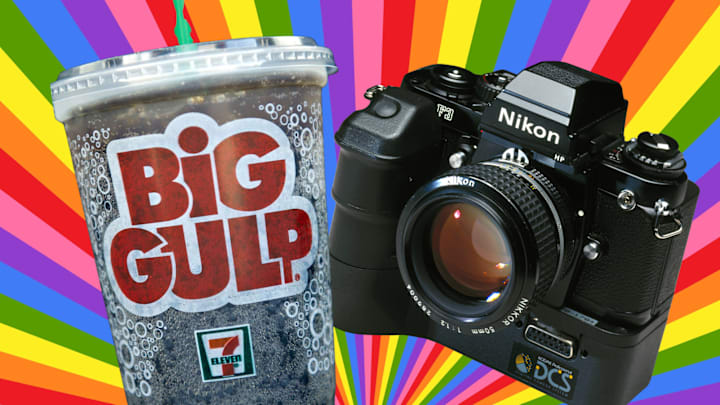
In the early 1970s, the standard size of a Coca-Cola bottle was just 16 fluid ounces (470 ml), while the largest drink that customers could buy at takeaway restaurants and soda fountains was the 21 fluid ounce (595 ml) cup available at some McDonald’s outlets.
Convenience store chain 7-Eleven, however, was struggling to compete. As its Southern California merchandising manager Dennis Potts is said to have commented, sales were so dire at the time that it had become “a sort of a we-need-to-do-something-or-get-out-of-the-business situation.”
Fortunately for Potts, a solution was to reveal itself: representatives from Coca-Cola heard his plight and approached him with the proposal that 7-Eleven start selling their drinks in a new 32 fluid ounce (950 ml) size. The idea was a controversial one, as even the McDonald’s 21-ounce cup was considered monstrously large at the time.
Nonetheless, Potts agreed to trial the size and sent 500 of the larger cups to a 7-Eleven store in Orange County. To his surprise, the cups sold out within a week. Convinced that the new cup size could be a success, the 32-ounce option was rolled out nationwide, and the now-iconic Big Gulp was born.
Breakout
The immense worldwide success of Atari’s simple tennis-like Pong video game in the early 1970s spurred the company on to develop similar games that would both keep them ahead of their competitors and give gamers a new challenge.
The solution—based around an idea of a game of Pong that could be played solo, without the need for a second player to control the opponent—was 1976’s Breakout. In the game, a series of flat bricks appear as a wall at the top of the screen, while the player controls a horizontally movable paddle at the foot of the screen, with which they can bounce a ball against the bricks to steadily knock them all out. The game ends when either all the bricks are knocked out or the player misses the ball with their paddle.
Breakout was the brainchild of Atari’s Nolan Bushnell; the technical side of its manufacture was handled by two little-known young technicians, named Steve Jobs and Steve Wozniak. Released to arcades in 1976, it became an instant success and another immense money-spinner for Atari, and went on to remain in the global top five most popular video games for the next two years.
Digital Camera

The concept of taking digital photographs dates back to the 1960s, when engineers at NASA first began concocting the idea that probes could take images of deep space and relay them back to Earth without the need for hands-on chemical processing in a photographic dark room.
The idea was to capture images using a mosaic photosensor—an early kind of digital image in which different colored light-sensitive squares were pieced together to form the completed picture, rather like pixels do in a digital image today. This technology remained something of a pipe dream for several years, until digital photography leapt forward in the early 1970s with the use of digital imaging on board NASA’s Landsat 1 Earth-monitoring satellite.
Then, in 1975, a Kodak engineer named Steve Sasson began experimenting with a new kind of integrated circuit, called a CCD or charge-coupled device. Sasson realised that the CCD could be used to convert light into a stream of digital information. Several months of painstaking experimentation and trial-and-error later, and the world’s first functioning filmless digital camera was unveiled the following year, nearly 50 years ago.
Everlasting Gobstopper
The world’s first everlasting gobstopper was a purely fictional one. In Roald Dahl’s 1964 childhood classic, Charlie and the Chocolate Factory, Willy Wonka develops a gobstopper “for children who are given very little pocket money,” and so cannot afford to continually buy sweets. “You can put an Everlasting Gobstobber in your mouth and you can suck it and suck it and suck it and suck it and it will never get any smaller!” he explains.
A truly eternal Willy Wonka-style gobstopper remains a work of fiction. But in 1976, a Chicago-based candy company named Breaker Confections—which had licensed the Willy Wonka brand name—released its own version of the everlasting gobstopper as a means of capitalizing on the success of Dahl’s book, and its 1971 movie adaptation.
In truth, of course, the candy was just a gigantic jawbreaker that takes a long time to wear away, but the slightly overexaggerated name nonetheless stuck.
Golden Grahams

Produced by Nestlé in Europe and General Mills in the US, Golden Grahams—toasted squares of whole wheat and corn, flavored with honey and brown sugar—were first introduced in 1976. Golden Grahams reached the peak of their popularity in the 1980s and 1990s and have remained so ever since.
In the UK, the cereal was unceremoniously removed from shelves and discontinued in 2021, before a campaign to reintroduce it saw Nestlé reverse their decision and continue to sell the cereal in 2025.
Hotel California
The 1970s saw the release of several best-selling and groundbreaking albums, from Pink Floyd’s Dark Side of the Moon in 1973 to Fleetwood Mac’s Rumours in 1977. December 6, 1976, however, was the release date for a quintessential ‘70s rock album that has remained consistently cited as one of the greatest albums of all time, and since sold in excess of 42 million copies worldwide: the Eagles’ Hotel California turns 50 in 2026.
Nespresso

In 1975, an engineer named Eric Favre, working at Nestlé’s headquarters in Vevey, Switzerland, returned home from a trip to Rome with tales of an espresso bar he had visited in which the baristas forced more pressurized air and hot water through the ground beans than is typical elsewhere at the city’s coffee shops.
This improved the flavor and produced more of the foamy head, or crema, on top of the espresso shot. Inspired by his time in Italy, Favre returned to Switzerland and began work on an innovative design for an at-home coffee machine that would replicate as close as possible what he had seen, using individual sealed foil coffee pods that would both ensure the ground beans kept their freshness, and the pressurized air and water contained.
The result, patented the following year in 1976, would go on to become the now-ubiquitous Nespresso machine; today, a staggering 14 billion of these unique coffee capsules are sold every year.
The Omen

A number of iconic movies are turning 50 in 2026, including 1976’s highest-grossing film (and eventual Best Picture winner) Rocky, as well as Taxi Driver, Marathon Man, Carrie, Network, and Barbra Streisand’s A Star is Born.
Another of the year’s biggest blockbusters, however, was one of the most iconic and groundbreaking horrors of all time, The Omen. Everything from Jerry Goldsmith’s extraordinary score (and its use of Carl Orff’s “Carmina Burana”) to the use of an A-list star (Oscar-winner Gregory Peck) to elevate the genre from its potential B-movie status conspired to establish The Omen as not only one of the year’s most successful films, but one of the greatest hits in horror cinema history.
Pop Rocks
Although the concept behind popping candy—in which pressurized carbon dioxide bubbles are blown into the liquid candy so that it pops when it dissolves—had been around since at least the ‘50s, it wasn’t until the 1970s that General Foods first successfully brought the product to market.
Following an earlier trial in Canada, popping candy was first sold under the name Pop Rock Crackling Candy in the United States in 1976. Costing just 20 cents a packet, the innovative candy soon proved popular with ‘70s kids, and has remained a popular novelty treat ever since.
You May Also Like:
Add Mental Floss as a preferred news source!