%20%20--%3E%0A%3Csvg%20version%3D%221.1%22%20id%3D%22Layer_1%22%20xmlns%3D%22http%3A%2F%2Fwww.w3.org%2F2000%2Fsvg%22%20xmlns%3Axlink%3D%22http%3A%2F%2Fwww.w3.org%2F1999%2Fxlink%22%20x%3D%220px%22%20y%3D%220px%22%0A%09%20viewBox%3D%220%200%20684.6%2068.1%22%20style%3D%22enable-background%3Anew%200%200%20684.6%2068.1%3B%22%20xml%3Aspace%3D%22preserve%22%3E%0A%3Cg%3E%0A%09%3Cpath%20d%3D%22M444.1%2C29.3h-17.4v14.5h17.4V29.3z%20M36.4%2C68.1l29.3-50.8V0H50.4L32.9%2C36.8L15.5%2C0H0v68.1h16.7V45.8l12.4%2C22.3H36.4z%0A%09%09%20M49.1%2C68.1h16.6V23.4L49.1%2C52.1V68.1z%20M76.6%2C68.1h45V53.8H93.3V41.6h21V27.1h-21V14.8h28.3V0.1h-45V68.1z%20M175.6%2C68.1h17.3v-68%0A%09%09h-16.5v40.3L150%2C0.1h-17.6v68h16.7V27.7L175.6%2C68.1z%20M235.8%2C14.8h15.4V0.1h-47.4v14.7H219v53.2h16.8V14.8z%20M290.3%2C45.9h-17.1%0A%09%09l7.5-15.6h2L290.3%2C45.9z%20M298.7%2C68.1h18l-32.2-68h-5.7l-32%2C68h18l3.3-7.1h27.1L298.7%2C68.1z%20M325.2%2C68.1h46.2V53.8h-29.6V0.1h-16.7%0A%09%09V68.1z%20M423.7%2C14.8h27.2V0.1H407v68h16.7V14.8z%20M462%2C68.1h46.2V53.8h-29.6V0.1H462V68.1z%20M564.8%2C34.1c0%2C10.7-7.2%2C19.2-18.5%2C19.2%0A%09%09c-11.4%2C0-18.5-8.5-18.5-19.2s7.1-19.2%2C18.5-19.2C557.6%2C14.9%2C564.8%2C23.4%2C564.8%2C34.1%20M580.6%2C34.1c0-19-14.2-34-34.3-34%0A%09%09c-20.2%2C0-34.3%2C15-34.3%2C34c0%2C19%2C14.1%2C34%2C34.3%2C34C566.4%2C68.1%2C580.6%2C53.1%2C580.6%2C34.1%20M604.8%2C20.5c0-4.1%2C3.3-6.2%2C6.7-6.2%0A%09%09c4.4%2C0%2C6.6%2C3%2C6.6%2C6.6h14.7C631.8%2C9.1%2C625.1%2C0.1%2C611%2C0.1c-12%2C0-21.7%2C9.3-21.7%2C20.6c0%2C10.9%2C5.9%2C15.9%2C16.7%2C19.8%0A%09%09c5.2%2C1.8%2C11.5%2C3.2%2C11.5%2C8c0%2C3.3-2.4%2C5.5-6.4%2C5.5c-3.6%2C0-6.6-3-6.6-6.7h-15.2c0%2C11.5%2C7.9%2C20.8%2C21.8%2C20.8c12%2C0%2C21.6-9.3%2C21.6-20.6%0A%09%09c0-10-5.3-16.4-16.7-19.8C610.6%2C26.1%2C604.8%2C25.3%2C604.8%2C20.5%20M670%2C20.9h14.7C683.8%2C9.1%2C677.1%2C0.1%2C663%2C0.1c-12%2C0-21.7%2C9.3-21.7%2C20.6%0A%09%09c0%2C10.9%2C5.9%2C15.9%2C16.7%2C19.8c5.2%2C1.8%2C11.5%2C3.2%2C11.5%2C8c0%2C3.3-2.4%2C5.5-6.4%2C5.5c-3.6%2C0-6.6-3-6.6-6.7h-15.2c0%2C11.5%2C7.9%2C20.8%2C21.8%2C20.8%0A%09%09c12%2C0%2C21.6-9.3%2C21.6-20.6c0-10-5.3-16.4-16.7-19.8c-5.4-1.6-11.3-2.4-11.3-7.2c0-4.1%2C3.3-6.2%2C6.7-6.2C667.7%2C14.4%2C670%2C17.3%2C670%2C20.9%0A%09%09%22%2F%3E%0A%3C%2Fg%3E%0A%3C%2Fsvg%3E%0A)

The world’s oceans have been the source of countless mysteries over the course of human history. From ships that have inexplicably disappeared to strange creatures washing ashore, the sea has a seemingly endless capacity for confounding humanity. But while many nautical puzzles have remained unsolved, there are a few that have actually been cracked. Read on to learn the truth behind five maritime mysteries.
- The Bloop Sound
- The Legend of the Flying Dutchman
- Underwater Crop Circles
- The Titanic Blip
- The Bermuda Triangle
The Bloop Sound

In 1997, scientists recorded a strange sound in the South Pacific Ocean. It was very low frequency but was also very loud, and was picked up by underwater microphones more than 3,000 miles apart. “If it’s a ship, or a whale, when it makes a sound in the ocean, it isn’t big enough to be recorded all the way across the Pacific,” explained Bob Dziak, the acoustics program manager at the National Oceanic and Atmospheric Administration. “But this sound was recorded on many hydrophones so it stood out in our mind as being something unique.”
Dubbed the Bloop, the possibility of the sound being manmade was soon ruled out, but it was far louder than any aquatic animal ever recorded, leading to speculation that it was an unidentified—and absolutely massive—sea creature. But the theories that it was a Kraken or Cthulhu were disproven in 2005, when scientists realized that it was actually the sound of an icequake (a.k.a. ice calving)—which occurs when chunks break away from a glacier or iceberg—in the sea around Antarctica.
The Legend of the Flying Dutchman

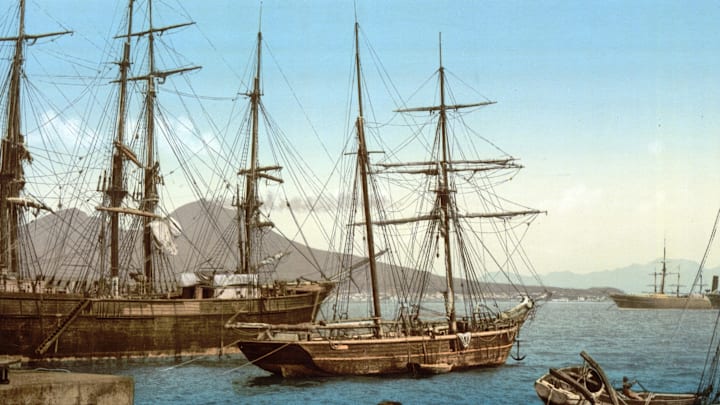
Spooky tales of ghost ships sailing the high seas are plentiful, but the Flying Dutchman remains the most famous phantom vessel. Thought to have originated during the 17th century, legends of the Flying Dutchman claim this ship is doomed to endlessly sail the oceans. But while this ghost story may have captivated the minds of sailors and landlubbers alike, science tells a different tale.
Reports of the ghostly ship may have been the result of a Fata Morgana—a type of mirage caused by light refracting through a band of cold air sitting directly below significantly warmer air. The inversion layer between the two distinct temperatures sometimes causes objects to appear visually distorted. Objects might take on a luminous sheen, appear as upside-down mirror images, or even look like they’re floating above the waves.
Underwater Crop Circles

In 1995, divers off the southern coast of Japan noticed strange shapes on the seabed. Large geometric circles—around seven feet (two meters) in diameter—had been etched into the sand, but by what was a mystery. The intricate circles were essentially the underwater version of crop circles, but while we’ve long known the culprits behind the formations on land (it’s humans, not aliens), the artist behind the aquatic circles was a mystery.
It wasn’t until around 2012 that cameras caught the creator of the circles in the act. Male white-spotted pufferfish were using their fins to shape the circles, which serve a dual purpose as a mating ritual and a nest. Because the pufferfish are only around five inches (12 centimeters) long, it takes them seven to nine days to create the intricate circles, which they decoratively line with seashell fragments. If a female pufferfish likes the look of the finished product, she lays her eggs in the fine sediment at the center of the circle. The male then fertilizes and guards the eggs until they hatch, after which he abandons his artistic nest.
The Titanic Blip

The sinking of the Titanic is a nautical tragedy that has been pored over since the ship went down in the North Atlantic Ocean on April 15, 1912. In 1996, diver and submersible pilot P. H. Nargeolet was exploring the wreck when his echo sounding equipment picked up a large sonar blip nearby. The Titanic lies on an abyssal plain—a relatively flat and largely featureless seabed at a depth of between 10,000 and 20,000 feet (3,000 to 6,000 meters)—so Nargeolet thought that the blip must have been another shipwreck.
In 2022, a team of researchers—including Nargeolet—went on an exploratory mission to find the mysterious underwater object. But instead of the remains of another ship, they found a huge rocky reef teeming with marine life—including lobsters, fish, sponges, and coral. “It is biologically fascinating. The animals that live there are very different to the animals that are found otherwise living in the abyssal ocean,” Murray Roberts, a marine biology and ecology professor and one of the expedition’s researchers, said in an interview with CNN. He described the find as “even more amazing than a shipwreck,” because it indicates that deep-sea life-sustaining reefs may be more common than previously thought.
The Bermuda Triangle

Over the years, many planes and ships have disappeared in the area of ocean famously known as the Bermuda Triangle, which stretches between Florida, Bermuda, and Puerto Rico. There have been numerous theories—some scientific, some rather more outlandish—put forward to explain the many mysterious disappearances there, including aliens, methane gas eruptions, a wormhole, and the lost city of Atlantis.
Not only do none of these theories hold water, but there’s actually no need for theories in the first place. “There is no evidence that mysterious disappearances occur with any greater frequency in the Bermuda Triangle than in any other large, well-traveled area of the ocean,” reports the National Oceanic and Atmospheric Administration. As for the disappearances that have occurred in the area, they’re easily explained by things such as bad weather and human error.