%20%20--%3E%0A%3Csvg%20version%3D%221.1%22%20id%3D%22Layer_1%22%20xmlns%3D%22http%3A%2F%2Fwww.w3.org%2F2000%2Fsvg%22%20xmlns%3Axlink%3D%22http%3A%2F%2Fwww.w3.org%2F1999%2Fxlink%22%20x%3D%220px%22%20y%3D%220px%22%0A%09%20viewBox%3D%220%200%20684.6%2068.1%22%20style%3D%22enable-background%3Anew%200%200%20684.6%2068.1%3B%22%20xml%3Aspace%3D%22preserve%22%3E%0A%3Cg%3E%0A%09%3Cpath%20d%3D%22M444.1%2C29.3h-17.4v14.5h17.4V29.3z%20M36.4%2C68.1l29.3-50.8V0H50.4L32.9%2C36.8L15.5%2C0H0v68.1h16.7V45.8l12.4%2C22.3H36.4z%0A%09%09%20M49.1%2C68.1h16.6V23.4L49.1%2C52.1V68.1z%20M76.6%2C68.1h45V53.8H93.3V41.6h21V27.1h-21V14.8h28.3V0.1h-45V68.1z%20M175.6%2C68.1h17.3v-68%0A%09%09h-16.5v40.3L150%2C0.1h-17.6v68h16.7V27.7L175.6%2C68.1z%20M235.8%2C14.8h15.4V0.1h-47.4v14.7H219v53.2h16.8V14.8z%20M290.3%2C45.9h-17.1%0A%09%09l7.5-15.6h2L290.3%2C45.9z%20M298.7%2C68.1h18l-32.2-68h-5.7l-32%2C68h18l3.3-7.1h27.1L298.7%2C68.1z%20M325.2%2C68.1h46.2V53.8h-29.6V0.1h-16.7%0A%09%09V68.1z%20M423.7%2C14.8h27.2V0.1H407v68h16.7V14.8z%20M462%2C68.1h46.2V53.8h-29.6V0.1H462V68.1z%20M564.8%2C34.1c0%2C10.7-7.2%2C19.2-18.5%2C19.2%0A%09%09c-11.4%2C0-18.5-8.5-18.5-19.2s7.1-19.2%2C18.5-19.2C557.6%2C14.9%2C564.8%2C23.4%2C564.8%2C34.1%20M580.6%2C34.1c0-19-14.2-34-34.3-34%0A%09%09c-20.2%2C0-34.3%2C15-34.3%2C34c0%2C19%2C14.1%2C34%2C34.3%2C34C566.4%2C68.1%2C580.6%2C53.1%2C580.6%2C34.1%20M604.8%2C20.5c0-4.1%2C3.3-6.2%2C6.7-6.2%0A%09%09c4.4%2C0%2C6.6%2C3%2C6.6%2C6.6h14.7C631.8%2C9.1%2C625.1%2C0.1%2C611%2C0.1c-12%2C0-21.7%2C9.3-21.7%2C20.6c0%2C10.9%2C5.9%2C15.9%2C16.7%2C19.8%0A%09%09c5.2%2C1.8%2C11.5%2C3.2%2C11.5%2C8c0%2C3.3-2.4%2C5.5-6.4%2C5.5c-3.6%2C0-6.6-3-6.6-6.7h-15.2c0%2C11.5%2C7.9%2C20.8%2C21.8%2C20.8c12%2C0%2C21.6-9.3%2C21.6-20.6%0A%09%09c0-10-5.3-16.4-16.7-19.8C610.6%2C26.1%2C604.8%2C25.3%2C604.8%2C20.5%20M670%2C20.9h14.7C683.8%2C9.1%2C677.1%2C0.1%2C663%2C0.1c-12%2C0-21.7%2C9.3-21.7%2C20.6%0A%09%09c0%2C10.9%2C5.9%2C15.9%2C16.7%2C19.8c5.2%2C1.8%2C11.5%2C3.2%2C11.5%2C8c0%2C3.3-2.4%2C5.5-6.4%2C5.5c-3.6%2C0-6.6-3-6.6-6.7h-15.2c0%2C11.5%2C7.9%2C20.8%2C21.8%2C20.8%0A%09%09c12%2C0%2C21.6-9.3%2C21.6-20.6c0-10-5.3-16.4-16.7-19.8c-5.4-1.6-11.3-2.4-11.3-7.2c0-4.1%2C3.3-6.2%2C6.7-6.2C667.7%2C14.4%2C670%2C17.3%2C670%2C20.9%0A%09%09%22%2F%3E%0A%3C%2Fg%3E%0A%3C%2Fsvg%3E%0A)

From books that envisioned cyberspace before the internet was even a consideration to dystopias that captured the unsettling closeness of algorithmic surveillance, literature has long been one step ahead of reality. Many of the technologies we now consider normal first appeared not in labs but within the pages of books.
These seven novels didn’t just entertain; they warned and predicted. And in some cases, they straight up nailed what the world would look like once our lives became intertwined with machines.
- The Machine Stops by E.M. Forster (1909)
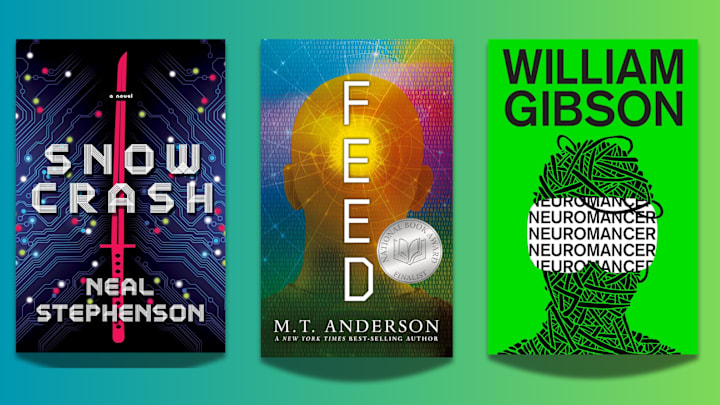
- Neuromancer by William Gibson (1984)
- Feed by M.T. Anderson (2002)
- Super Sad True Love Story by Gary Shteyngart (2010)
- Snow Crash by Neal Stephenson (1992)
- The Circle by Dave Eggers (2013)
- Player Piano by Kurt Vonnegut (1952)
The Machine Stops by E.M. Forster (1909)

More than a century ago, when the telephone was still a novelty, E.M. Forster sat down and wrote a novella about a future where humans live underground in individual pods, relying on a massive Machine to deliver food, entertainment, and social connection via glowing screens. Sound familiar?
In The Machine Stops, face-to-face interaction has become obsolete, and people share ideas through quick bursts of mediated content. No one travels anywhere; they swipe, scroll, and attend lectures from the comfort of their ergonomic chairs. It’s quiet and optimized…until the machine running all of this breaks down.
If you’ve ever stared blankly at a screen during your third Zoom meeting of the day and wondered what happened to regular human contact or screamed into the void when your Wi-Fi crashed, Forster somehow saw you coming.
Neuromancer by William Gibson (1984)

William Gibson unknowingly pioneered the vocabulary of the Internet age. In his novel Neuromancer, he laid the groundwork for modern hacker archetypes and crafted a gritty, neon-lit digital underworld where consciousness could exist outside the body.
The main character, Case, is a washed-up hacker hired for one last mission inside a sprawling network controlled by shadowy corporations and sentient code. Sounds a little like half of Netflix’s catalog now.
Gibson’s vision of a hyper-connected, hyper-commercialized world wasn’t just ahead of its time; it also helped create the cultural blueprint for how we think about the internet.
Feed by M.T. Anderson (2002)

Before smartphones glued themselves to our hands, Feed imagined what might happen if the internet lived inside your head. In Anderson’s YA dystopia, people are wired directly to the “feed,” which is a nonstop stream of entertainment, ads, and updates that make consumerism inescapable.
Titus, the narrator, mostly floats along in the hyper-capitalist haze until his love interest, Violet, starts glitching out and questioning everything. What follows is a disturbing look at what happens when your inner life is no longer private and your personality is shaped by the corporations that feed you content 24/7.
Today, of course, we don’t have literal feeds in our skulls, but we do have push notifications, wearable tech, and dopamine loops, so we’re not far off. Yikes.
You May Also Like:
Super Sad True Love Story by Gary Shteyngart (2010)

In this oddly tender, darkly funny novel, Gary Shteyngart imagines a crumbling America where everyone’s value is visible. You carry a device that ranks you on desirability, credit score, income, and political status. Dating profiles scroll overhead. Privacy is extinct, and the government is mostly broke.
At the center of it all is Lenny, a sweet old school guy in love with Eunice, a digitally native, emotionally unavailable millennial. Their relationship unfolds in a world that’s part Black Mirror and part Love Story.
Shteyngart captures the queasy reality of being ranked, rated, and datamined in public, long before influencer culture made it feel normal.
Snow Crash by Neal Stephenson (1992)

Stephenson’s cyberpunk satire predicted so many things that it’s hard to know where to start. The book coined the term “metaverse,” imagined lifelike avatars before The Sims or Fortnite, and introduced the idea of viral code that could infect not only software but also humans.
The hero, Hiro Protagonist, delivers pizza in the real world and swordfights in the virtual one. The book is chaotic, brilliant, and strangely prophetic. VR, NFTs, and the future of decentralized identity might just owe something to Snow Crash.
Also, as a side note: Stephenson has taken offense to Mark Zuckerberg’s centralized, profit-driven portrayal of what Stephenson saw as an open, decentralized world; ironically, Meta recently algorithmically suspended Stephenson’s Facebook account for impersonating a notable person.
The Circle by Dave Eggers (2013)

Eggers takes Silicon Valley culture and dials it up to terrifying levels. The Circle follows Mae, a new hire at a Google-esque tech company where the motto is “Secrets are lies.” Everyone is expected to share everything: thoughts, feelings, GPS locations (hmm, Snapchat anyone?), all in real time.
As Mae rises through the ranks, the line between sharing and surveillance disappears. Eggers isn’t subtle here, but that’s part of the point: he’s showing what happens when convenience, ego, and peer pressure combine into a moral collapse.
It’s The Truman Show meets corporate onboarding, and it will make you rethink the next “terms of service” you unquestioningly accept.
Player Piano by Kurt Vonnegut (1952)

Vonnegut’s first novel came out in the ‘50s but still feels painfully current. In Player Piano, machines have taken over almost every job worth doing, leaving most of society stuck in meaningless roles or none at all. Engineers and managers rule. Everyone else just watches TV.
The story follows Paul Proteus, a top-tier engineer who starts to question the system. What makes us human if machines can outperform us at everything? What happens when even meaning is outsourced?
These books weren’t just playing with far-off hypotheticals. They were picking up on something that was already brewing. If you want to understand where we are now and maybe where we’re headed next, fiction might be the best user manual we have.