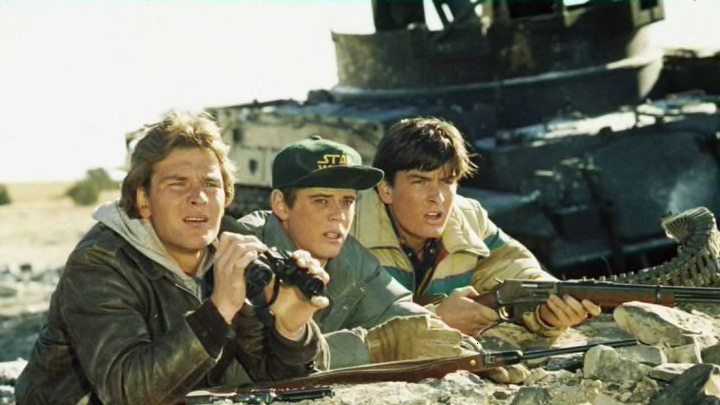
12 Surprising Facts About Red Dawn

Metro-Goldwyn-Mayer Studios Inc.

On August 10, 1984, Red Dawn stormed into theaters. The Cold War-era film envisioned a WWIII-like scenario of what it would look like if Communist Soviets and Cubans invaded a small Colorado town, and what might happen if a group of teenagers fought back with heavy artillery. The cast included then-unknowns Jennifer Grey, Lea Thompson, and Charlie Sheen, plus rising stars Patrick Swayze and C. Thomas Howell (who had co-starred in 1983’s The Outsiders), plus veteran actors Powers Boothe and Harry Dean “Avenge Me!” Stanton.

John Milius, who had been nominated for an Oscar for co-writing Apocalypse Now and who had co-written and directed 1982’s Conan the Barbarian, directed Red Dawn from a script—originally named Ten Soldiers—written by future Waterworld director Kevin Reynolds. With a budget of $17 million, the film—the first to be distributed with the newly formed PG-13 rating—grossed $38.3 million. Here are some things you might not know about Red Dawn.

1. John Milius rewrote the script of Red Dawn.

Kevin Reynolds wrote Red Dawn while still a student at USC film school. MGM optioned the script and asked Milius to direct it. “I brought the writer in and said, ‘This isn’t going to be easy for you to take because, you know, you’re kind of full of yourself, but I’m going to take this and I’m going to make it into my movie, and you’re just going to have to sit back and watch, and it may not be too pleasant,” Milius told Creative Screenwriting. “My advice is to take the money you have and spend it on a young girl. Enjoy getting laid and write another script. Because this isn’t going to be fun to watch.’”

Milius said Reynolds’s script was similar to Lord of the Flies. “I kept some of that, but my script was about the resistance. And my script was tinged by the time, too. We made it really outrageous, infinitely more outrageous than his vision. And to this day, it holds up, because people ask, ‘What’s that movie about?’ And I say that movie’s not about the Russians; it’s about the federal government.”

2. Milus had a very unique way of auditioning actresses for the film.

Red Dawn co-casting director Jane Jenkins explained that Milius would ask each auditioning actress “What would happen if you were in the wilderness and you were starving? Could you kill a bunny?” “And he’d always say a bunny, not a rabbit,” Jenkins said. “And he’d say, ‘Could you kill a bunny and skin it, and eat it?’ And the girls were horrified at that suggestion, and needless to say didn’t go any further. The girls who said, ‘Well, if it were life or death …’ got to go on and read for the parts they eventually were going to play.”

3. Red Dawn was described as "the most violent movie ever made."

After the movie was released in 1984, The National Coalition on Television Violence deemed Red Dawn “the most violent movie ever made.” They said it contained 134 acts of violence an hour, and they rated it X. “This summer’s releases are the most violent in the history of the industry, averaging 28.5 violent acts an hour,” the Coalition said. They also gave X ratings to Gremlins and Indiana Jones and the Temple of Doom.

4. Milius put Patrick Swayze in charge of Red Dawn's cast.

Charlie Sheen, Jennifer Grey, Patrick Swayze, Lea Thompson, C. Thomas Howell, Darren Dalton, Brad Savage, and Doug Toby in 'Red Dawn' (1984)
Metro-Goldwyn-Mayer Studios Inc.

Because Patrick Swayze was older than most of the actors, and because he had more acting experience than them, Milius trusted Swayze to control his co-stars. “Milius is a very intense director,” Swayze said in the Red Dawn commentary. “He’s a very wonderful director, but we had to call him the General and he called me, he says, ‘Swayze, you’re my lieutenant of the art. I’m directing these little suckers through you.’ He put a lot of responsibility on my shoulders, and I took it really seriously.”

5. The U.S. military named an operation after Red Dawn.

In 2003, when U.S. troops invaded Iraq, Army Capt. Geoffrey McMurray named the mission Operation Red Dawn. “Operation Red Dawn was so fitting because it was a patriotic, pro-American movie,” McMurray told USA Today. A commander in the 1st Brigade, 4th Infantry Division had already named the target farmhouses Wolverine 1 and Wolverine 2, so McMurray said the name made sense.

6. Milius knew Hollywood would "condemn" him for making the film.

“I knew that Hollywood would condemn me for it,” Milius said in the Red Dawn commentary. “That I’d be regarded as a right wing warmonger from then on, uncontrollable and un-housebroken.” Milius supposedly left one of his guns on his desk while journalists interviewed him, so he demonstrated his ideals well.

“I was the only person in Hollywood who would dare do this movie,” he said. “Hollywood was very left-wing. But I have a lot of contractions. I’m a militarist and an extreme patriot at times, so I believe in all of that rugged individualism hogwash.”

7. Patrick Swayze and Jennifer Grey did not get along.

Not all the actors were thrilled with Milius's decision to put Swayze in charge of the cast. Swayze told Daily Mail that he butted heads with Jennifer Grey in particular, who disliked how he ordered her around. “At the end of Red Dawn, however, when we shot her character’s death scene, she seemed to warm to me,” he said. “It's a tender scene and, as I stroked her hair, it was truly emotional. I think it endeared me to her, and it was clear she and I had chemistry together.” Almost exactly three years later, the pair’s chemistry would ignite the dance floor in Dirty Dancing.

8. Patrick Swayze got frostbite.

Filming in Las Vegas, New Mexico, sometimes meant extremely cold conditions. So cold, in fact, that Swayze ended up with frostbite. “I got frostbite so bad in my hands and my toes, that now if my hands and fingers get the slightest bit cold it feels like someone’s shoving toothpicks under my fingernails,” he said in the Red Dawn commentary.

C. Thomas Howell had a different perspective on the cold temperatures. “You know it’s cold when you’re forced to spoon Charlie Sheen,” he said. “That’s what we were forced to do: to huddle together and pretend we liked each other.”

9. William Smith frightened Charlie Sheen.

William Smith played the Russian Colonel Strelnikov, but in real life he had been a Russian Intercept Interrogator for the CIA. “He was terrifying,” Sheen said in the Red Dawn commentary. “I don’t know if he was in character the whole time, but you couldn’t talk to him on the set. You just kept your distance. But it worked in the movie—look how brilliant he is in the film. He’s an imposing force.”

10. Milius thought Red Dawn was a "zombie movie with Russians."

In the ‘80s, the Cold War was in full swing, and the world lived in fear of a nuclear attack. (Not totally unlike today.) “Red Dawn the film was about the impending possible reality, which at that time was an actual fear of the Soviet Union invading this country,” Milius told Mandatory. “People actually thought that way. That’s why I made that movie, that’s why people liked it. The fear was real and it played on that. That’s what made it an exciting movie.”

Milius compared the film to Close Encounters of the Third Kind. “In this case, I made a movie of the same vein but with Russians. It’s like a zombie movie with Russians. That’s what it was like at the time. People were paranoid about aliens and people were paranoid about Russians. It was Close Encounters with Cold War Russians.”

11. The studio cut a love scene between Lea Thompson and Powers Boothe.

In the Red Dawn commentary, Thompson described a “beautiful love scene” between her and co-star Powers Boothe, who was 13 years older than her. “I say, ‘I’m going to die before having made love. Will you please make love with me?’ We said okay, and disappeared out of frame. And they took the scene out of the movie, which was sad because it explained my character. It was a nice scene.”

12. Fans still yell "Wolverines!" at C. Thomas Howell.

Charlie Sheen, Patrick Swayze, and C. Thomas Howell in Red Dawn (1984)
Metro-Goldwyn-Mayer Studios Inc.

One of the most iconic lines in the movie comes from C. Thomas Howell’s character, Robert. From a mountaintop he shouts “Wolverines!” which is the name the guerilla group gives themselves. It’s also the name of their high school mascot.

“I get that about twice a week in real life,” Howell told USA Today in 2012. “And about 40 times a day through Twitter.” He said in real life he doesn’t shout back, “but on Twitter, I cannot help typing a ‘Wolverine’ with a few exclamation points on it.”

You Can Get Paid $1000 to Watch 15 Hours of The Office in Nine Days

Oscar Nuñez, Brian Baumgartner, Jake Lacy, Paul Lieberstein, Angela Kinsey, Phyllis Smith, Craig Robinson, Ellie Kemper, Kate Flannery, Ed Helms, and Leslie David Baker in The Office.
NBCUniversal Media, LLC

If you're anything like millions of people around the world, you probably watch at least a season of The Office a week. After a long day at your own office, few things are as relaxing as witnessing the hilarious antics of the Dunder Mifflin crew, who you can always rely on to make you laugh—and perhaps appreciate your own job just a little bit more. Nearly 15 years after its original NBC premiere, The Office is still one of the most binge-watched TV shows around. And now one company wants to pay you for the time you already spend lounging on the couch waiting for the moment where Jim and Pam finally get together.

USDish, an authorized DISH Network retailer, wants to pay one lucky fan $1000 to simply watch 15 hours of The Office in nine days. Easy, right? Some of us already do more than that for free—but there's a bit of a catch, As the rules explain, the selected individual must take copious notes on the many popular tropes that pop up as they watch 45 episodes of the classic sitcom. The guidelines read:

"For instance, how many times does Stanley roll his eyes at the camera? How often does Phyllis talk about Bob Vance from Vance Refrigeration? The goal is to help us understand how often sitcoms repeat popular tropes. We’ll provide you with general guidelines to track your experience, but in true Kelly Kapoor fashion, we also want you to share your unfiltered opinions and reactions on social media."

So you basically you have to do a little work while watching and document it on social media, too. In addition to the $1000 stipend, the selected binge-watcher will receive some sweet Dunder Mifflin swag, including a Dundie Award, along with a Netflix gift card.

To apply for this no-brainer of an opportunity, click here. You have until Monday, March 16 to submit your information.

13 Facts About Francis Ford Coppola’s The Conversation

Gene Hackman and John Cazale in The Conversation (1974).
Paramount Home Entertainment

In 1972, Paramount Pictures released The Godfather, one of the most acclaimed movies ever made and a cinematic triumph for its director, Francis Ford Coppola. With newfound cinematic clout in the wake of The Godfather’s success, Coppola chose for his follow-up feature an intimate, tense thriller inspired by his own interest in surveillance technology, Herman Hesse, and Michelangelo Antonioni's Blow-Up.

The movie was The Conversation, and though it has been overshadowed by the two Godfather films that bookend it in Coppola’s filmography, it remains a tense and expertly crafted classic in its own right. From its roots in a chat between directors to its unlikely connection to the Watergate scandal, here are some facts about how it was made.

1. The Conversation began, appropriately, with a conversation.

The story that would become The Conversation began with a conversation between two directors. In the mid-1960s, as Francis Ford Coppola would later recall, he was chatting with director Irvin Kershner (who would later become best known for directing The Empire Strikes Back) when the talk turned to eavesdropping. Kershner theorized that the best way to keep someone from overhearing you, even with wiretapping, would be to have a conversation in a crowd. Then he kept talking.

“Then he added that he had heard of microphones that had gun sights on them that were so powerful and selective that they could, if aimed at the mouths of these people in the crowd, pick up their conversation,” Coppola later recalled in an interview with Film Comment. “I thought what an odd both device and motif for a film.”

From there, Coppola began to “very informally” begin crafting the story.

2. The Conversation was inspired by Herman Hesse and Blow-Up.

With the notion of a film about eavesdropping using state-of-the-art electronic surveillance equipment in his mind, Coppola began writing The Conversation in 1967, though he noted on the commentary track for the film that he set the script aside at one point, and told Film Comment that he didn’t finish the script until 1969. In that time, a wide range of influences were at play in the writing process.

Coppola’s protagonist is named Harry because, at the time, he was reading Herman Hesse’s novel Steppenwolf, which is also the story of a loner, this one named Harry Haller. Though it would prove challenging to craft such an isolated character for a family man like Coppola, he liked the idea of Harry’s almost sterile existence outside of his work.

Another major influence, as Coppola was later careful to acknowledge, was Blow-Up, Michelangelo Antonioni’s 1966 thriller about a fashion photographer who accidentally captures a murder plot through a candid picture.

“I got into The Conversation because I was reading Hesse and saw Blow-Up at the same time,” Coppola recalled in an interview with Brian De Palma a few years later. “And I’m very open about [Blow-Up’s] relevance to The Conversation because I think the two films are actually very different. What’s similar about them is obviously similar, and that’s where it ends. But it was my admiration for the moods and the way those things happened in that film which made me say ‘I want to do something like that.’”

Interestingly, De Palma would also eventually produce his own riff on Antonioni’s Blow-Up. In 1981, he released Blow Out, the story of a movie sound effects man who accidentally captures an apparent political assassination on tape.

3. The concept for The Conversation came first, and then the story.

Though he was heavily inspired by Blow-Up in the sense that it’s also a thriller about an investigative puzzle that an unlikely person is trying to solve, Coppola noted on the commentary track for The Conversation that he was actually more inspired by things like the “textures” in films by people like Antonioni. He liked the idea of starting from a place of conceptual or tonal inspiration, and then building a story around it. It proved challenging.

“I have to say that this project began differently from other things I’ve done, because instead of starting to write it out of an emotional thing—the emotional identity of the people I knew—I started it as sort of a puzzle, which I’ve never done before and which I don’t think I’ll ever do again,” Coppola recalled.

Because he “started with a premise,” Coppola struggled to find the human core of The Conversation, particularly when it came to his emotionally disconnected protagonist, Harry Caul.

4. Francis Ford Coppola wanted to make The Conversation before he made The Godfather.

Francis Ford Coppola, circa 1975
Francis Ford Coppola, circa 1975.
Hulton Archive/Silver Screen Collection/Getty Images

Coppola finished writing The Conversation in 1969, the same year he released his film The Rain People. At that point, Coppola was already pursuing his alternative filmmaking studio, American Zoetrope, alongside George Lucas in San Francisco, but he was also a family man trying to gain some financial security in Hollywood. Then came Patton, which Coppola co-wrote. The film earned him an Oscar for Best Original Screenplay, and that level of attention led Paramount to consider him to adapt Mario Puzo’s novel The Godfather for the screen.

In a conversation on Inside the Actor’s Studio, Coppola said he believed part of the reason he was offered The Godfather was Paramount Pictures executives’ belief that, because he was a young and relatively unknown filmmaker, he could be pushed around. Coppola was resistant to the idea, and wanted to pursue his screenplay for The Conversation instead, but Lucas and others encouraged him to take the Godfather job.

The Godfather was an accident. I was broke and we needed the money,” Coppola later admitted. “We had no way to keep American Zoetrope going. I had no idea it was going to be that successful. It was awful to work on, and then my career took off and I didn’t get to be what I wanted to be.”

The Godfather was a massive success and won three Oscars, including Best Picture and a Best Adapted Screenplay win for Coppola and Mario Puzo. In the commentary track for The Conversation, he noted that the film’s success led to executives at Paramount warming to the idea of his little eavesdropping movie.

“I suddenly found myself in a position where I had some importance among the film people,” he said.

5. Francis Ford Coppola based Gene Hackman’s Harry Caul partially on himself.

Because he began The Conversation not as a story, but as a premise that presented itself as a kind of narrative puzzle, Coppola had difficulty crafting the characters for his screenplay. He made this more difficult for himself when he envisioned his central character, Harry Caul, as a loner so intent on privacy that he would even lie about having a home telephone.

“I could not relate to Harry; I could not be him,” Coppola recalled.

In an effort to combat this, Coppola decided to infuse some of his own past into Harry's.

“Ultimately, though, I drew on my own past, and the scene where he’s in the park and tells all that stuff about his childhood and the polio—those are things that actually happened to me. That was almost a desperate attempt to give him a real character that I could relate to.”

Coppola also noted that Harry’s Catholicism is something drawn from his own life, but it also works within the symbolism of the film because he considers confession “the oldest form of eavesdropping."

6. Harry Caul’s name came from a mistake.

Coppola began writing The Conversation in part by dictating it into a tape recorder, which a transcriptionist would then type up for him to review later. In his mind, he’d decided to name his central character “Harry Call,” an apt name for a guy who listens in on other people’s conversations, by phone or otherwise. When he got the transcribed notes back, though, he noticed the transcriptionist had named his protagonist “Harry Caul.” It proved to be an even better metaphor.

“When I saw what she had typed, I decided to keep the spelling, since I knew what a caul is,” Coppola later said. “It is the membrane that surrounds a fetus until it is born.”

Coppola also noted that this is one of the reasons why Harry wears that translucent raincoat all the time. It’s a representation of a membrane around him, cutting him off from the rest of the world as though he’s not really a part of it yet.

7. Gene Hackman was the first choice to play Harry Caul.

Gene Hackman in The Conversation (1974)
Gene Hackman stars in The Conversation (1974).
Paramount Home Entertainment

As Coppola began gearing up to make The Conversation, it was essential that he find the perfect actor to embody his enigmatic central character, Harry Caul. Coppola managed to get his first choice: Gene Hackman, who was then still riding high from The French Connection, the William Friedkin crime thriller that earned him an Oscar, a BAFTA, and a Golden Globe for Best Actor.

According to Coppola, he wanted Hackman not just because of his acting talents, but because of his ability to appear rather unremarkable.

"He's ideal because he's so ordinary, so unexceptional in appearance," Coppola said. "The man he plays is in his forties, and has been doing this strange job for years."

8. Gene Hackman didn’t enjoy playing Harry Caul.

Hackman’s performance as Harry Caul—subdued and guarded right up until the point that the tension becomes too much even for him—is another great performance in an astonishing career. But just as Coppola had trouble crafting the character in the script, Hackman had trouble bringing the character to life onscreen.

"He was really a constipated character," Hackman said. "It was a difficult role to play because it was so low-key."

On the commentary track for the film, Coppola recalled that Hackman would often get “grumpy” and “impatient” on set while he walked around in Caul’s rather restrictive costume.

“He really I think liked the movie and working on it, and liked the character, and I've heard subsequently that he enjoyed it very much and thinks it was really good work on his part, which I certainly agree with,” Coppola said. “But during the time I think this anal personality really felt very uncomfortably on his shoulders and was not pleasant. I've seen that happen with actors, where playing a certain role is not fun, is not pleasant, and having to do that all day, and look that way all day and really inhabit that kind of a personality can get to you.”

For his performance as Harry Caul, Hackman was named the Best Actor of 1974 by The National Board of Review, and was nominated for a BAFTA and a Golden Globe.

9. Harry Caul’s girlfriend was inspired by a dream.

One of the most memorable scenes in The Conversation involves a key insight into Harry’s life: That he actually has a girlfriend (played by Teri Garr), who he seems to be keeping in an apartment. The scene is compelling in part because of Garr’s vulnerable performance, but also because it reveals that Harry is still distant even from the person he is physically closest to. According to Coppola on the commentary track for the film, the scene was entirely inspired by a recurring dream he had when he was a younger man.

“I've had this re-occurring dream of going to some house or some apartment somewhere ... No one realized that I actually owned this place ... almost as though they were personal parts of myself that no one knew about,” he said. “And in those days, I used to dream sometimes that there was a girl in the apartment who waited for me and who was always there when I went there, but there was something sad about her, something heartbreaking. Obviously with good reason, because this was a secret. No one knew that this place or this woman existed, and in fact I was not there very often. Having once had this dream in a very vivid way and a touching way, I wrote the scene in The Conversation that was almost verbatim how the dream had been, and it was interesting in that after I made the film and actually photographed that scene I never dreamed of a girl being in that place ever again.”

10. The Conversation’s opening sequence was extremely complex.

The structure of The Conversation hinges on setting up the titular event, a conversation between two apparent lovers walking around a crowd in San Francisco’s Union Square. The conversation unfolds in the film’s ambitious opening sequence, which introduces Harry and his crew as they surveil the couple and allows us to hear the first few words of what will later become a much more complex bit of dialogue. According to Coppola, shooting the scene didn’t just look complicated in the final product. It actually unfolded much as you see it in the film, with a crew working to keep tabs on the two actors, Cindy Williams and Frederic Forrest, using long lenses and camera positions on rooftops.

“To shoot the park scene we had some six camera positions, and we did some of it with extremely long lenses,” Coppola later told Brian De Palma. “We just showed the principals to the cameramen and said ‘Try to find them and keep them in focus.’ And then the actors kept walking around and around and it was literally done as though the situation was as it was. This was shot many times—for at least three or four days.”

Coppola also noted that much of the sound for the sequence was captured just as Harry would have done: With radio microphones.

“It was total chaos,” Coppola recalled. “Half our crew was in all those shots. And you could see them! But there were a lot of cameras. It was really John Cassavetes time: cameras photographing cameras.”

11. Francis Ford Coppola fired his cinematographer.

To shoot The Conversation, Coppola managed to nab one of the best cinematographers working at the time: Haskell Wexler, who’d enjoyed a string of success in the late 1960s that included Who’s Afraid of Virginia Woolf?, The Thomas Crown Affair, and Medium Cool (which Wexler also directed). Wexler was responsible for shooting the extremely complex opening sequence of the film, and it’s his work that you still see in the finished product. As the production moved beyond that scene, however, Coppola recalled that he and Wexler had a “difference of opinion” as to how the film should proceed.

“I think Haskell saw it in a slightly more romantic style,” Coppola said on the film’s commentary track, noting that he saw it more as Medium Cool, while Wexler thought it should be shot more like The Thomas Crown Affair.

Because of this creative friction, Wexler was ultimately fired from the production, and Coppola brought in his fried Bill Butler, who he’d previously worked with on The Rain People, and who would go on to shoot Jaws and Grease. Butler shot the remainder of the film.

Interestingly, this was not the only time Wexler was let go in favor of Butler. The same replacement happened again just a year later, when Butler came in to finish Wexler’s work on One Flew Over the Cuckoo’s Nest.

12. No, The Conversation was not inspired by Watergate.

Gene Hackman and John Cazale in The Conversation (1974)
John Cazale and Gene Hackman in The Conversation (1974).
Paramount Home Entertainment

The Conversation was released in the spring of 1974, as the impeachment process against President Richard Nixon was already underway after the public revelations of the Watergate scandal. That scandal would famously grow to encompass a secret recording system set up in the Oval Office, and public knowledge of Nixon’s secret tapes created a natural parallel to Coppola’s story of a man who uncovers a conspiracy through recording equipment. Despite this cultural parallel, Coppola has always emphasized that the film was not inspired by Watergate, nor did he ever alter the story in response to it.

“The political references in the picture, which are very slight, are all in the old script,” Coppola said. “It’s just a matter of common sense that if people were using taps to bug business companies, they would be using it in political elections. Watergate is a funny accident. I never meant it to be so relevant. I almost think that the picture would have been better received had Watergate not happened. Now, you can look at it, even if you know it was written before Watergate and say, ‘Oh, look at that. Of course, well, sure.’”

13. The Conversation lost the Best Picture Oscar to another Francis Ford Coppola movie.

When the 47th Academy Award nominations were announced in 1975, The Conversation earned three nominations: for Best Picture, Best Original Screenplay, and Best Sound. Ultimately, it lost in all three categories—but Francis Ford Coppola didn't go home empty-handed. The Conversation premiered in New York City in April 1974, just eight months ahead of The Godfather: Part II. The two movies went head-to-head in the Best Picture category, with Coppola and co-producer Fred Roos (who also worked on The Conversation) taking home the award for The Godfather: Part II.

Additional Sources:
Inside the Actors Studio, “Francis Ford Coppola,” 2001
The Conversation, director’s commentary by Francis Ford Coppola

SECTIONS

arrow
LIVE SMARTER